\n
## Diagram: Reasoning Extraction vs. Program Generation
### Overview
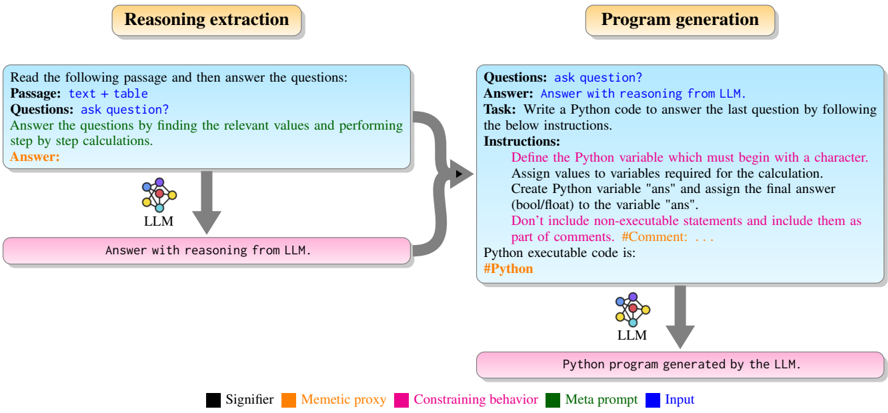
This diagram illustrates two distinct processes: "Reasoning Extraction" and "Program Generation," both utilizing a Large Language Model (LLM). The diagram visually represents the input, processing steps, and output for each process, highlighting the different instructions and expected outcomes.
### Components/Axes
The diagram is divided into two main sections, one for each process, positioned side-by-side. Each section contains rectangular boxes representing stages: Input, LLM processing, and Output. Arrows indicate the flow of information. A legend at the bottom explains the color-coding used to represent different elements within the diagram.
**Legend:**
* **Black:** Signifier
* **Orange:** Memetic proxy
* **Yellow:** Constraining behavior
* **Purple:** Meta prompt
* **Green:** Input
**Reasoning Extraction Section:**
* **Header:** "Reasoning extraction" (Black text on light blue background)
* **Input Box:** Contains the text: "Read the following passage and then answer the questions: Passage: text + table Questions: ask question? Answer the questions by finding the relevant values and performing step by step calculations. Answer:" (Black text)
* **LLM Box:** Contains the text: "LLM" and below it "Answer with reasoning from LLM." (Black text)
* **Output Box:** Contains the text: "Answer with reasoning from LLM." (Black text)
**Program Generation Section:**
* **Header:** "Program generation" (Black text on light blue background)
* **Input Box:** Contains the text: "Questions: ask question? Answer: Answer with reasoning from LLM." (Black text)
* **Instructions Box:** Contains the text: "Instructions: Define the Python variable which must begin with a character. Assign values to variables required for the calculation. Create Python variable "ans" and assign the final answer (bool/float) to the variable "ans". Don't include non-executable statements and include them as part of comments. #Comment: ... Python executable code is: #Python" (Black text)
* **LLM Box:** Contains the text: "LLM" and below it "Python program generated by the LLM." (Black text)
* **Output Box:** Contains the text: "Python program generated by the LLM." (Black text)
### Detailed Analysis or Content Details
The diagram illustrates a clear distinction in the tasks performed by the LLM.
**Reasoning Extraction:**
The input is a passage of text combined with a table, and a question. The LLM is instructed to answer the question by extracting relevant values and performing calculations. The output is the answer, accompanied by the reasoning process.
**Program Generation:**
The input is a question and an initial answer from the LLM. The LLM is provided with specific instructions for generating Python code to answer the question. These instructions include defining variables, assigning values, and creating a final answer variable. The output is a Python program generated by the LLM.
### Key Observations
The diagram highlights the LLM's versatility in handling different types of tasks. It can be used for both reasoning and code generation, depending on the input and instructions provided. The color-coding effectively distinguishes between different elements of the process, such as input, processing, and output. The use of "Meta prompt" (purple) suggests a higher-level instruction guiding the LLM's behavior.
### Interpretation
The diagram demonstrates two distinct applications of LLMs: one focused on extracting and reasoning about information from text and tables, and the other focused on translating reasoning into executable code. The "Reasoning Extraction" process emphasizes understanding and interpretation, while the "Program Generation" process emphasizes implementation and execution. The diagram suggests a workflow where the LLM can first reason about a problem and then generate a program to solve it. The inclusion of instructions for Python code generation indicates a focus on practical application and automation. The diagram is a conceptual illustration of how LLMs can be used in a broader system for problem-solving and decision-making. The color coding is a visual aid to understand the flow of information and the different roles played by various components. The diagram does not contain any numerical data or specific values, but rather focuses on the process and flow of information.