\n
## Block-Based Image: Color Distribution
### Overview
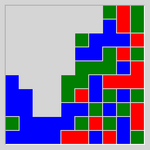
The image presents a grid of colored blocks, arranged in a roughly square shape. There are no axes, labels, or legends explicitly present. The colors used are red, green, and blue, along with white representing empty space. The arrangement of these blocks forms a shape resembling a stylized letter "T". The image appears to be a visual pattern or puzzle, rather than a data-driven chart.
### Components/Axes
There are no axes or legends. The components are individual colored blocks. The grid appears to be approximately 10x10, though the exact dimensions are difficult to determine due to the irregular shape formed by the colored blocks.
### Detailed Analysis or Content Details
The image consists of a grid of colored squares. The colors are distributed as follows:
* **White:** Occupies the top-left portion of the grid, forming the upper part of the "T" shape. Approximately 25-30 blocks are white.
* **Blue:** Forms the vertical stem of the "T" shape, extending downwards from the white area. There are approximately 15-20 blue blocks.
* **Red:** Appears in the top-right quadrant and interspersed within the lower portion of the grid. There are approximately 15-20 red blocks.
* **Green:** Primarily located in the bottom-left and right corners, and scattered throughout the lower portion of the grid. There are approximately 20-25 green blocks.
The arrangement of the blocks is not random. The blue blocks form a continuous column, while the red and green blocks are more fragmented. The white blocks create a clear separation between the blue stem and the colored blocks forming the "T" head.
### Key Observations
The image lacks quantitative data. The distribution of colors appears deliberate, forming a recognizable shape. The white space is significant, defining the overall structure. There is no clear pattern in the arrangement of red and green blocks beyond their general location within the grid.
### Interpretation
The image is likely a visual representation of a pattern or a puzzle. The "T" shape could be symbolic, or simply a design element. The use of different colors might represent different categories or states within the puzzle. Without additional context, it is difficult to determine the specific meaning or purpose of the image. It does not appear to be a standard chart or graph conveying numerical data. The image is more akin to a visual exercise in pattern recognition or spatial reasoning. It could be a simplified representation of a more complex system, where each color represents a different component or state. The white space could represent an absence of something, or a boundary between different areas.