## Diagram: Kernel State Transformation
### Overview
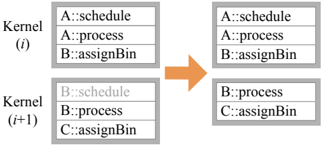
This image presents a diagram illustrating a transformation or filtering process applied to two distinct kernel states, labeled "Kernel (i)" and "Kernel (i+1)". The diagram shows the initial state on the left, an orange arrow indicating a transition, and the resulting state on the right. Each kernel state is represented by a rectangular block containing a list of items, likely representing functions, processes, or components within that kernel.
### Components/Axes
The diagram is structured into two main columns and two rows, with an arrow in the center column indicating a transformation from left to right.
* **Left Column (Initial State):**
* **Top-left block:** Labeled "Kernel (i)" on its left side. This block contains three text entries, each on a new line, within a gray-bordered rectangle.
* **Bottom-left block:** Labeled "Kernel (i+1)" on its left side. This block also contains three text entries within a gray-bordered rectangle, similar in structure to the top-left block.
* **Center Column:**
* An orange, right-pointing arrow is positioned centrally between the left and right columns, spanning both rows.
* **Right Column (Transformed State):**
* **Top-right block:** A gray-bordered rectangle containing three text entries.
* **Bottom-right block:** A gray-bordered rectangle containing two text entries.
### Detailed Analysis
The content of each block is as follows:
* **Kernel (i) - Initial State (Top-left block):**
* A::schedule
* A::process
* B::assignBin
* **Kernel (i+1) - Initial State (Bottom-left block):**
* B::schedule (This text is rendered in a light gray color, distinct from the black text of other entries.)
* B::process
* C::assignBin
* **Transformed State (Top-right block):**
* A::schedule
* A::process
* B::assignBin
(This block is identical in content to the "Kernel (i) - Initial State" block.)
* **Transformed State (Bottom-right block):**
* B::process
* C::assignBin
(This block shows a change from the "Kernel (i+1) - Initial State" block.)
### Key Observations
1. **Kernel (i) Stability:** The content of the "Kernel (i)" block remains entirely unchanged after the transformation. The list "A::schedule", "A::process", "B::assignBin" is present on both the left and right sides for this kernel state.
2. **Kernel (i+1) Modification:** The content of the "Kernel (i+1)" block undergoes a specific change. The entry "B::schedule", which was rendered in light gray text in the initial state, is absent in the transformed state. The other two entries, "B::process" and "C::assignBin", remain present and unchanged.
3. **Significance of Gray Text:** The light gray rendering of "B::schedule" in the initial "Kernel (i+1)" state strongly suggests that this item is a candidate for removal, a temporary element, or an item with a specific status that leads to its exclusion in the subsequent state.
### Interpretation
This diagram illustrates a process of filtering or refinement applied to kernel states. The orange arrow signifies a transition from an initial set of components/tasks to a refined set.
The primary insight is that certain elements, specifically those marked with a distinct visual cue (light gray text), are removed during this transformation. In the context of "Kernel (i+1)", "B::schedule" is identified as an element that does not persist in the transformed state. This could represent:
* **Optimization:** "B::schedule" might be a redundant, unnecessary, or temporary scheduling task that is optimized out.
* **Filtering:** The process might be filtering out specific types of operations or components based on certain criteria, with "B::schedule" meeting those criteria for removal.
* **State Progression:** The transition from Kernel (i) to Kernel (i+1) might involve different sets of operations, and the transformation shown could be a cleanup step for Kernel (i+1) specifically.
The fact that "Kernel (i)" remains entirely unchanged suggests that either the transformation process is not applicable to "Kernel (i)"'s components, or its components are all considered essential and not subject to this particular filtering rule. The diagram effectively highlights a selective removal mechanism, where the visual distinction of "B::schedule" in the initial state provides a strong hint about its fate in the subsequent state.