## Diagram: Transformer-Based Language Model Architecture
### Overview
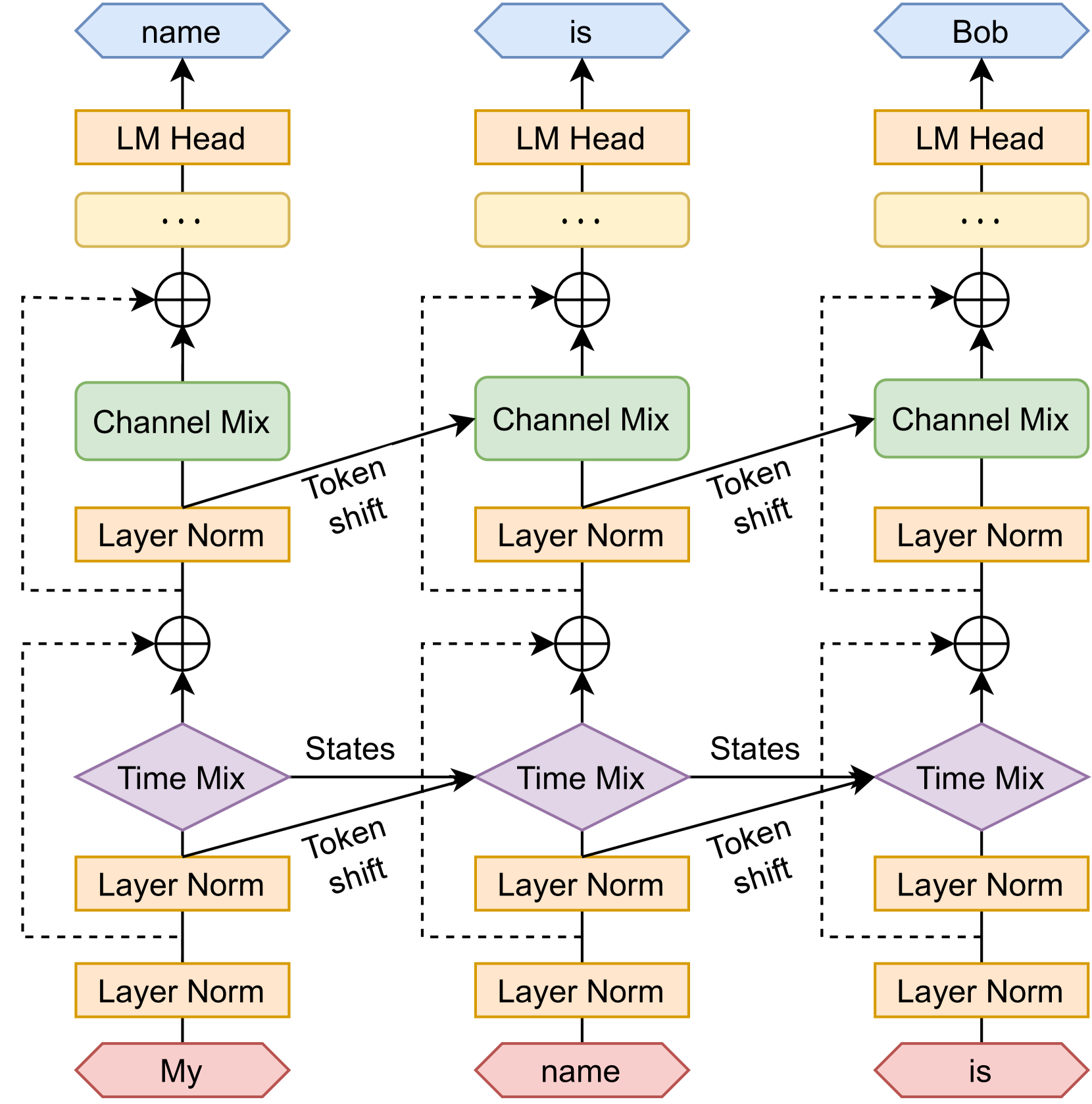
The diagram illustrates a transformer-based language model architecture processing three input tokens ("name," "is," "Bob") through sequential layers. Each token undergoes transformations via "LM Head," "Channel Mix," "Layer Norm," and "Time Mix" components, with residual connections (dashed arrows) and token shifts. The output tokens ("My," "name," "is") represent the model's generated sequence.
### Components/Axes
- **Input Tokens**:
- Top row: "name," "is," "Bob" (blue hexagons).
- **Processing Layers**:
- **LM Head**: Orange rectangles (first layer for all tokens).
- **Channel Mix**: Green rectangles (applied post-LM Head).
- **Layer Norm**: Yellow rectangles (applied after Channel Mix and Time Mix).
- **Time Mix**: Purple diamonds (introduces "States" and "Token shift").
- **Output Tokens**:
- Bottom row: "My," "name," "is" (pink hexagons).
- **Arrows**:
- Solid arrows: Data flow direction.
- Dashed arrows: Residual connections or additional pathways.
### Detailed Analysis
1. **Token Flow**:
- Each input token ("name," "is," "Bob") is first processed by an "LM Head" (orange).
- Outputs are fed into "Channel Mix" (green), followed by "Layer Norm" (yellow).
- Residual connections (dashed arrows) bypass "Channel Mix" and "Layer Norm" to later layers.
- "Time Mix" (purple) introduces "States" (token shifts) and connects to another "Layer Norm."
- Final outputs ("My," "name," "is") emerge after the second "Layer Norm."
2. **Key Patterns**:
- **Residual Connections**: Dashed arrows ensure information from earlier layers is preserved.
- **Token Shifts**: "Time Mix" modifies token positions (e.g., "name" → "My").
- **Layer Normalization**: Applied after both "Channel Mix" and "Time Mix" to stabilize gradients.
### Key Observations
- The architecture combines **spatial processing** ("Channel Mix") and **temporal processing** ("Time Mix"), typical of transformer models.
- "States" in "Time Mix" likely represent positional or contextual embeddings.
- Output tokens differ from inputs, indicating the model generates new sequences (e.g., "My" instead of "Bob").
### Interpretation
This diagram represents a transformer-based language model where:
- **LM Head** initializes token embeddings.
- **Channel Mix** captures contextual relationships between tokens.
- **Time Mix** introduces sequential dependencies via "States."
- **Layer Norm** ensures stable training by normalizing activations.
- Residual connections prevent vanishing gradients, enabling deeper networks.
The model likely performs tasks like text generation or translation, where input tokens ("name," "is," "Bob") are transformed into coherent outputs ("My," "name," "is"). The architecture balances local context (Channel Mix) and global sequence structure (Time Mix), a hallmark of modern NLP systems.