# Technical Document Extraction: Text Completion Diagram
## Diagram Overview
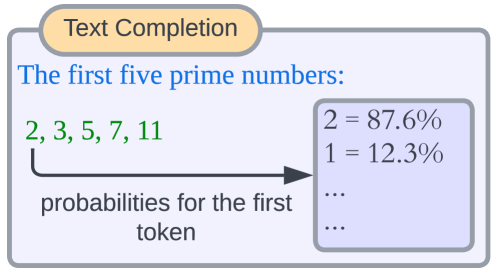
The image depicts a **text completion diagram** illustrating the probabilistic distribution of the first token in a sequence of prime numbers. The diagram combines textual labels, numerical probabilities, and visual elements to represent the model's output.
---
## Key Components and Labels
1. **Title Bar**
- **Label**: `Text Completion` (orange background, black text).
- Positioned at the top of the diagram.
2. **Main Text Block**
- **Header**: `The first five prime numbers:` (blue text).
- **List of Primes**:
- `2, 3, 5, 7, 11` (green text, left-aligned).
- **Probability Section**:
- **Label**: `probabilities for the first token` (black text, below the primes).
- **Probability Values**:
- `2 = 87.6%` (dark blue text, top of the probability box).
- `1 = 12.3%` (dark blue text, below `2`).
- `...` (ellipsis, repeated for subsequent tokens).
3. **Visual Elements**
- **Arrow**: A black arrow connects the primes list to the probability box, indicating the flow from input to output.
- **Color Gradient**:
- **Orange to Blue**: Represents the transition from the title bar to the probability box.
- **Legend**: The title bar's orange color is labeled as `Text Completion` (no explicit color-key legend for the gradient).
---
## Data Structure
### Probability Distribution Table
| Token | Probability |
|-------|-------------|
| 2 | 87.6% |
| 1 | 12.3% |
| ... | ... |
---
## Flow and Interpretation
1. **Input**: The first five prime numbers (`2, 3, 5, 7, 11`) are provided as context.
2. **Output**: The model predicts the probability distribution for the **first token** in the sequence.
- The highest probability (`87.6%`) is assigned to the token `2`, reflecting its likelihood as the next number in the sequence.
- The token `1` has a lower probability (`12.3%`), indicating it is less likely to follow the given primes.
3. **Visual Flow**: The arrow from the primes to the probability box emphasizes the causal relationship between the input and the model's output.
---
## Notes
- **Color Coding**:
- Green text highlights the prime numbers.
- Blue text emphasizes the probability values.
- Orange background in the title bar distinguishes the "Text Completion" label.
- **Ellipsis (`...`)**: Indicates continuation of the probability distribution beyond the first two tokens.
- **No Explicit Legend for Gradient**: The orange-to-blue gradient is used for visual hierarchy but lacks a formal legend.
---
## Conclusion
This diagram demonstrates how a text completion model processes a sequence of prime numbers and generates probabilistic predictions for the next token. The high probability for `2` suggests the model prioritizes continuity in the sequence, while `1` is considered a less likely candidate. The use of color and layout aids in distinguishing input, output, and model confidence.