## Diagram: Spatial Cognition Tasks
### Overview
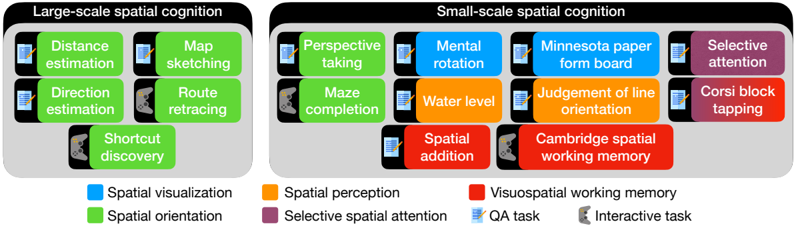
The image presents a diagram categorizing spatial cognition tasks into two main groups: Large-scale spatial cognition and Small-scale spatial cognition. Each category lists specific tasks associated with different cognitive functions, indicated by color-coded blocks. Icons are used to denote the task type (QA task or Interactive task).
### Components/Axes
* **Titles:**
* Top-left: Large-scale spatial cognition
* Top-right: Small-scale spatial cognition
* **Legend:** Located at the bottom of the image.
* Blue: Spatial visualization
* Green: Spatial orientation
* Orange: Spatial perception
* Purple: Selective spatial attention
* QA task: Icon of a document with a pen
* Interactive task: Icon of a game controller
* **Task Blocks:** Rectangular blocks containing the name of each task, color-coded according to the cognitive function it relates to.
### Detailed Analysis or ### Content Details
**Large-scale spatial cognition:**
* **Spatial Orientation (Green):**
* Distance estimation (QA task icon)
* Map sketching (QA task icon)
* Direction estimation (QA task icon)
* Route retracing (Interactive task icon)
* Shortcut discovery (Interactive task icon)
**Small-scale spatial cognition:**
* **Spatial Orientation (Green):**
* Perspective taking (QA task icon)
* Maze completion (Interactive task icon)
* **Spatial Visualization (Blue):**
* Mental rotation (QA task icon)
* **Spatial Perception (Orange):**
* Water level (QA task icon)
* Spatial addition (QA task icon)
* Judgement of line orientation (QA task icon)
* **Selective Spatial Attention (Purple):**
* Selective attention (QA task icon)
* Corsi block tapping (QA task icon)
* **Visuospatial Working Memory (Red):**
* Cambridge spatial working memory (Interactive task icon)
* Minnesota paper form board (QA task icon)
### Key Observations
* Large-scale spatial cognition tasks are primarily associated with spatial orientation.
* Small-scale spatial cognition tasks are more diverse, involving spatial visualization, spatial perception, selective spatial attention, and visuospatial working memory.
* QA tasks are more prevalent than interactive tasks.
### Interpretation
The diagram illustrates the different cognitive processes involved in spatial reasoning, distinguishing between large-scale and small-scale environments. Large-scale cognition focuses on navigation and orientation within larger spaces, while small-scale cognition involves more detailed spatial analysis and manipulation. The color-coding helps to categorize tasks based on the underlying cognitive functions they engage. The presence of both QA and interactive tasks suggests a variety of methods for assessing these cognitive abilities.