\n
## Diagram: Spatial Cognition Tasks
### Overview
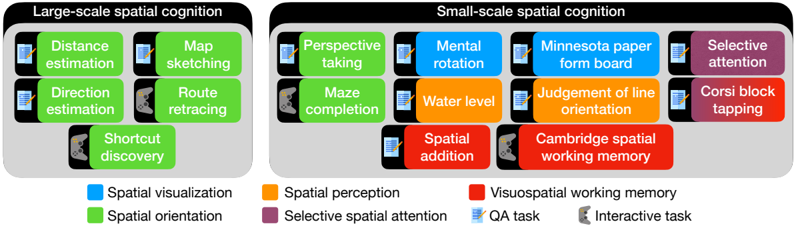
The image presents a diagram categorizing spatial cognition tasks into two main groups: Large-scale spatial cognition and Small-scale spatial cognition. Each category contains several specific tasks, visually represented as rounded rectangles with icons and labels. A legend at the bottom of the diagram explains the color-coding used to indicate the cognitive process involved in each task.
### Components/Axes
The diagram is divided into two main sections, labeled "Large-scale spatial cognition" (left) and "Small-scale spatial cognition" (right). Each section contains a grid of task labels within colored rectangles. The legend at the bottom provides a key for the colors, associating them with different cognitive processes:
* **Blue:** Spatial visualization
* **Green:** Spatial orientation
* **Orange:** Spatial perception
* **Red:** Visuospatial working memory
* **Light Blue:** Selective spatial attention
* **Black Icon:** QA task
* **Grey Icon:** Interactive task
### Detailed Analysis or Content Details
**Large-Scale Spatial Cognition (Left Side):**
* **Distance estimation:** Blue rectangle with a grey icon.
* **Map sketching:** Green rectangle with a grey icon.
* **Direction estimation:** Blue rectangle with a grey icon.
* **Route retracing:** Green rectangle with a grey icon.
* **Shortcut discovery:** Green rectangle with a grey icon.
**Small-Scale Spatial Cognition (Right Side):**
* **Perspective taking:** Blue rectangle with a grey icon.
* **Mental rotation:** Orange rectangle with a grey icon.
* **Minnesota paper form board:** Blue rectangle with a grey icon.
* **Selective attention:** Light Blue rectangle with a grey icon.
* **Maze completion:** Orange rectangle with a grey icon.
* **Water level:** Orange rectangle with a grey icon.
* **Judgement of line orientation:** Orange rectangle with a grey icon.
* **Corsi block tapping:** Red rectangle with a grey icon.
* **Spatial addition:** Orange rectangle with a grey icon.
* **Cambridge spatial working memory:** Red rectangle with a grey icon.
### Key Observations
The diagram visually separates spatial cognition into large-scale and small-scale processes. The color-coding highlights the different cognitive abilities involved in each task. Tasks involving spatial visualization and orientation (blue and green) are prominent in large-scale cognition, while spatial perception and visuospatial working memory (orange and red) are more prevalent in small-scale cognition. The presence of both QA and interactive task icons suggests a distinction in the method of assessment for these tasks.
### Interpretation
This diagram illustrates a conceptual framework for understanding the diverse range of cognitive processes involved in spatial cognition. The distinction between large-scale and small-scale cognition likely reflects differences in the spatial extent and complexity of the tasks. Large-scale tasks involve navigating and understanding environments, while small-scale tasks focus on manipulating and reasoning about objects within a limited space. The color-coding provides a valuable way to categorize tasks based on the underlying cognitive abilities they engage. The inclusion of task type icons (QA vs. Interactive) suggests that the assessment methods used for these tasks may differ, potentially influencing the cognitive processes emphasized. This diagram could be used as a basis for designing experiments or interventions aimed at improving specific aspects of spatial cognition.