## Diagram: Large-scale vs. Small-scale Spatial Cognition Tasks
### Overview
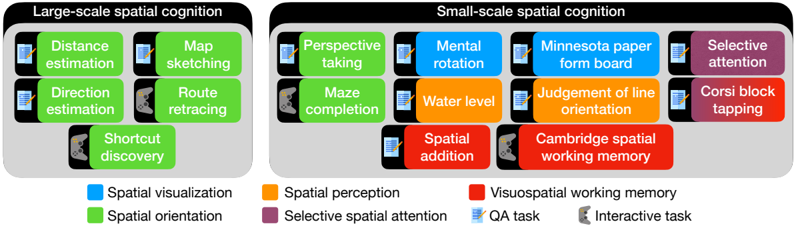
The diagram compares tasks associated with **large-scale spatial cognition** (left) and **small-scale spatial cognition** (right), organized into color-coded categories. Each task is represented by a colored box with a label, and a legend at the bottom maps colors to cognitive categories.
---
### Components/Axes
#### Legend (Bottom)
- **Blue**: Spatial visualization
- **Green**: Spatial orientation
- **Orange**: Spatial perception
- **Red**: Visuospatial working memory
- **Purple**: Selective spatial attention
- **Gray**: Interactive task
#### Left Side (Large-scale Spatial Cognition)
- **Green Boxes (Spatial orientation)**:
- Distance estimation
- Map sketching
- Route retracing
- Maze completion
- Shortcut discovery
- **Blue Boxes (Spatial visualization)**:
- Direction estimation
- Perspective taking
- **Gray Boxes (Interactive task)**:
- Spatial orientation
- Maze completion
- Shortcut discovery
#### Right Side (Small-scale Spatial Cognition)
- **Blue Boxes (Spatial visualization)**:
- Perspective taking
- Mental rotation
- Minnesota paper form board
- **Orange Boxes (Spatial perception)**:
- Water level
- Judgement of line orientation
- **Red Boxes (Visuospatial working memory)**:
- Corsi block tapping
- Spatial addition
- Cambridge spatial working memory
- **Purple Box (Selective spatial attention)**:
- Selective attention
- **Gray Box (Interactive task)**:
- QA task
---
### Detailed Analysis
#### Left Side (Large-scale)
- **Spatial orientation (Green)**: Tasks like *Distance estimation* and *Map sketching* are grouped here, though the legend associates green with spatial orientation. However, the task *Spatial orientation* itself appears in a gray box (Interactive task), creating a potential inconsistency.
- **Spatial visualization (Blue)**: *Direction estimation* and *Perspective taking* align with spatial visualization.
- **Interactive tasks (Gray)**: *Spatial orientation*, *Maze completion*, and *Shortcut discovery* are labeled as interactive tasks, conflicting with the legend’s green assignment for spatial orientation.
#### Right Side (Small-scale)
- **Spatial visualization (Blue)**: Tasks like *Mental rotation* and *Minnesota paper form board* fit this category.
- **Spatial perception (Orange)**: *Water level* and *Judgement of line orientation* align with perception.
- **Visuospatial working memory (Red)**: *Corsi block tapping*, *Spatial addition*, and *Cambridge spatial working memory* are grouped here.
- **Selective spatial attention (Purple)**: *Selective attention* is correctly color-coded.
- **Interactive task (Gray)**: *QA task* matches the legend’s gray category.
---
### Key Observations
1. **Color-Label Mismatch**: The task *Spatial orientation* is placed in a gray box (Interactive task) despite the legend associating green with spatial orientation.
2. **Task Distribution**:
- Large-scale cognition emphasizes **spatial orientation** (green) and **interactive tasks** (gray).
- Small-scale cognition focuses on **spatial visualization** (blue), **perception** (orange), and **working memory** (red).
3. **Overlap**: *Maze completion* and *Shortcut discovery* appear in both large-scale (green/gray) and small-scale (gray) sections, suggesting potential overlap in task categorization.
---
### Interpretation
The diagram illustrates how spatial cognition tasks are partitioned into large- and small-scale domains, with color coding to denote cognitive categories. However, inconsistencies arise in the placement of *Spatial orientation* (green vs. gray) and the inclusion of *Maze completion* in both sections. This may reflect nuanced task complexity or overlapping cognitive demands. The use of interactive tasks (gray) in both sections suggests these tasks bridge large- and small-scale cognition, requiring dynamic spatial processing. The selective attention (purple) and QA task (gray) highlight metacognitive and problem-solving components, respectively.