## Diagram: Dependency Parsing
### Overview
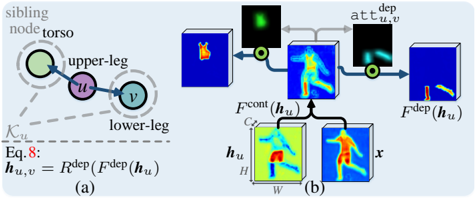
The image presents a diagram illustrating a dependency parsing process, likely within a computer vision or machine learning context. It shows the relationships between different body parts (torso, upper-leg, lower-leg) and the flow of information between them, represented by feature maps and attention mechanisms. The diagram is divided into two parts: (a) a graph representation of the body part dependencies and (b) a visual representation of the feature processing steps.
### Components/Axes
* **Part (a): Graph Representation**
* Nodes:
* "torso" (top-left, green circle)
* "upper-leg" (center, purple circle labeled "u")
* "lower-leg" (bottom-right, teal circle labeled "v")
* Edges:
* Directed edge from "torso" to "upper-leg"
* Directed edge from "upper-leg" to "lower-leg"
* Other:
* "sibling node" label above "torso"
* "K\_u" label below the graph
* Equation: h\_u,v = R^(dep)(F^(dep)(h\_u))
* Label: (a)
* **Part (b): Feature Processing**
* Input:
* Two 3D feature maps labeled "h\_u" and "x" (bottom-left and bottom-center)
* Dimensions of "h\_u": W (width), H (height), C (channels)
* Processing Steps:
* F^(cont)(h\_u): Combination of "h\_u" and "x" to produce a feature map.
* Feature map with a heat map of the upper leg.
* Attention map "att^(dep)\_{u,v}" (top-center, black square with a teal blob).
* F^(dep)(h\_u): Final feature map after applying the attention mechanism.
* Labels: (b)
### Detailed Analysis
* **Graph Representation (Part a):**
* The graph shows a hierarchical relationship between body parts. The torso is the parent node, the upper-leg is a child node, and the lower-leg is a child node of the upper-leg.
* The equation h\_u,v = R^(dep)(F^(dep)(h\_u)) describes the computation of a feature vector h\_u,v based on the feature vector h\_u and a dependency function F^(dep) and a relation function R^(dep).
* **Feature Processing (Part b):**
* The feature maps "h\_u" and "x" likely represent different types of information about the body part "u" (upper-leg).
* F^(cont)(h\_u) combines these features.
* The attention map "att^(dep)\_{u,v}" highlights the relevant regions in the feature map for the dependency between "u" and "v" (upper-leg and lower-leg).
* F^(dep)(h\_u) represents the final feature map after applying the attention mechanism, focusing on the dependency between the upper and lower leg.
### Key Observations
* The diagram illustrates a dependency parsing approach for understanding the relationships between body parts.
* Attention mechanisms are used to focus on the relevant regions in the feature maps for each dependency.
* The diagram shows the flow of information from the input feature maps to the final feature map, highlighting the key processing steps.
### Interpretation
The diagram presents a method for modeling the dependencies between body parts using feature maps and attention mechanisms. The graph representation captures the hierarchical relationships between body parts, while the feature processing steps show how these dependencies are used to refine the feature representations. This approach is likely used for tasks such as pose estimation or action recognition, where understanding the relationships between body parts is crucial. The use of attention mechanisms allows the model to focus on the most relevant regions in the feature maps, improving the accuracy and efficiency of the parsing process.