\n
## Diagram: Human Pose Dependency Modeling
### Overview
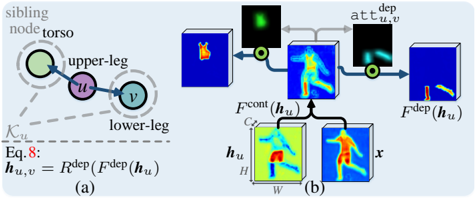
The image presents a diagram illustrating a dependency modeling approach for human pose estimation. It depicts a graph-based representation of body parts and their relationships, alongside a visual representation of feature extraction and attention mechanisms. The diagram is divided into two main sections: (a) a graph representation of body part dependencies, and (b) a visual depiction of feature processing and attention.
### Components/Axes
The diagram includes the following components:
* **Graph (a):** Nodes representing body parts (torso, upper-leg, lower-leg) and edges representing dependencies between them. Labels: "sibling node", "torso", "upper-leg", "lower-leg", "u", "v", "κ<sub>u,v</sub>".
* **Equation (a):** "Eq. 8: h<sub>u,v</sub> = R<sup>dep</sup>(F<sup>dep</sup>(h<sub>u</sub>))"
* **Feature Maps (b):** Cuboid representations of feature maps, labeled as "F<sub>front</sub>(h<sub>u</sub>)", "F<sup>dep</sup>(h<sub>u</sub>)", "x", "h<sub>u</sub>", "C<sub>z</sub>", "W".
* **Attention Maps (b):** Darker cuboid representations of attention maps, labeled as "att<sub>u,v</sub>", "dep".
* **Arrows (b):** Indicate the flow of information between feature maps and attention mechanisms.
* **Visual Representation (b):** Heatmaps overlaid on human silhouettes, showing feature activation.
### Detailed Analysis or Content Details
**Section (a): Graph Representation**
* The graph shows a torso node connected to both an upper-leg node (labeled 'u') and a lower-leg node (labeled 'v').
* The edge connecting 'u' and 'v' is labeled "κ<sub>u,v</sub>", representing the dependency between the upper and lower leg.
* The equation "h<sub>u,v</sub> = R<sup>dep</sup>(F<sup>dep</sup>(h<sub>u</sub>))" defines a dependency representation 'h<sub>u,v</sub>' based on a feature 'h<sub>u</sub>' processed through a dependency feature extractor 'F<sup>dep</sup>' and a transformation 'R<sup>dep</sup>'.
**Section (b): Feature Processing and Attention**
* **Input Feature Map (x):** A cuboid representing the input feature map 'x', showing a heatmap of human pose.
* **Frontal Feature Map (F<sub>front</sub>(h<sub>u</sub>)):** A cuboid representing the frontal view feature map, derived from 'h<sub>u</sub>'. The heatmap shows activation in the torso and upper body.
* **Dependency Feature Map (F<sup>dep</sup>(h<sub>u</sub>)):** A cuboid representing the dependency feature map, derived from 'h<sub>u</sub>'. The heatmap shows activation in the lower body, specifically the legs.
* **Dependency Attention Map (att<sub>u,v</sub>):** A darker cuboid representing the attention map between nodes 'u' and 'v'. The heatmap shows a focused activation area.
* **Dependency Map (dep):** A darker cuboid representing the dependency map.
* **Feature h<sub>u</sub>:** A cuboid representing the feature 'h<sub>u</sub>', showing a heatmap of human pose.
* **Feature C<sub>z</sub>:** A cuboid representing the feature 'C<sub>z</sub>', showing a heatmap of human pose.
* **Feature W:** A cuboid representing the feature 'W', showing a heatmap of human pose.
* The arrows indicate that 'F<sub>front</sub>(h<sub>u</sub>)' and 'F<sup>dep</sup>(h<sub>u</sub>)' are inputs to the attention mechanism, which generates 'att<sub>u,v</sub>'.
* 'att<sub>u,v</sub>' is then used to refine 'F<sup>dep</sup>(h<sub>u</sub>)', resulting in an output feature map.
### Key Observations
* The diagram highlights a dependency modeling approach where the relationships between body parts are explicitly modeled.
* The use of attention mechanisms suggests that the model focuses on relevant dependencies when processing features.
* The heatmaps indicate that different feature maps capture different aspects of the human pose.
* The equation suggests a transformation of features to represent dependencies.
### Interpretation
The diagram illustrates a novel approach to human pose estimation that leverages dependency modeling and attention mechanisms. The graph representation in (a) provides a structured way to define relationships between body parts, while the feature processing pipeline in (b) demonstrates how these dependencies are incorporated into the feature extraction process. The attention mechanism allows the model to selectively focus on relevant dependencies, improving the accuracy and robustness of pose estimation. The equation formalizes the dependency representation, suggesting a mathematical framework for modeling these relationships. The use of heatmaps provides a visual representation of feature activation, allowing for a better understanding of how the model processes information. The overall design suggests a system that aims to capture contextual information about human pose, going beyond simple feature detection to understand the relationships between body parts.