## Diagram: Comparison of LLM Reasoning Paradigms
### Overview
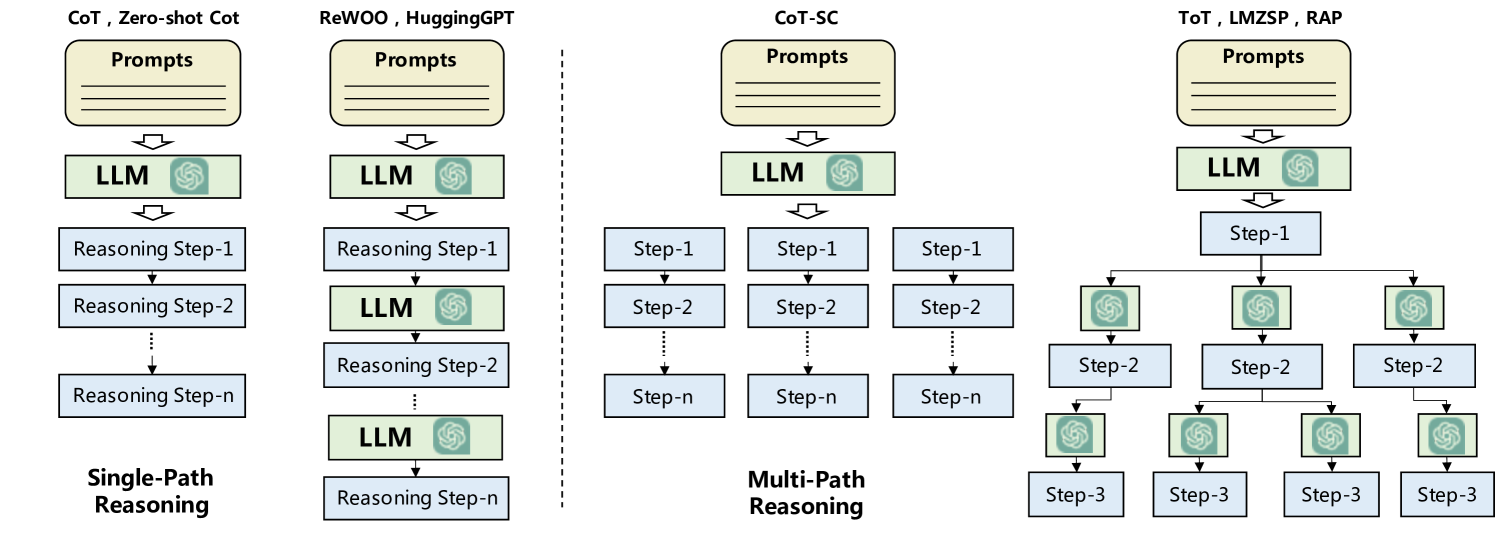
This diagram illustrates four distinct reasoning paradigms utilized by Large Language Models (LLMs), categorized into two primary groups: **Single-Path Reasoning** (left side) and **Multi-Path Reasoning** (right side). The diagram uses a flowchart format to demonstrate how prompts are processed through LLMs and subsequent reasoning steps, highlighting the structural differences in how these models approach problem-solving.
### Components/Axes
The diagram is divided into four vertical columns, separated by a dashed vertical line between the two main categories.
* **Top Level:** All four columns begin with a beige box labeled "Prompts" containing horizontal lines representing text input.
* **Processing Level:** All four columns contain at least one green box labeled "LLM" featuring the OpenAI logo.
* **Reasoning Level:** All four columns contain blue boxes labeled "Reasoning Step-X" or "Step-X".
* **Flow Indicators:** White arrows indicate the direction of the process flow. Dotted vertical lines within the columns indicate a continuation or repetition of the sequence.
### Detailed Analysis
#### 1. Single-Path Reasoning (Left Side)
This section represents linear, sequential processing.
* **Column 1: CoT (Chain of Thought), Zero-shot CoT**
* **Flow:** Prompt $\rightarrow$ LLM $\rightarrow$ Reasoning Step-1 $\rightarrow$ Reasoning Step-2 $\rightarrow$ [Dotted line] $\rightarrow$ Reasoning Step-n.
* **Structure:** A single, continuous vertical line of reasoning steps following a single LLM invocation.
* **Column 2: ReWOO, HuggingGPT**
* **Flow:** Prompt $\rightarrow$ LLM $\rightarrow$ Reasoning Step-1 $\rightarrow$ LLM $\rightarrow$ Reasoning Step-2 $\rightarrow$ [Dotted line] $\rightarrow$ LLM $\rightarrow$ Reasoning Step-n.
* **Structure:** This process is iterative. It alternates between a "Reasoning Step" and an "LLM" call, suggesting an agentic workflow where the model pauses to process or verify information before proceeding to the next step.
#### 2. Multi-Path Reasoning (Right Side)
This section represents branching, parallel, or tree-based processing.
* **Column 3: CoT-SC (Chain of Thought - Self Consistency)**
* **Flow:** Prompt $\rightarrow$ LLM $\rightarrow$ [Three parallel branches] $\rightarrow$ Step-1 $\rightarrow$ Step-2 $\rightarrow$ [Dotted line] $\rightarrow$ Step-n.
* **Structure:** A single LLM invocation initiates three parallel, identical reasoning paths. This implies the model generates multiple solutions to the same problem to find a consistent answer.
* **Column 4: ToT (Tree of Thoughts), LMZSP, RAP**
* **Flow:** Prompt $\rightarrow$ LLM $\rightarrow$ Step-1 $\rightarrow$ [Three branches, each with an LLM box] $\rightarrow$ Step-2 $\rightarrow$ [Branches continue] $\rightarrow$ Step-3.
* **Structure:** A complex tree structure. The process branches at every step, with an LLM invocation occurring at every node (every step of every branch). This indicates a search-based approach (like Breadth-First or Depth-First Search) where the model explores multiple potential reasoning paths simultaneously.
### Key Observations
* **Complexity Gradient:** The diagram demonstrates an increase in architectural complexity from left to right.
* **LLM Frequency:** In "Single-Path" (Col 1) and "Multi-Path" (Col 3), the LLM is primarily used at the start. In "ReWOO/HuggingGPT" (Col 2) and "ToT/LMZSP/RAP" (Col 4), the LLM is invoked repeatedly throughout the reasoning process.
* **Branching Logic:** The right side of the diagram explicitly visualizes branching, which is absent in the left side, indicating a shift from linear generation to exploratory or consensus-based generation.
### Interpretation
This diagram serves as a taxonomy of LLM reasoning strategies.
* **Single-Path Reasoning** is optimized for straightforward, sequential tasks where the model can derive an answer in one go (CoT) or requires external tool integration (ReWOO/HuggingGPT).
* **Multi-Path Reasoning** is designed for complex, ambiguous, or high-stakes tasks.
* **CoT-SC** uses redundancy (parallel paths) to improve reliability through consensus.
* **ToT/LMZSP/RAP** uses a tree-search approach, allowing the model to "look ahead," backtrack, or explore multiple hypotheses, which is essential for tasks like planning, coding, or complex mathematical problem-solving where a single linear path might fail.
The visual distinction between the "LLM" boxes in the different columns highlights a fundamental shift in agent design: moving from a "prompt-and-wait" model to an "interactive-agent" model that continuously engages the LLM to refine its reasoning trajectory.