## Flowchart: Comparative Analysis of Reasoning Methods in Large Language Models (LLMs)
### Overview
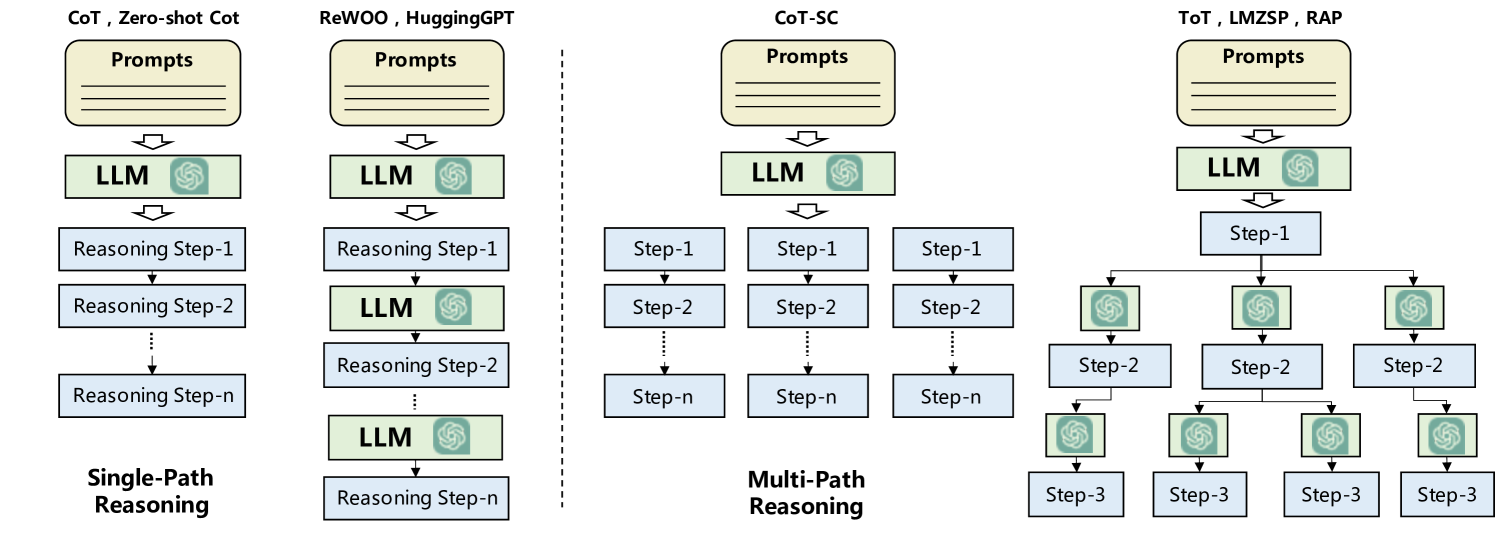
The diagram illustrates four distinct reasoning methodologies used in LLMs, visualized through hierarchical and branched workflows. Each method begins with "Prompts" feeding into an LLM, followed by sequential or parallel reasoning steps. The structure progresses from simple single-path reasoning (left) to complex multi-path and tree-like branching (right), demonstrating increasing computational complexity.
### Components/Axes
1. **Key Elements**:
- **Prompts**: Rectangular beige boxes at the top of each method, representing input instructions.
- **LLM**: Green circular icons with a swirl pattern, symbolizing the language model processing unit.
- **Reasoning Steps**: Blue rectangular boxes labeled "Step-1", "Step-2", etc., indicating iterative processing.
- **Method Labels**: Text annotations above each workflow (e.g., "CoT", "ReWOO", "ToT").
2. **Spatial Structure**:
- **Left Section**: Single-path reasoning (CoT, Zero-shot Cot).
- **Middle Section**: Multi-path reasoning (CoT-SC).
- **Right Section**: Complex branching (ToT, LMZSP, RAP).
- **Color Coding**: Beige (prompts), green (LLM), blue (steps).
### Detailed Analysis
1. **Single-Path Reasoning (Left)**:
- **CoT & Zero-shot Cot**:
- Linear flow: Prompts → LLM → Step-1 → Step-2 → ... → Step-n.
- No branching; each step depends sequentially on the previous.
2. **Multi-Path Reasoning (Middle)**:
- **CoT-SC**:
- Parallel processing: Prompts → LLM → three independent Step-1 branches.
- Each Step-1 feeds into separate Step-2 branches, maintaining parallelism.
3. **Complex Branching (Right)**:
- **ToT, LMZSP, RAP**:
- Tree-like structure: Prompts → LLM → Step-1 → three Step-2 branches.
- Each Step-2 branches into three Step-3 branches, creating exponential growth in paths.
### Key Observations
1. **Complexity Gradient**: Methods increase in computational demand from left (simple) to right (complex).
2. **LLM Centrality**: The LLM acts as the core processor in all methods, with prompts and steps acting as input/output interfaces.
3. **Branching Patterns**:
- Single-path: Linear dependency chains.
- Multi-path: Parallel but independent branches.
- Tree-like: Hierarchical branching with multiplicative complexity.
### Interpretation
The diagram reveals a taxonomy of reasoning strategies in LLMs, where:
- **Single-path methods** (CoT) prioritize simplicity and directness, suitable for straightforward tasks.
- **Multi-path methods** (CoT-SC) enable parallel exploration of reasoning paths, improving robustness for ambiguous problems.
- **Tree-like methods** (ToT) represent advanced architectures for complex problem-solving, where multiple reasoning layers compound to handle intricate tasks.
This progression suggests that more sophisticated prompting strategies (e.g., ToT) are designed to address limitations in earlier methods by leveraging combinatorial reasoning through structured branching. The absence of explicit numerical data implies the focus is on architectural differences rather than performance metrics.