## Diagram: Tweety Inference
### Overview
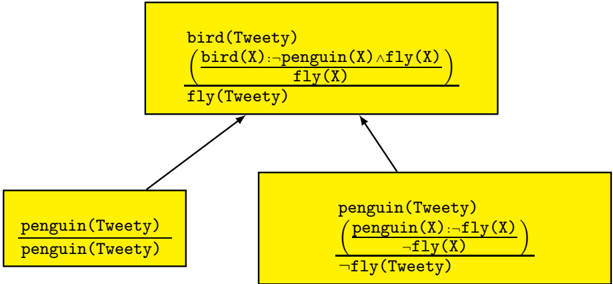
The image depicts a diagram representing logical inferences about whether Tweety can fly, based on whether Tweety is a bird and/or a penguin. The diagram uses yellow boxes to represent logical statements and arrows to indicate inference relationships.
### Components/Axes
* **Nodes:** Three yellow rectangular boxes, each containing logical statements.
* **Arrows:** Two arrows indicating the direction of inference.
* **Logical Statements:** Predicates and rules written in a Prolog-like syntax.
### Detailed Analysis
* **Top Box:**
* `bird(Tweety)`
* `(bird(X):-penguin(X)^fly(X))`
* `fly(X)`
* `fly(Tweety)`
* **Bottom-Left Box:**
* `penguin(Tweety)`
* `penguin(Tweety)`
* **Bottom-Right Box:**
* `penguin(Tweety)`
* `(penguin(X):-fly(X))`
* `-fly(X)`
* `-fly(Tweety)`
The arrow from the bottom-left box points to the top box. The arrow from the bottom-right box points to the top box.
### Key Observations
* The diagram presents two separate lines of reasoning regarding Tweety's ability to fly.
* The bottom-left box asserts that Tweety is a penguin.
* The bottom-right box uses the rule that if something is a penguin, it cannot fly.
* The top box contains the statement that Tweety is a bird, and also a rule stating that birds are penguins and can fly.
### Interpretation
The diagram illustrates a conflict in logical inferences. One line of reasoning (bottom-left to top) suggests Tweety can fly because it's a bird. The other line of reasoning (bottom-right to top) suggests Tweety cannot fly because it's a penguin. This is a classic example of non-monotonic reasoning, where adding new information (Tweety is a penguin) invalidates a previous conclusion (Tweety can fly). The diagram highlights the need for conflict resolution or prioritization of rules when dealing with incomplete or contradictory information.