\n
## Diagram: Logical Decomposition of Bird(Tweety)
### Overview
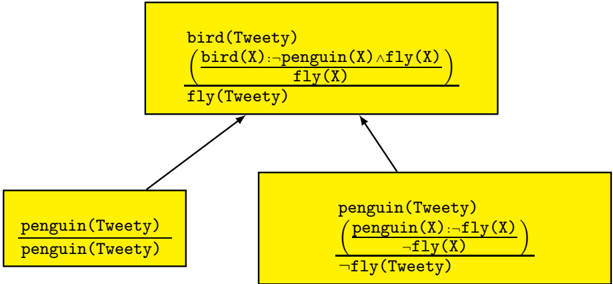
The image presents a diagram illustrating the logical decomposition of the statement "bird(Tweety)". It shows how this statement can be broken down into its constituent parts, specifically relating to whether Tweety is a penguin and whether Tweety can fly. The diagram uses a hierarchical structure with boxes representing logical statements and arrows indicating derivation or implication.
### Components/Axes
The diagram consists of three yellow rectangular boxes connected by arrows. Each box contains logical statements written in a formal notation. The top box represents the initial statement, and the lower two boxes represent derived statements. The arrows point downwards, indicating a decomposition or derivation process.
### Detailed Analysis or Content Details
**Top Box:**
* **Statement:** `bird(Tweety)`
* **Decomposition:** `(bird(X) :- penguin(X) ∧ fly(X))`
* **Derived Statement:** `fly(Tweety)`
**Left Box:**
* **Statement:** `penguin(Tweety)`
* **Decomposition:** `penguin(X)`
* **Derived Statement:** `penguin(Tweety)`
**Right Box:**
* **Statement:** `penguin(Tweety)`
* **Decomposition:** `(penguin(X) :- ¬fly(X))`
* **Derived Statement:** `¬fly(Tweety)` (meaning "Tweety does not fly")
The notation `:-` appears to represent logical implication (if...then). `∧` represents logical conjunction (and). `¬` represents logical negation (not).
### Key Observations
The diagram demonstrates a logical argument. The initial statement `bird(Tweety)` is decomposed into a rule relating birds to penguins and flying, and a statement that Tweety can fly. This leads to the conclusion that Tweety is a penguin, and also that Tweety cannot fly. There appears to be a contradiction, as Tweety is both stated to fly and not fly.
### Interpretation
The diagram illustrates a logical deduction process, potentially highlighting a flaw or paradox in the initial assumptions. The decomposition of `bird(Tweety)` suggests that being a bird implies being a penguin *and* being able to fly. However, the subsequent derivations lead to the conclusion that Tweety is a penguin but cannot fly. This contradiction suggests that the initial rule `(bird(X) :- penguin(X) ∧ fly(X))` is either incorrect or incomplete, or that the initial statement `bird(Tweety)` is false. The diagram is a demonstration of how logical rules can be applied to derive new information, and how inconsistencies can arise if the rules or initial statements are flawed. The diagram is a formal representation of a logical argument, and the use of symbols and notation allows for precise and unambiguous communication of the reasoning process.