## Diagram: Machine Learning Pipeline Architecture (BYOL-A Feature Extractor and DNN Classifier)
### Overview
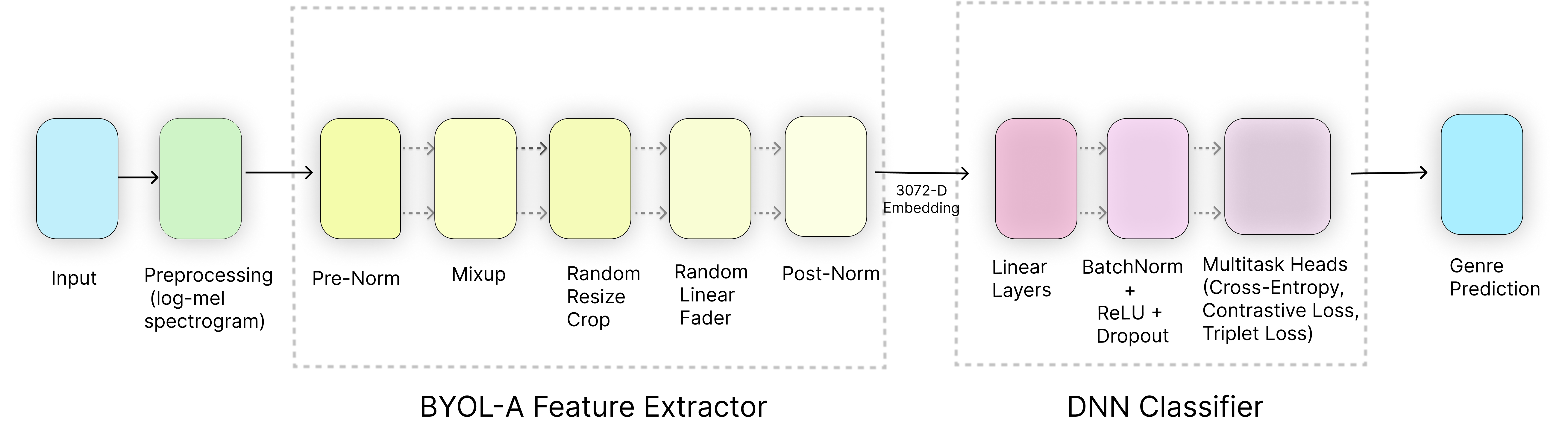
The image presents a high-level architectural flow diagram of a machine learning pipeline designed for audio genre prediction. The pipeline is divided into two primary modules: the "BYOL-A Feature Extractor" and the "DNN Classifier." The process flows from left to right, beginning with raw input and culminating in a genre prediction.
### Components/Axes
The diagram is organized into a linear sequence of processing blocks, grouped into two distinct dashed-line containers.
**Color Coding & Legend:**
* **Blue (Rounded Rectangles):** Input and Output stages.
* **Green (Rounded Rectangle):** Preprocessing stage.
* **Yellow (Rounded Rectangles):** Components within the BYOL-A Feature Extractor.
* **Pink/Purple (Rounded Rectangles):** Components within the DNN Classifier.
**Flow Indicators:**
* **Solid Arrows:** Represent the primary data flow between major stages.
* **Dashed Arrows:** Represent the internal data flow within the modular blocks.
### Detailed Analysis
#### 1. Input and Preprocessing (Left)
* **Input:** A blue rounded rectangle labeled "Input".
* **Preprocessing:** A green rounded rectangle labeled "Preprocessing (log-mel spectrogram)". A solid arrow connects "Input" to this block.
#### 2. BYOL-A Feature Extractor (Center, Dashed Box)
This module contains a sequence of five yellow rounded rectangles connected by dashed arrows:
1. **Pre-Norm**
2. **Mixup**
3. **Random Resize Crop**
4. **Random Linear Fader**
5. **Post-Norm**
#### 3. Transition
* A solid arrow connects the "BYOL-A Feature Extractor" to the "DNN Classifier."
* **Label:** "3072-D Embedding" is written above this arrow, indicating the dimensionality of the feature vector passed between the two modules.
#### 4. DNN Classifier (Right, Dashed Box)
This module contains three pink/purple rounded rectangles connected by dashed arrows:
1. **Linear Layers** (Pink)
2. **BatchNorm + ReLU + Dropout** (Light Purple)
3. **Multitask Heads (Cross-Entropy, Contrastive Loss, Triplet Loss)** (Darker Purple)
#### 5. Output (Far Right)
* **Genre Prediction:** A blue rounded rectangle. A solid arrow connects the "DNN Classifier" to this final output block.
### Key Observations
* **Modular Design:** The architecture clearly separates feature extraction (BYOL-A) from classification (DNN).
* **Data Bottleneck:** The "3072-D Embedding" serves as the critical interface between the two modules, suggesting that the feature extractor compresses the input into a high-dimensional vector.
* **Augmentation:** The presence of "Mixup," "Random Resize Crop," and "Random Linear Fader" within the feature extractor suggests the use of data augmentation techniques to improve model robustness.
* **Multitask Learning:** The final stage of the classifier uses three distinct loss functions (Cross-Entropy, Contrastive Loss, Triplet Loss), indicating that the model is trained to optimize for multiple objectives simultaneously, likely to improve the quality of the learned embeddings.
### Interpretation
This diagram illustrates a sophisticated deep learning pipeline, likely for Audio Information Retrieval (AIR).
* **BYOL-A (Bootstrap Your Own Latent - Audio):** The inclusion of "Pre-Norm," "Mixup," and "Random" operations suggests this is a self-supervised learning framework. By applying these augmentations, the model learns to extract invariant features from audio spectrograms without needing explicit labels during the feature extraction phase.
* **The Embedding:** The 3072-D vector is the "latent representation" of the audio. This is the compressed knowledge the model has learned about the audio input.
* **The Classifier:** The DNN Classifier takes this high-dimensional representation and maps it to a specific genre. The use of "Multitask Heads" is significant; it implies that the model is not just learning to classify genres (Cross-Entropy), but is also being regularized or guided by contrastive and triplet losses. These losses force the model to group similar audio samples closer together in the embedding space and push dissimilar ones apart, resulting in a more discriminative and robust feature representation for the final genre prediction.