## Flowchart: Audio Genre Classification Pipeline
### Overview
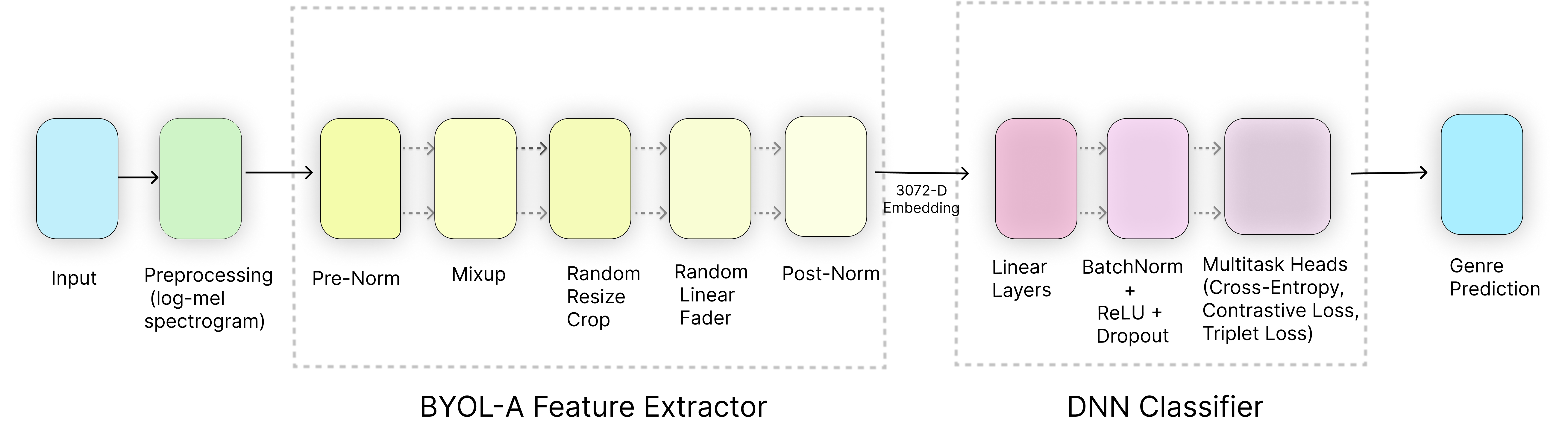
The diagram illustrates a two-stage technical pipeline for audio genre classification. The left section ("BYOL-A Feature Extractor") processes raw audio input through self-supervised feature extraction, while the right section ("DNN Classifier") uses these features for genre prediction via multitask learning. The flow progresses left-to-right through sequential processing stages.
### Components/Axes
**BYOL-A Feature Extractor (Left Section):**
1. Input (blue rectangle)
2. Preprocessing (log-mel spectrogram) (green rectangle)
3. Pre-Norm (light yellow rectangle)
4. Mixup (yellow rectangle)
5. Random Resize Crop (medium yellow rectangle)
6. Random Linear Fader (light yellow rectangle)
7. Post-Norm (white rectangle)
8. 3072-D Embedding (darker yellow rectangle)
**DNN Classifier (Right Section):**
1. Linear Layers (pink rectangle)
2. BatchNorm + ReLU + Dropout (light pink rectangle)
3. Multitask Heads (Cross-Entropy, Contrastive Loss, Triplet Loss) (medium pink rectangle)
4. Genre Prediction (blue rectangle)
**Flow Direction:** All components connected by rightward arrows. Color coding differentiates sections: blue/green for input processing, yellow for augmentation, pink for classification.
### Detailed Analysis
**BYOL-A Feature Extractor:**
- **Preprocessing:** Converts raw audio to log-mel spectrogram representation
- **Normalization:** Pre-Norm and Post-Norm stages suggest batch normalization implementation
- **Augmentation:** Mixup, Random Resize Crop, and Random Linear Fader indicate data augmentation techniques
- **Embedding:** Final 3072-dimensional feature vector output
**DNN Classifier:**
- **Feature Processing:** Linear layers followed by BatchNorm + ReLU + Dropout for regularization
- **Multitask Learning:** Three concurrent loss functions:
- Cross-Entropy (standard classification)
- Contrastive Loss (similarity learning)
- Triplet Loss (embedding space optimization)
- **Output:** Final genre prediction
### Key Observations
1. **Pipeline Structure:** Clear separation between feature extraction (BYOL-A) and classification (DNN)
2. **Augmentation Emphasis:** Three distinct augmentation techniques in feature extraction phase
3. **Multitask Complexity:** Three loss functions operating simultaneously in classification phase
4. **Dimensionality:** 3072-D embedding suggests high-dimensional feature space
### Interpretation
This diagram represents a sophisticated audio classification system combining:
1. **Self-Supervised Learning (BYOL):** The feature extractor uses contrastive learning principles (evidenced by Mixup and Random operations) to learn representations without labeled data
2. **Multitask Learning:** The classifier simultaneously optimizes for three different objectives, potentially improving generalization through shared representations
3. **Architectural Choices:**
- The 3072-D embedding dimension balances capacity and computational efficiency
- BatchNorm + ReLU + Dropout combination suggests careful attention to training stability
- Triplet Loss implementation indicates interest in metric learning for better embedding discrimination
The pipeline demonstrates a modern approach to audio classification that leverages both self-supervised pre-training and multitask fine-tuning, likely resulting in improved performance on genre classification tasks compared to single-task approaches.