## Flowchart: Multi-Stage Reasoning System Architecture
### Overview
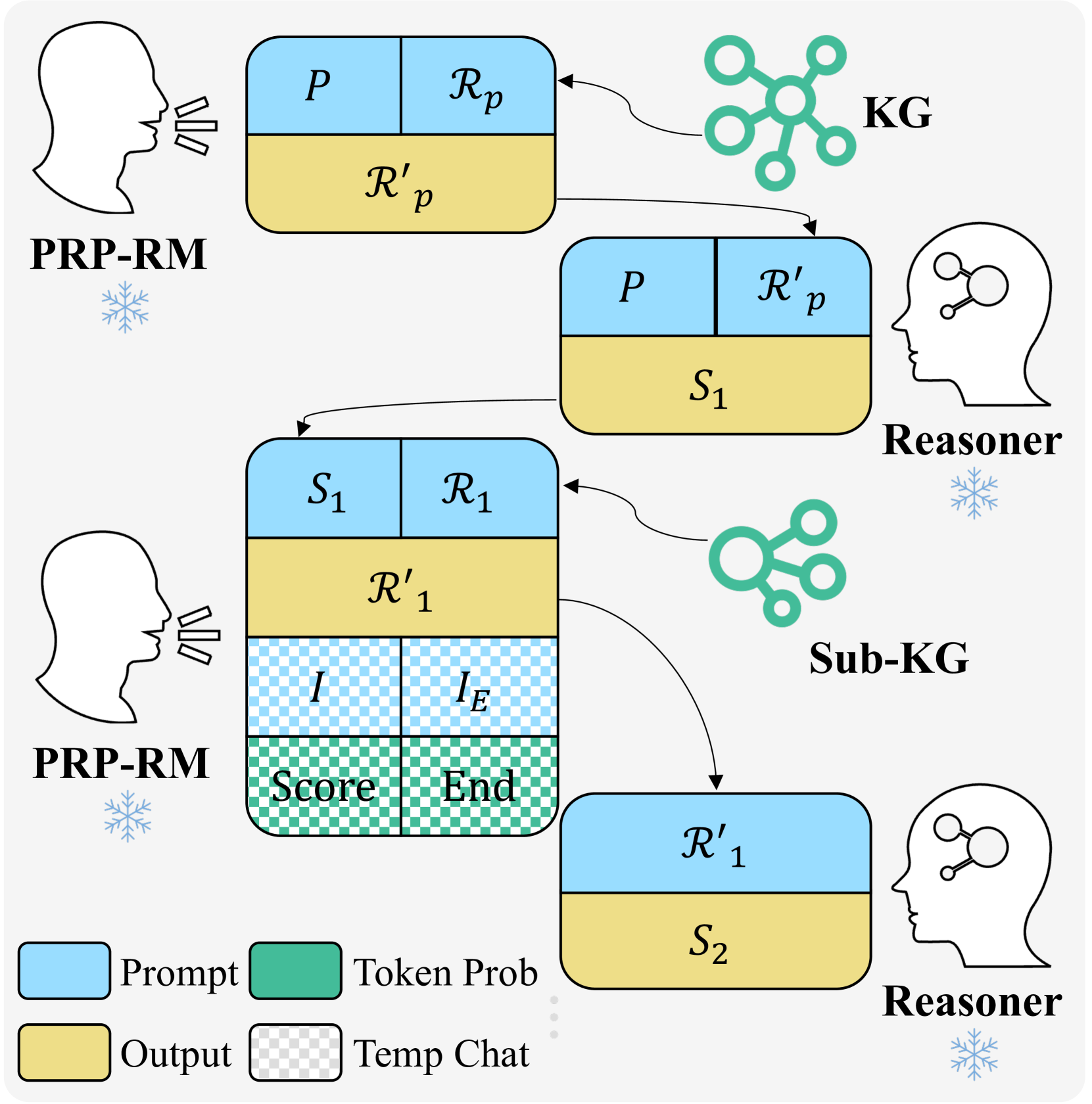
The diagram illustrates a multi-stage reasoning system involving a Prompt-Response Model (PRP-RM), a Reasoner, and knowledge graph components (KG, Sub-KG). The system processes inputs through probabilistic outputs, token probabilities, and temperature-based chat interactions, culminating in reasoned outputs.
### Components/Axes
1. **Legend**:
- **Blue**: Prompt
- **Yellow**: Output
- **Green**: Token Probability
- **Checkered (Blue/White)**: Temperature Chat
- **Green Network Nodes**: Knowledge Graph (KG) / Sub-Knowledge Graph (Sub-KG)
2. **Key Elements**:
- **PRP-RM (Upper Left)**: Contains prompt (`P`), output (`R'_p`), and token probability (`R'_p`).
- **Reasoner (Upper Right)**: Depicted as a brain with interconnected nodes, receiving inputs from KG and Sub-KG.
- **KG (Top Center)**: Green network connecting PRP-RM to `S1`.
- **Sub-KG (Bottom Center)**: Green network connecting `S1` to Reasoner.
- **PRP-RM (Lower Left)**: Contains structured components (`S1`, `R1`, `R'_1`, `I`, `I_E`, `Score`, `End`).
- **S2 (Lower Right)**: Output from `R'_1`, feeding into Reasoner.
### Detailed Analysis
1. **Upper PRP-RM**:
- **Prompt (`P`)**: Initiates the process.
- **Output (`R'_p`)**: Directly feeds into KG.
- **Token Probability (`R'_p`)**: Linked to `S1`.
2. **KG and Sub-KG**:
- **KG**: Connects PRP-RM to `S1` (blue/yellow box).
- **Sub-KG**: Connects `S1` to Reasoner via `S2`.
3. **Lower PRP-RM**:
- **`S1`**: Receives input (`I`) and external input (`I_E`).
- **`R1`**: Output from `S1`, feeding into `R'_1`.
- **`R'_1`**: Processes `Score` and `End` (checkered sections), outputs `S2`.
- **`Score`/`End`**: Likely evaluation/termination markers.
4. **Reasoner**:
- Integrates inputs from KG, Sub-KG, and `S2` to produce final outputs.
### Key Observations
- **Flow Direction**:
- Prompts → Outputs → Token Probabilities → KG → `S1` → Sub-KG → Reasoner.
- Lower PRP-RM processes structured data (`Score`, `End`) to refine outputs via `R'_1` → `S2` → Reasoner.
- **Color Consistency**:
- Blue (`Prompt`) and yellow (`Output`) dominate PRP-RM sections.
- Green networks (`KG`, `Sub-KG`) visually separate probabilistic and knowledge-based components.
- **Checkered Sections**:
- `Score` and `End` in lower PRP-RM suggest probabilistic evaluation steps.
### Interpretation
This architecture represents a hybrid reasoning system where:
1. **Probabilistic Processing**: PRP-RM generates outputs with token probabilities and temperature-adjusted chat interactions, ensuring variability.
2. **Knowledge Integration**: KG and Sub-KG provide contextual grounding, refining raw outputs into structured inputs (`S1`, `S2`).
3. **Reasoning Pipeline**: The Reasoner synthesizes knowledge and structured data to produce final outputs, likely for tasks requiring both creativity (via PRP-RM) and logic (via Reasoner).
The system emphasizes iterative refinement: initial prompts are probabilistically expanded, evaluated via knowledge graphs, and finally reasoned through a structured pipeline. The `Score`/`End` markers suggest built-in quality control or termination criteria, preventing infinite loops or low-quality outputs.