## Diagram: Reasoning Process with Knowledge Graph Interaction
### Overview
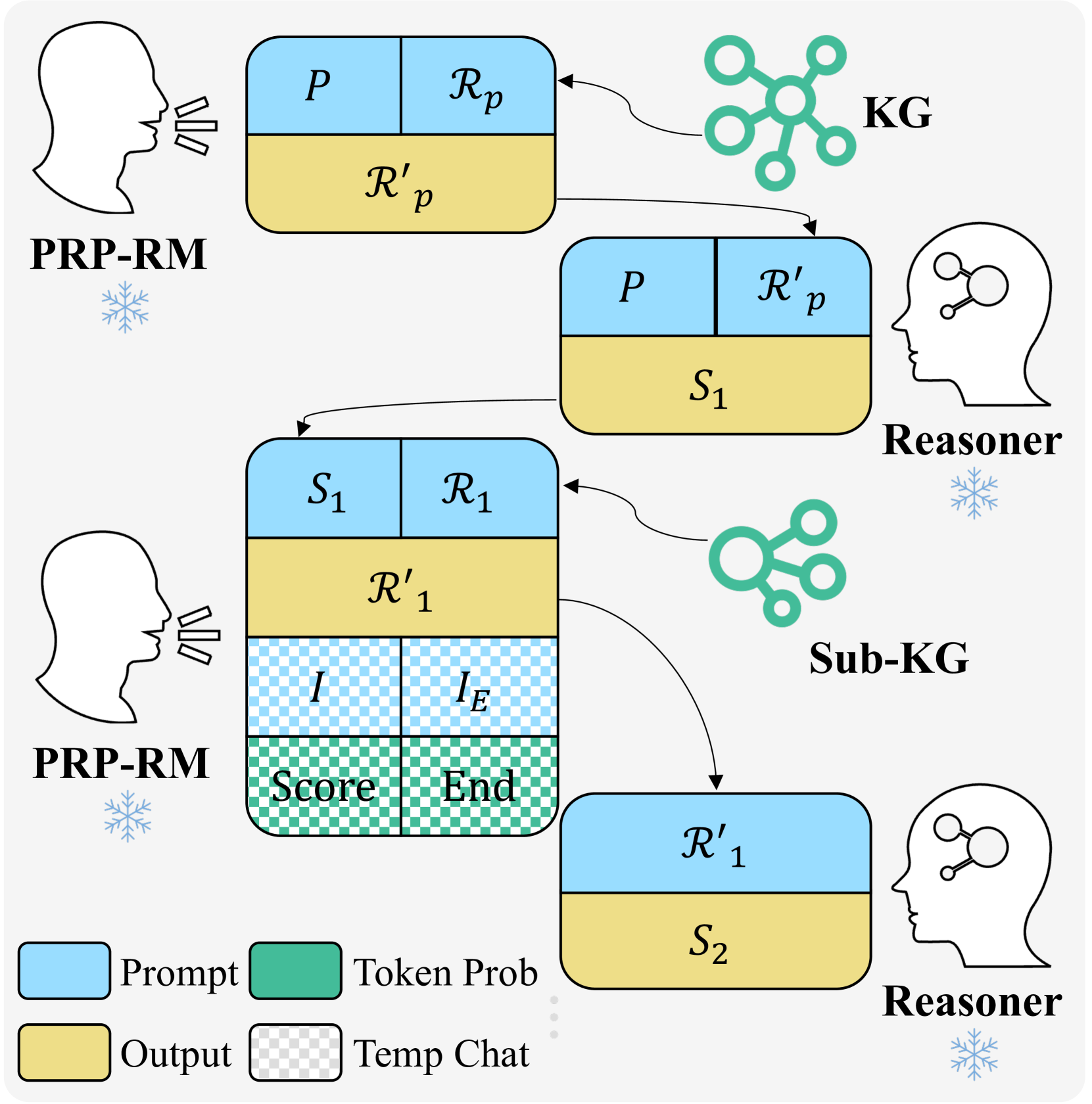
The image is a diagram illustrating a reasoning process that interacts with a knowledge graph (KG). It shows a sequence of steps involving a Prompt-Response-Prompt Reasoning Module (PRP-RM) and a Reasoner, with intermediate states and interactions with the KG and a Sub-KG. The diagram uses color-coding to represent different types of data or processes.
### Components/Axes
* **PRP-RM:** Prompt-Response-Prompt Reasoning Module, represented by a head outline with speech bubbles.
* **Reasoner:** Represented by a head outline with interconnected circles inside.
* **KG:** Knowledge Graph, represented by a green interconnected node diagram.
* **Sub-KG:** Sub-Knowledge Graph, represented by a green interconnected node diagram.
* **Prompt (Blue):** Represents the input prompt.
* **Output (Yellow):** Represents the output generated.
* **Token Prob (Green):** Represents token probabilities.
* **Temp Chat (Checkered):** Represents temporary chat data.
* **Boxes:** Rectangular boxes divided into sections, representing different states or data.
* P: Prompt
* Rp: Response
* R'p: Refined Response
* S1: State 1
* R1: Response 1
* R'1: Refined Response 1
* I: Input
* IE: Input End
* Score: Score
* End: End
* S2: State 2
### Detailed Analysis
The diagram shows a multi-step reasoning process:
1. **Initial Prompt:** A PRP-RM generates a prompt (P) and a response (Rp). The refined response (R'p) is output. This output is fed into a Knowledge Graph (KG).
2. **First Reasoning Step:** The KG provides information to the Reasoner, which uses the prompt (P) and refined response (R'p) to generate a state (S1).
3. **Second Prompt:** A second PRP-RM takes the state (S1) and generates a response (R1). The refined response (R'1) is output. This output is fed into a Sub-KG.
4. **Second Reasoning Step:** The Sub-KG provides information to the Reasoner, which uses the refined response (R'1) along with input (I), input end (IE), score, and end to generate a new state (S2).
**Detailed Breakdown of Boxes:**
* **Top Box:** Divided into two blue sections labeled "P" and "Rp" on top, and a yellow section labeled "R'p" on the bottom.
* **Second Box:** Divided into two sections, a blue section labeled "P" and a blue section labeled "R'p" on top, and a yellow section labeled "S1" on the bottom.
* **Third Box:** Divided into multiple sections:
* Top: Two blue sections labeled "S1" and "R1".
* Middle: A yellow section labeled "R'1".
* Bottom Middle: Two checkered sections labeled "I" and "IE".
* Bottom: Two green sections labeled "Score" and "End".
* **Bottom Box:** Divided into two sections, a blue section labeled "R'1" on top, and a yellow section labeled "S2" on the bottom.
### Key Observations
* The process involves iterative prompting and reasoning, with interactions with both a KG and a Sub-KG.
* The PRP-RM modules seem to be responsible for generating prompts and responses, while the Reasoner uses these prompts and responses in conjunction with knowledge from the KGs to update its state.
* The use of "refined responses" (R'p, R'1) suggests a process of iterative refinement or improvement of the responses.
* The "Temp Chat" (checkered) section suggests a temporary storage or processing of chat-related data.
* The "Token Prob" (green) section suggests a probability score is being calculated.
### Interpretation
The diagram illustrates a complex reasoning process that leverages knowledge graphs to enhance the quality of responses. The iterative nature of the process, with repeated prompting and reasoning steps, suggests a system designed for complex tasks that require multiple steps of inference and knowledge retrieval. The use of both a KG and a Sub-KG may indicate a hierarchical knowledge structure or a process of focusing on relevant subsets of knowledge. The inclusion of "Score" and "End" suggests a mechanism for evaluating the quality of the reasoning process and determining when to terminate the process. The diagram highlights the interplay between prompting, reasoning, and knowledge retrieval in achieving intelligent behavior.