TECHNICAL ASSET FINGERPRINT
2e71d3fa569fe5499ea760b9
Click to view fullscreen
Press ESC or click to close
FOUND IN PAPERS
EXPERT: gemini-2.0-flash VERSION 1
RUNTIME: nugit/gemini/gemini-2.0-flash
INTEL_VERIFIED
## Chart/Diagram Type: Multi-Panel Performance Comparison
### Overview
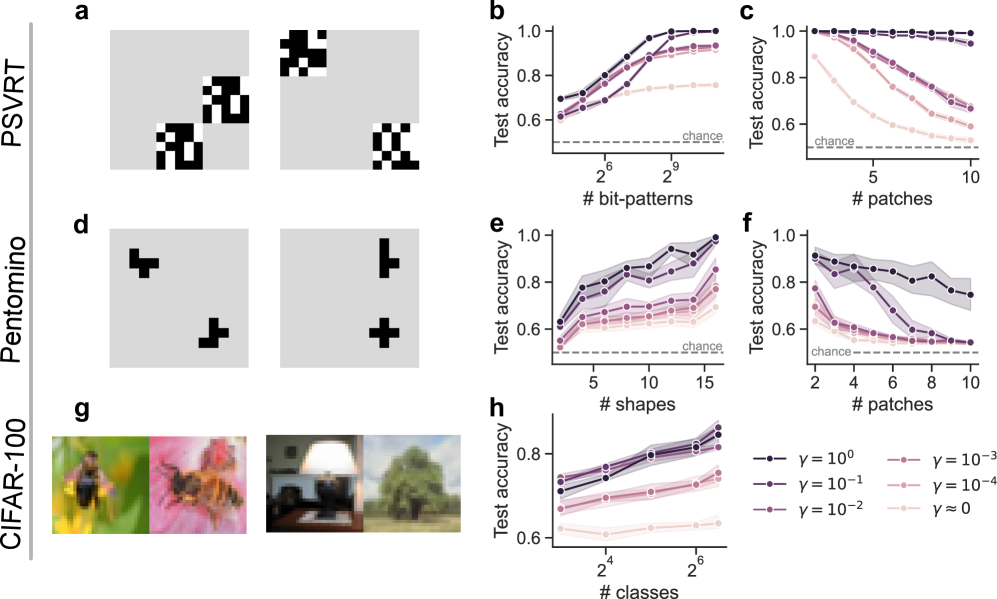
The image presents a multi-panel figure comparing the performance of a model across three different datasets (PSVRT, Pentomino, and CIFAR-100) under varying conditions. The performance metric used is "Test accuracy," and the conditions are related to the complexity of the dataset (number of bit-patterns, shapes, patches, or classes) and a hyperparameter denoted as gamma (γ).
### Components/Axes
* **Overall Structure:** The figure is divided into three rows, each corresponding to a dataset: PSVRT, Pentomino, and CIFAR-100. Each row contains an example image from the dataset and two plots showing the test accuracy under different conditions.
* **Y-axis (Test accuracy):** All plots share the same y-axis, labeled "Test accuracy," ranging from 0.6 to 1.0. A dashed horizontal line labeled "chance" is present at approximately 0.52.
* **X-axes:** The x-axes vary depending on the dataset and plot:
* **PSVRT:**
* Panel b: "# bit-patterns" ranging from 2<sup>6</sup> to 2<sup>9</sup>.
* Panel c: "# patches" ranging from 4 to 10.
* **Pentomino:**
* Panel e: "# shapes" ranging from 5 to 15.
* Panel f: "# patches" ranging from 2 to 10.
* **CIFAR-100:**
* Panel h: "# classes" ranging from 2<sup>4</sup> to 2<sup>6</sup>.
* **Legend:** Located in the bottom-right corner, the legend indicates the different values of the hyperparameter gamma (γ) using different line styles and colors:
* Black solid line: γ = 10<sup>0</sup>
* Dark purple dashed line: γ = 10<sup>-1</sup>
* Purple dotted line: γ = 10<sup>-2</sup>
* Light purple solid line: γ = 10<sup>-3</sup>
* Pink dashed line: γ = 10<sup>-4</sup>
* Light pink dotted line: γ ≈ 0
### Detailed Analysis or Content Details
**PSVRT (Panels a, b, c):**
* **Panel a:** Shows example images from the PSVRT dataset, which appear to be binary pixel patterns.
* **Panel b:** Test accuracy vs. # bit-patterns.
* γ = 10<sup>0</sup> (Black): Accuracy increases from ~0.7 to ~0.9 as # bit-patterns increases.
* γ = 10<sup>-1</sup> (Dark Purple): Accuracy increases from ~0.65 to ~0.9 as # bit-patterns increases.
* γ = 10<sup>-2</sup> (Purple): Accuracy increases from ~0.6 to ~0.85 as # bit-patterns increases.
* γ = 10<sup>-3</sup> (Light Purple): Accuracy remains relatively constant at ~0.75 as # bit-patterns increases.
* γ = 10<sup>-4</sup> (Pink): Accuracy remains relatively constant at ~0.7 as # bit-patterns increases.
* γ ≈ 0 (Light Pink): Accuracy remains relatively constant at ~0.6 as # bit-patterns increases.
* **Panel c:** Test accuracy vs. # patches.
* γ = 10<sup>0</sup> (Black): Accuracy remains high at ~1.0 as # patches increases.
* γ = 10<sup>-1</sup> (Dark Purple): Accuracy remains high at ~1.0 as # patches increases.
* γ = 10<sup>-2</sup> (Purple): Accuracy decreases from ~1.0 to ~0.95 as # patches increases.
* γ = 10<sup>-3</sup> (Light Purple): Accuracy decreases from ~0.95 to ~0.7 as # patches increases.
* γ = 10<sup>-4</sup> (Pink): Accuracy decreases from ~0.85 to ~0.6 as # patches increases.
* γ ≈ 0 (Light Pink): Accuracy remains relatively constant at ~0.6 as # patches increases.
**Pentomino (Panels d, e, f):**
* **Panel d:** Shows example images from the Pentomino dataset, which are composed of tetromino shapes.
* **Panel e:** Test accuracy vs. # shapes.
* γ = 10<sup>0</sup> (Black): Accuracy increases from ~0.7 to ~0.95 as # shapes increases.
* γ = 10<sup>-1</sup> (Dark Purple): Accuracy increases from ~0.65 to ~0.9 as # shapes increases.
* γ = 10<sup>-2</sup> (Purple): Accuracy increases from ~0.6 to ~0.8 as # shapes increases.
* γ = 10<sup>-3</sup> (Light Purple): Accuracy increases from ~0.6 to ~0.7 as # shapes increases.
* γ = 10<sup>-4</sup> (Pink): Accuracy remains relatively constant at ~0.6 as # shapes increases.
* γ ≈ 0 (Light Pink): Accuracy remains relatively constant at ~0.55 as # shapes increases.
* **Panel f:** Test accuracy vs. # patches.
* γ = 10<sup>0</sup> (Black): Accuracy decreases from ~0.9 to ~0.8 as # patches increases.
* γ = 10<sup>-1</sup> (Dark Purple): Accuracy decreases from ~0.8 to ~0.6 as # patches increases.
* γ = 10<sup>-2</sup> (Purple): Accuracy decreases from ~0.7 to ~0.55 as # patches increases.
* γ = 10<sup>-3</sup> (Light Purple): Accuracy remains relatively constant at ~0.6 as # patches increases.
* γ = 10<sup>-4</sup> (Pink): Accuracy remains relatively constant at ~0.55 as # patches increases.
* γ ≈ 0 (Light Pink): Accuracy remains relatively constant at ~0.5 as # patches increases.
**CIFAR-100 (Panels g, h):**
* **Panel g:** Shows example images from the CIFAR-100 dataset, which are color images of various objects.
* **Panel h:** Test accuracy vs. # classes.
* γ = 10<sup>0</sup> (Black): Accuracy increases from ~0.7 to ~0.85 as # classes increases.
* γ = 10<sup>-1</sup> (Dark Purple): Accuracy increases from ~0.7 to ~0.8 as # classes increases.
* γ = 10<sup>-2</sup> (Purple): Accuracy increases from ~0.65 to ~0.75 as # classes increases.
* γ = 10<sup>-3</sup> (Light Purple): Accuracy increases from ~0.6 to ~0.7 as # classes increases.
* γ = 10<sup>-4</sup> (Pink): Accuracy remains relatively constant at ~0.6 as # classes increases.
* γ ≈ 0 (Light Pink): Accuracy remains relatively constant at ~0.6 as # classes increases.
### Key Observations
* The hyperparameter gamma (γ) significantly impacts the test accuracy across all datasets. Higher values of gamma (γ = 10<sup>0</sup>, 10<sup>-1</sup>, 10<sup>-2</sup>) generally lead to higher accuracy compared to lower values (γ = 10<sup>-3</sup>, 10<sup>-4</sup>, ≈ 0).
* For PSVRT and Pentomino, increasing the number of bit-patterns/shapes generally improves accuracy, while increasing the number of patches can decrease accuracy, especially for lower values of gamma.
* For CIFAR-100, increasing the number of classes generally improves accuracy, but the effect is less pronounced compared to the other datasets.
* The "chance" level is approximately 0.52, indicating the performance of a random classifier.
### Interpretation
The data suggests that the model's performance is influenced by both the complexity of the dataset (number of bit-patterns, shapes, patches, or classes) and the hyperparameter gamma (γ). Higher values of gamma likely correspond to stronger regularization, which can improve generalization performance, especially when the dataset is complex. The decrease in accuracy with increasing patches for PSVRT and Pentomino might indicate overfitting or that the model struggles to learn meaningful representations from larger patches. The relatively lower impact of the number of classes on CIFAR-100 accuracy could be due to the dataset's inherent complexity or the model's architecture being better suited for simpler datasets like PSVRT and Pentomino. The performance above the "chance" level indicates that the model is learning meaningful patterns from the data, but the optimal value of gamma needs to be carefully tuned to achieve the best performance for each dataset.
DECODING INTELLIGENCE...