## Line Chart: Performance Comparison of Different Solution Methods
### Overview
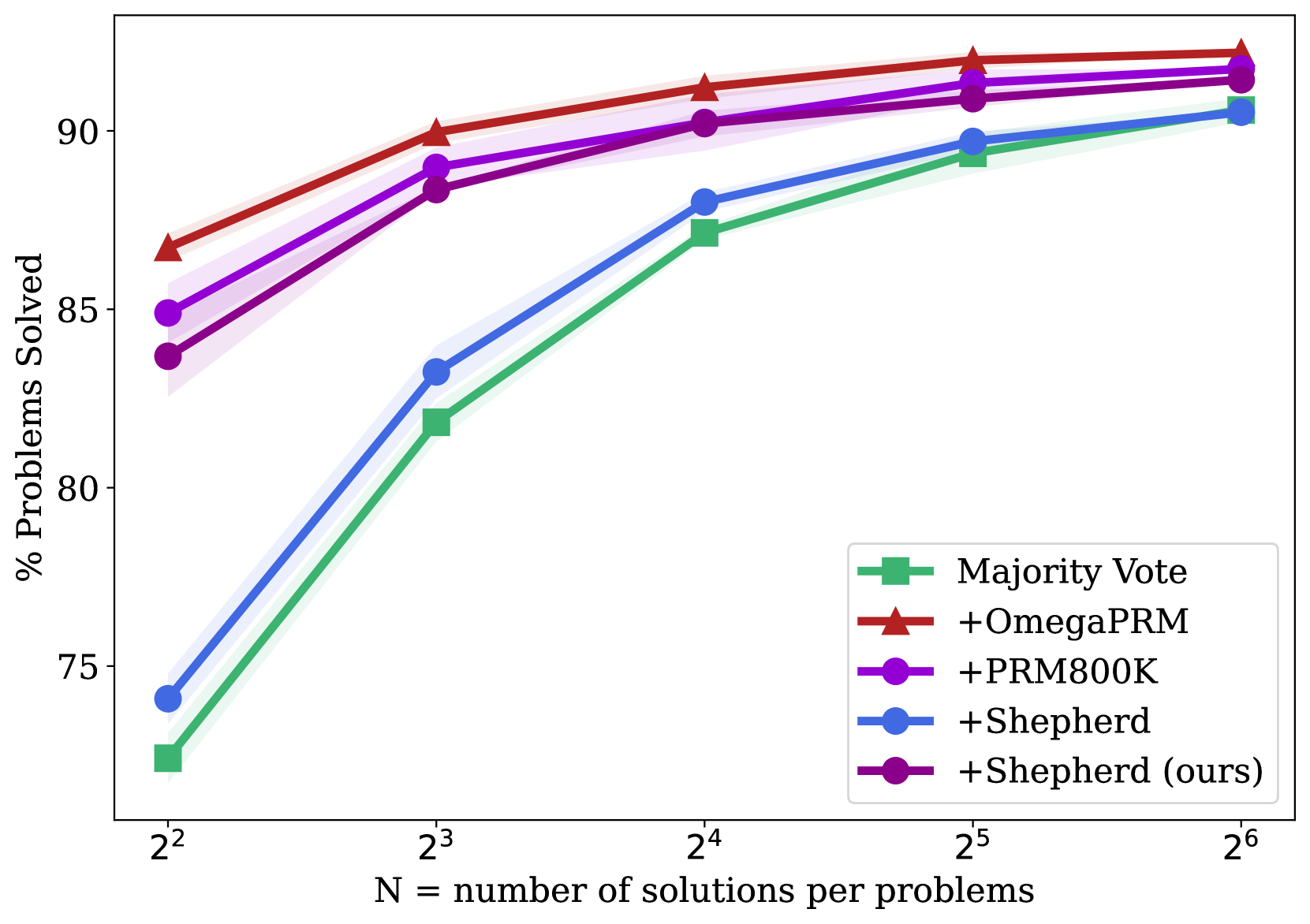
The image is a line chart comparing the performance of five different solution methods for solving problems. The chart plots the percentage of problems solved against the number of solutions per problem. The methods being compared are Majority Vote, +OmegaPRM, +PRM800K, +Shepherd, and +Shepherd (ours).
### Components/Axes
* **X-axis:** N = number of solutions per problems. The x-axis is on a log base 2 scale, with markers at 2<sup>2</sup>, 2<sup>3</sup>, 2<sup>4</sup>, 2<sup>5</sup>, and 2<sup>6</sup>. These correspond to 4, 8, 16, 32, and 64 solutions per problem.
* **Y-axis:** % Problems Solved. The y-axis ranges from 75% to 90% in increments of 5%.
* **Legend:** Located on the bottom-right of the chart, the legend identifies each line by color and label:
* Green: Majority Vote
* Red: +OmegaPRM
* Purple: +PRM800K
* Blue: +Shepherd
* Dark Purple: +Shepherd (ours)
* Each line has a shaded region around it, representing the uncertainty or variance in the data.
### Detailed Analysis
Here's a breakdown of each data series:
* **Majority Vote (Green):** The line starts at approximately 72% at 2<sup>2</sup> (4 solutions), increases to approximately 82% at 2<sup>3</sup> (8 solutions), then to approximately 87% at 2<sup>4</sup> (16 solutions), then to approximately 89% at 2<sup>5</sup> (32 solutions), and finally reaches approximately 91% at 2<sup>6</sup> (64 solutions). The trend is upward, with diminishing returns as the number of solutions increases.
* **+OmegaPRM (Red):** The line starts at approximately 87% at 2<sup>2</sup> (4 solutions), increases to approximately 90% at 2<sup>3</sup> (8 solutions), then to approximately 92% at 2<sup>4</sup> (16 solutions), then to approximately 93% at 2<sup>5</sup> (32 solutions), and finally reaches approximately 93% at 2<sup>6</sup> (64 solutions). The trend is upward, with diminishing returns as the number of solutions increases.
* **+PRM800K (Purple):** The line starts at approximately 84% at 2<sup>2</sup> (4 solutions), increases to approximately 88% at 2<sup>3</sup> (8 solutions), then to approximately 90% at 2<sup>4</sup> (16 solutions), then to approximately 92% at 2<sup>5</sup> (32 solutions), and finally reaches approximately 92% at 2<sup>6</sup> (64 solutions). The trend is upward, with diminishing returns as the number of solutions increases.
* **+Shepherd (Blue):** The line starts at approximately 74% at 2<sup>2</sup> (4 solutions), increases to approximately 83% at 2<sup>3</sup> (8 solutions), then to approximately 87% at 2<sup>4</sup> (16 solutions), then to approximately 89% at 2<sup>5</sup> (32 solutions), and finally reaches approximately 91% at 2<sup>6</sup> (64 solutions). The trend is upward, with diminishing returns as the number of solutions increases.
* **+Shepherd (ours) (Dark Purple):** The line starts at approximately 84% at 2<sup>2</sup> (4 solutions), increases to approximately 88% at 2<sup>3</sup> (8 solutions), then to approximately 90% at 2<sup>4</sup> (16 solutions), then to approximately 92% at 2<sup>5</sup> (32 solutions), and finally reaches approximately 92% at 2<sup>6</sup> (64 solutions). The trend is upward, with diminishing returns as the number of solutions increases.
### Key Observations
* +OmegaPRM consistently outperforms the other methods across all numbers of solutions.
* Majority Vote and +Shepherd have similar performance, with Majority Vote slightly outperforming +Shepherd.
* +PRM800K and +Shepherd (ours) have similar performance.
* All methods show diminishing returns as the number of solutions increases, indicating that there is a limit to the improvement gained by increasing the number of solutions.
### Interpretation
The data suggests that +OmegaPRM is the most effective method for solving the problems in this context. The performance of all methods improves as the number of solutions increases, but the rate of improvement decreases as the number of solutions gets larger. This indicates that there is a point of diminishing returns where increasing the number of solutions does not significantly improve the percentage of problems solved. The "ours" version of +Shepherd does not appear to offer a significant advantage over the original +Shepherd or +PRM800K.