## Chat Comparison: History vs. Current Conversation
### Overview
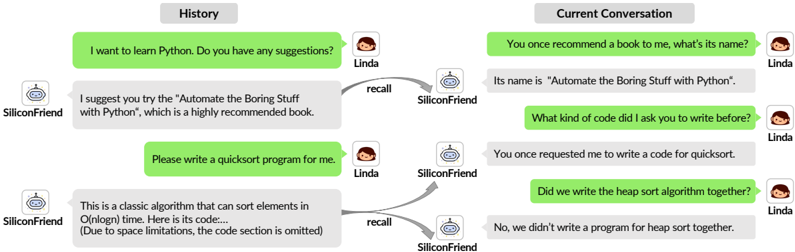
The image presents a comparison between a "History" of a conversation and a "Current Conversation," both seemingly between a user named Linda and an AI assistant named SiliconFriend. The image shows a series of chat bubbles representing questions and answers. The "History" section shows past interactions, while the "Current Conversation" section shows a more recent exchange. The AI demonstrates recall capabilities, referencing past interactions.
### Components/Axes
* **Titles:** "History" (top-left), "Current Conversation" (top-right)
* **Speakers:** Linda (represented by a female avatar) and SiliconFriend (represented by a robot avatar).
* **Chat Bubbles:** Green bubbles indicate messages from Linda, and gray bubbles indicate messages from SiliconFriend.
* **Recall Arrows:** Curved gray arrows labeled "recall" indicate the AI's ability to remember and reference past conversations.
### Detailed Analysis or ### Content Details
**History:**
* **Linda:** "I want to learn Python. Do you have any suggestions?"
* **SiliconFriend:** "I suggest you try the 'Automate the Boring Stuff with Python', which is a highly recommended book."
* *Recall Arrow:* Points from this message to a similar message in the "Current Conversation."
* **Linda:** "Please write a quicksort program for me."
* **SiliconFriend:** "This is a classic algorithm that can sort elements in O(nlogn) time. Here is its code:.... (Due to space limitations, the code section is omitted)"
* *Recall Arrow:* Points from this message to a similar message in the "Current Conversation."
**Current Conversation:**
* **Linda:** "You once recommend a book to me, what's its name?"
* **SiliconFriend:** "Its name is 'Automate the Boring Stuff with Python'."
* **Linda:** "What kind of code did I ask you to write before?"
* **SiliconFriend:** "You once requested me to write a code for quicksort."
* **Linda:** "Did we write the heap sort algorithm together?"
* **SiliconFriend:** "No, we didn't write a program for heap sort together."
### Key Observations
* The AI, SiliconFriend, demonstrates the ability to recall past conversations and provide relevant information.
* The "History" section provides context for the "Current Conversation."
* The AI seems to be able to remember specific requests and details from past interactions.
* The AI is able to answer questions about past interactions.
### Interpretation
The image illustrates the functionality of an AI assistant that can maintain a memory of past conversations. This allows for more natural and context-aware interactions. The "recall" feature is a key component of this functionality, enabling the AI to provide relevant information and respond to user queries based on previous exchanges. The example shows the AI remembering a book recommendation and a request for a quicksort program. The AI also demonstrates the ability to distinguish between past requests (quicksort) and things that did not happen (heap sort). This suggests a system that can not only remember past interactions but also process and understand the context of those interactions.