## Diagram: Conversation Flow with Memory Recall
### Overview
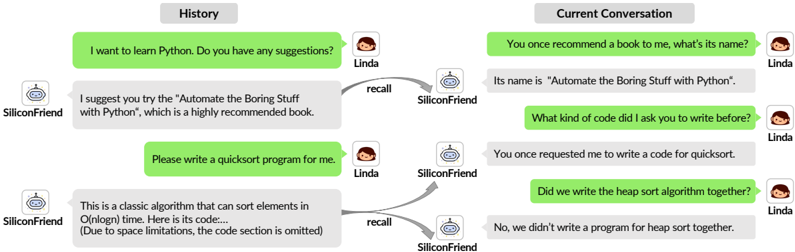
The image is a technical diagram illustrating a conversational AI's memory recall function. It displays two parallel conversation threads: a past "History" and a "Current Conversation," connected by "recall" arrows that show how the AI retrieves specific past information to answer current questions. The diagram uses a chat interface metaphor with two participants: a user named "Linda" (represented by a female avatar and green chat bubbles) and an AI assistant named "SiliconFriend" (represented by a robot avatar and gray chat bubbles).
### Components/Axes
* **Primary Sections:** The diagram is split into two main vertical sections.
* **Left Section:** Labeled "History" at the top. Contains three past exchanges.
* **Right Section:** Labeled "Current Conversation" at the top. Contains three current exchanges.
* **Participants:**
* **Linda:** User. Avatar is a cartoon of a woman with brown hair. Chat bubbles are green.
* **SiliconFriend:** AI Assistant. Avatar is a simple robot icon. Chat bubbles are gray.
* **Flow Indicators:** Two curved, gray arrows labeled "recall" connect specific bubbles from the "History" section to corresponding bubbles in the "Current Conversation" section, indicating the retrieval of past context.
### Detailed Analysis
**History Section (Left Column, Top to Bottom):**
1. **Linda (Green Bubble):** "I want to learn Python. Do you have any suggestions?"
2. **SiliconFriend (Gray Bubble):** "I suggest you try the 'Automate the Boring Stuff with Python', which is a highly recommended book."
3. **Linda (Green Bubble):** "Please write a quicksort program for me."
4. **SiliconFriend (Gray Bubble):** "This is a classic algorithm that can sort elements in O(nlogn) time. Here is its code: (Due to space limitations, the code section is omitted)"
**Current Conversation Section (Right Column, Top to Bottom):**
1. **Linda (Green Bubble):** "You once recommend a book to me, what's its name?"
* *Connected by a "recall" arrow from SiliconFriend's book recommendation in History.*
2. **SiliconFriend (Gray Bubble):** "Its name is 'Automate the Boring Stuff with Python'."
3. **Linda (Green Bubble):** "What kind of code did I ask you to write before?"
* *Connected by a "recall" arrow from SiliconFriend's quicksort response in History.*
4. **SiliconFriend (Gray Bubble):** "You once requested me to write a code for quicksort."
5. **Linda (Green Bubble):** "Did we write the heap sort algorithm together?"
6. **SiliconFriend (Gray Bubble):** "No, we didn't write a program for heap sort together."
### Key Observations
* **Memory Recall Function:** The core function demonstrated is the AI's ability to accurately retrieve specific, discrete facts from a past conversation (book title, requested algorithm) when prompted with a vague, current query.
* **Contextual Denial:** The AI correctly identifies that a specific past interaction (writing heap sort code) did *not* occur, showing it can verify the absence of information in its memory.
* **Information Omission:** The "History" explicitly notes that code was omitted due to space limitations, indicating this is a simplified representation of a potentially more detailed log.
* **Visual Coding:** Consistent color (green/gray) and avatar use clearly distinguishes between the user and the AI across both timeframes.
### Interpretation
This diagram serves as a functional specification or explanatory graphic for a conversational AI's memory architecture. It visually argues that the system maintains a retrievable history of interactions, enabling coherent, context-aware dialogue over time.
The "recall" arrows are the most critical element, representing the underlying mechanism that links a current question ("what's its name?") to a specific past data point (the book title mentioned earlier). This moves beyond simple chat logging to active memory retrieval.
The final exchange is particularly insightful. It demonstrates that the AI's memory is not just for affirming past events but also for validating their non-occurrence. This is crucial for maintaining factual accuracy and preventing the AI from hallucinating or confirming false user assumptions. The diagram implies a system designed for reliability and truthfulness in long-term interaction.
**Language Note:** All text in the image is in English.