## Diagram: Comparison of Traditional Distributed Method vs. EDIT Method
### Overview
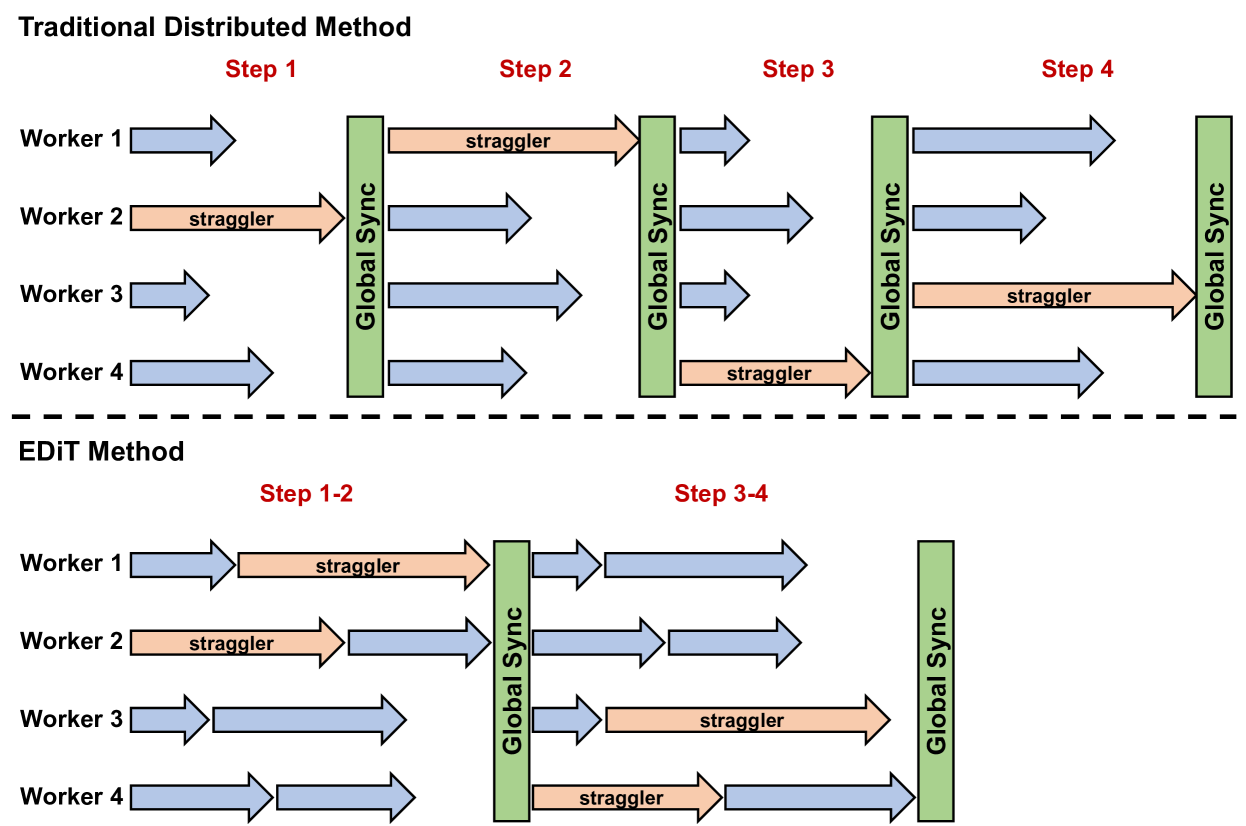
The image compares two distributed computing methods: the **Traditional Distributed Method** (top) and the **EDIT Method** (bottom). Both diagrams illustrate data flow between workers and global synchronization points ("Global Sync"), with "straggler" nodes causing delays. Arrows represent data transmission, with color coding (blue for normal flow, orange for stragglers).
### Components/Axes
- **Methods**:
- **Traditional Distributed Method**: Four sequential steps (Step 1–4).
- **EDIT Method**: Two grouped steps (Step 1-2 and Step 3-4).
- **Workers**: Labeled Worker 1–4 in both methods.
- **Global Sync**: Green rectangles representing synchronization points.
- **Stragglers**: Orange-labeled arrows indicating delayed or stalled data transmission.
- **Arrows**:
- Blue: Normal data flow.
- Orange: Straggler-induced delays.
### Detailed Analysis
#### Traditional Distributed Method
- **Step 1**: Workers 1–4 send data to Global Sync. Worker 2 is a straggler (orange arrow).
- **Step 2**: Global Sync redistributes data to Workers 1–4. Worker 4 is a straggler.
- **Step 3**: Global Sync redistributes data again. Worker 3 is a straggler.
- **Step 4**: Final Global Sync. Worker 2 is a straggler.
- **Pattern**: Frequent Global Sync steps (4 total) with stragglers in every step.
#### EDIT Method
- **Step 1-2**:
- Workers 1–4 send data to Global Sync. Worker 1 and 2 are stragglers.
- Global Sync redistributes data. Worker 3 is a straggler.
- **Step 3-4**:
- Global Sync redistributes data. Worker 2 and 4 are stragglers.
- Final Global Sync. Worker 3 is a straggler.
- **Pattern**: Fewer Global Sync steps (2 total) but stragglers persist across steps.
### Key Observations
1. **Global Sync Frequency**:
- Traditional: 4 Global Sync steps (one per step).
- EDIT: 2 Global Sync steps (grouped steps).
2. **Straggler Distribution**:
- Both methods have stragglers in every step, but EDIT reduces synchronization overhead.
3. **Flow Efficiency**:
- EDIT’s grouped steps may reduce latency by minimizing synchronization points.
### Interpretation
The diagram highlights a trade-off between synchronization frequency and straggler management. The **EDIT Method** optimizes efficiency by reducing Global Sync steps, which could lower system latency and resource contention. However, stragglers remain a persistent issue in both methods, suggesting that fault tolerance mechanisms (e.g., redundancy, timeout thresholds) are critical for distributed systems. The color-coded stragglers emphasize the need for adaptive strategies to handle delays without over-reliance on frequent synchronization.