## Diagram: Nested Model of the Self
### Overview
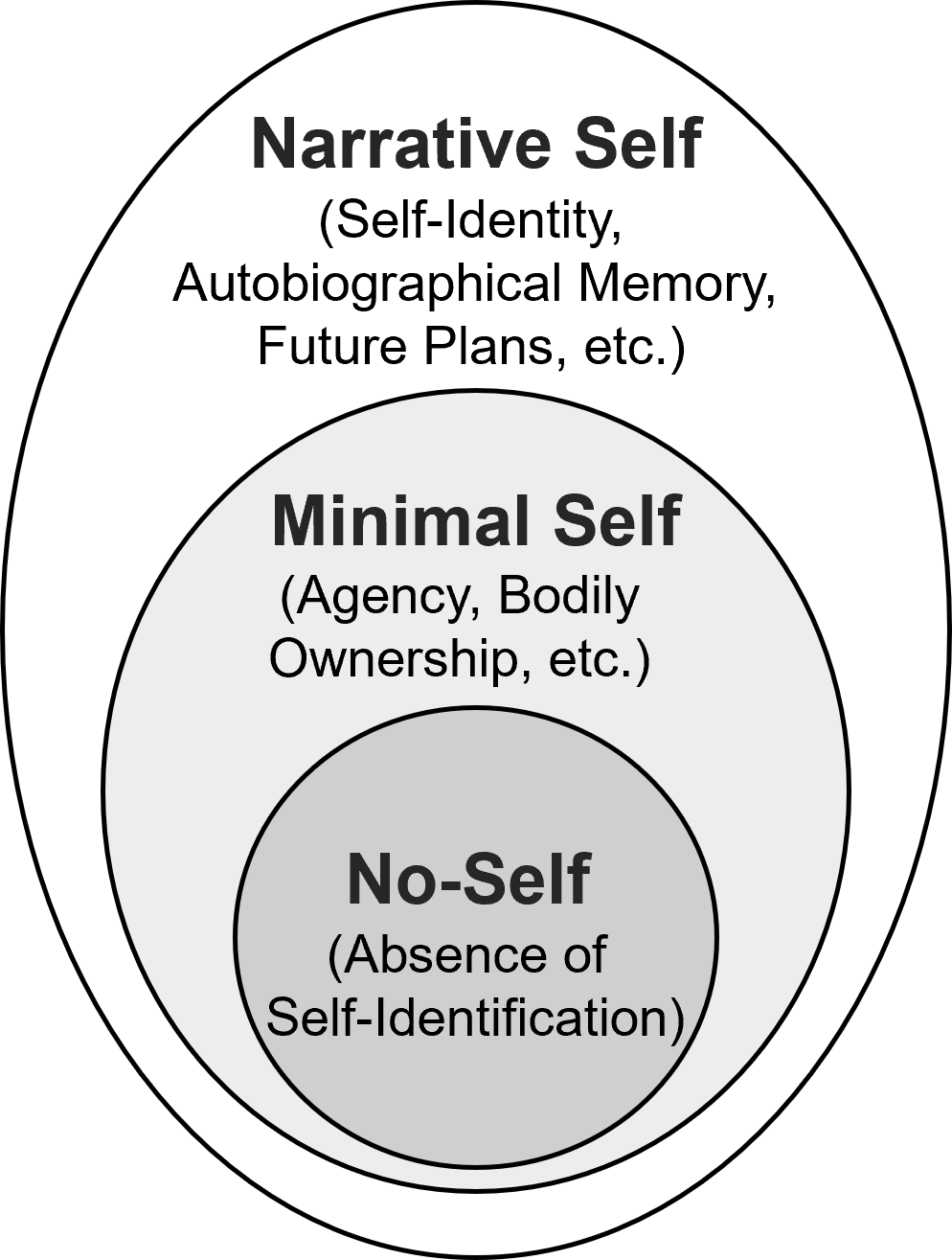
The image is a conceptual diagram illustrating a hierarchical, nested model of the self. It consists of three concentric circles, each representing a distinct layer or aspect of selfhood, with the innermost circle being the most fundamental and the outermost being the most complex.
### Components
The diagram is composed of three primary components, each a circle containing text:
1. **Outermost Circle (Largest):**
* **Label:** `Narrative Self`
* **Description (in parentheses):** `(Self-Identity, Autobiographical Memory, Future Plans, etc.)`
* **Positioning:** This circle forms the outer boundary of the entire diagram. It is white with a black outline.
2. **Middle Circle:**
* **Label:** `Minimal Self`
* **Description (in parentheses):** `(Agency, Bodily Ownership, etc.)`
* **Positioning:** This circle is nested entirely within the "Narrative Self" circle. It is filled with a light gray color and has a black outline.
3. **Innermost Circle (Smallest):**
* **Label:** `No-Self`
* **Description (in parentheses):** `(Absence of Self-Identification)`
* **Positioning:** This circle is nested entirely within the "Minimal Self" circle, at the center of the diagram. It is filled with a darker gray color and has a black outline.
### Detailed Analysis
The diagram presents a clear hierarchical relationship through spatial nesting:
* The **"No-Self"** is the core, representing a foundational state characterized by the absence of self-identification.
* The **"Minimal Self"** encompasses the "No-Self." It builds upon that foundation to include basic, pre-reflective experiences of agency (the sense of being the author of one's actions) and bodily ownership (the sense that one's body belongs to oneself).
* The **"Narrative Self"** is the outermost layer, encompassing both the "Minimal Self" and the "No-Self." It represents the extended, story-based concept of identity, constructed from autobiographical memories, ongoing self-concept, and future-oriented plans.
### Key Observations
* **Visual Hierarchy:** The nesting of circles is the primary visual cue, explicitly showing that each outer layer contains and depends upon the inner layers.
* **Progression of Complexity:** The model moves from a state of non-identification ("No-Self") to basic experiential selfhood ("Minimal Self") to a complex, temporally extended identity ("Narrative Self").
* **Color Gradient:** The fill color darkens from white (Narrative) to light gray (Minimal) to darker gray (No-Self), which may visually emphasize the "No-Self" as the dense, foundational core.
### Interpretation
This diagram visually argues for a layered or stratified model of human self-consciousness. It suggests that our rich, autobiographical sense of identity (the Narrative Self) is not a fundamental given but is constructed upon more basic layers of experience.
* **Relationship Between Layers:** The containment implies that the "Narrative Self" cannot exist without the "Minimal Self," which in turn is built upon the substrate of "No-Self." One must have a sense of agency and body ownership to then construct a personal story.
* **Philosophical/Psychological Context:** The model aligns with theories in philosophy of mind and cognitive science that distinguish between the "ecological self" (Minimal) and the "conceptual self" (Narrative). The "No-Self" concept resonates with certain contemplative or phenomenological traditions that investigate the absence of a fixed, enduring ego.
* **Notable Implication:** By placing "No-Self" at the center, the diagram provocatively suggests that the most fundamental state might be one *without* self-identification, challenging the common intuition that a solid sense of self is our default, primary condition. The outer layers are presented as developments or constructions upon this core.