## Venn Diagram: Hierarchical Model of Self-Concept
### Overview
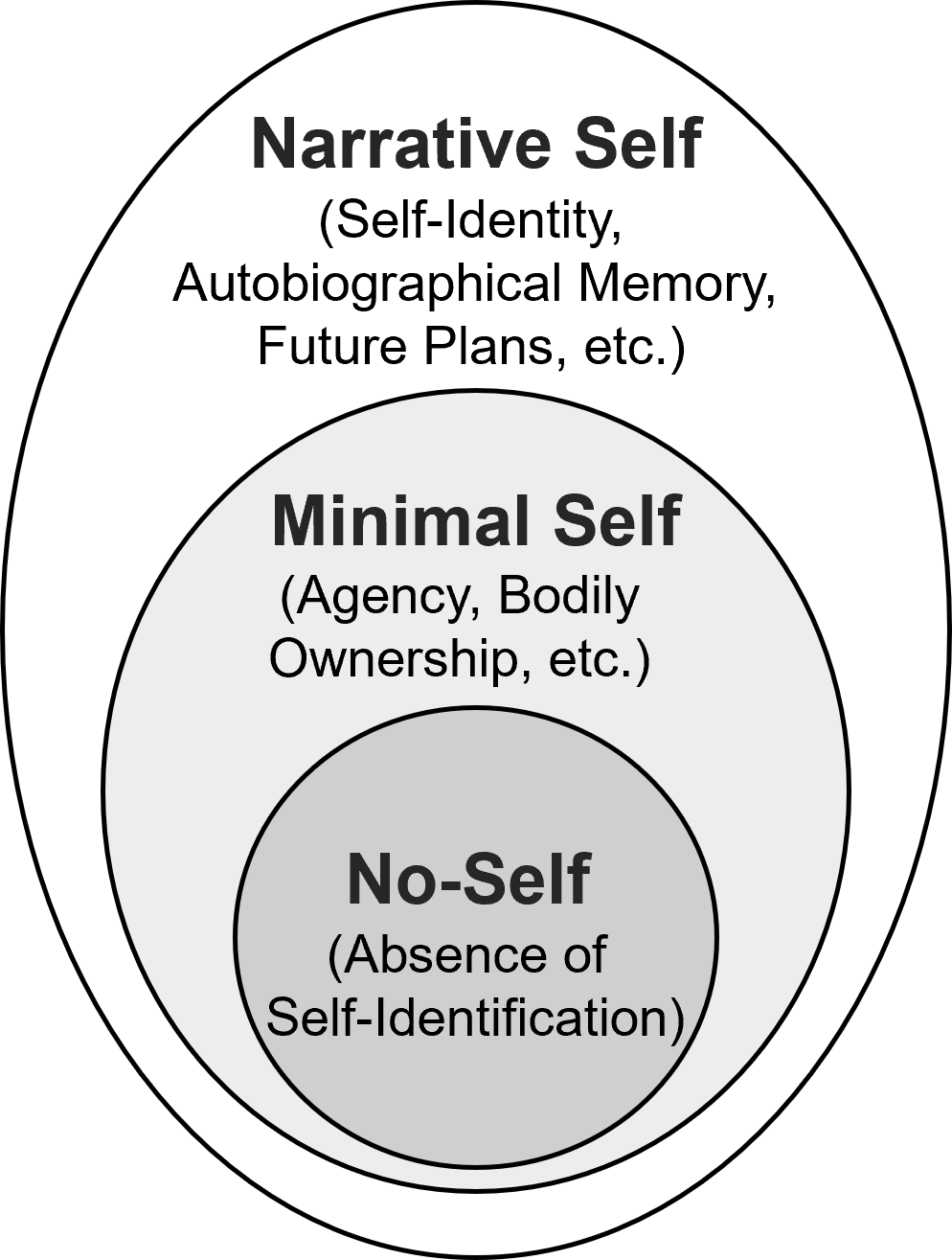
The image depicts a three-tiered concentric circle diagram illustrating a hierarchical model of self-concept. The outermost circle represents the "Narrative Self," the middle circle represents the "Minimal Self," and the innermost circle represents the "No-Self" state. Each tier contains descriptive terms in parentheses, suggesting a progression from complex self-identification to its absence.
### Components/Axes
- **Outermost Circle**:
- Label: **Narrative Self**
- Subpoints:
- Self-Identity
- Autobiographical Memory
- Future Plans
- (etc.)
- **Middle Circle**:
- Label: **Minimal Self**
- Subpoints:
- Agency
- Bodily Ownership
- (etc.)
- **Innermost Circle**:
- Label: **No-Self**
- Subpoints:
- Absence of Self-Identification
### Detailed Analysis
- **Narrative Self**:
- Contains the most abstract and expansive self-concept elements.
- Terms like "Autobiographical Memory" and "Future Plans" imply a constructed, story-driven identity.
- The "(etc.)" suggests additional, unspecified components of this tier.
- **Minimal Self**:
- Represents a reduced, functional self-concept.
- Focuses on basic agency (e.g., decision-making) and bodily ownership (e.g., physical embodiment).
- The "(etc.)" indicates potential overlap or additional minimal components.
- **No-Self**:
- Defined strictly as the "Absence of Self-Identification."
- Positioned as the core of the model, suggesting it underpins or contrasts with the other tiers.
### Key Observations
1. **Hierarchical Structure**: The model implies a nested relationship, where the Narrative Self encompasses the Minimal Self, which in turn encompasses the No-Self.
2. **Terminology**:
- "Narrative Self" emphasizes storytelling and future-oriented identity.
- "Minimal Self" focuses on functional, embodied existence.
- "No-Self" denotes a state of non-identification, potentially aligning with philosophical or meditative concepts.
3. **Ambiguity**: The use of "(etc.)" in the first two tiers introduces uncertainty about the full scope of each category.
### Interpretation
This diagram likely represents a psychological or philosophical framework for understanding self-awareness. The **Narrative Self** aligns with theories of autobiographical memory and identity construction (e.g., Dan McAdams' life narrative theory). The **Minimal Self** resonates with embodied cognition models, where agency and bodily ownership are foundational to consciousness. The **No-Self** concept may reference Buddhist *Anatta* (non-self) or psychological states like depersonalization, where self-identification dissolves.
The hierarchical arrangement suggests that complex self-narratives (Narrative Self) depend on basic embodied agency (Minimal Self), which ultimately rests on the absence of fixed self-identification (No-Self). This could imply that even advanced self-concepts are transient or context-dependent, dissolving into a more fundamental, non-identifying state.
The model invites further exploration of how these tiers interact—e.g., whether the No-Self state enables or constrains the Minimal and Narrative Selves, or how disruptions to the Narrative Self (e.g., trauma) might collapse the hierarchy toward the Minimal or No-Self states.