## Screenshot: ChatGPT Joke Exchange
### Overview
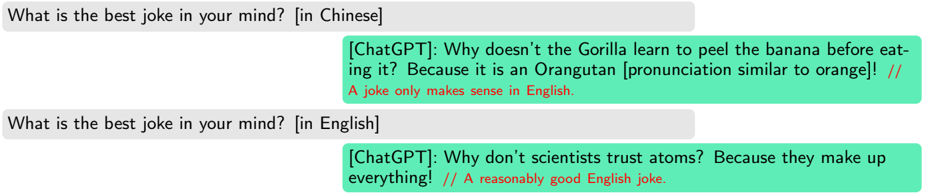
The image captures a text-based conversation between a user and ChatGPT, where the user asks for "the best joke" in two languages (Chinese and English). ChatGPT responds with jokes tailored to each language, including meta-commentary on their linguistic context.
### Components/Axes
- **User Queries**:
1. "What is the best joke in your mind? [in Chinese]"
2. "What is the best joke in your mind? [in English]"
- **ChatGPT Responses**:
1. Joke: "Why doesn't the Gorilla learn to peel the banana before eating it? Because it is an Orangutan [pronunciation similar to orange]! // A joke only makes sense in English."
2. Joke: "Why don't scientists trust atoms? Because they make up everything! // A reasonably good English joke."
### Content Details
- **Language Tags**:
- Chinese query: Explicitly labeled with `[in Chinese]`.
- English query: Explicitly labeled with `[in English]`.
- **Joke Annotations**:
- Red text in ChatGPT's first response: "A joke only makes sense in English."
- Red text in ChatGPT's second response: "A reasonably good English joke."
### Key Observations
1. **Language-Specific Humor**:
- The first joke relies on a phonetic similarity between "Orangutan" and "orange," which is clarified in brackets.
- The second joke uses a pun ("make up" = compose vs. fabricate), which is culturally/linguistically tied to English.
2. **Meta-Commentary**:
- ChatGPT explicitly notes the language dependency of the jokes, highlighting the role of linguistic context in humor.
### Interpretation
The exchange demonstrates how humor is often culturally and linguistically anchored. The first joke's reliance on pronunciation (Orangutan/orange) and the second's wordplay ("make up") both require familiarity with English nuances. ChatGPT's annotations ("A joke only makes sense in English") underscore the importance of language in joke comprehension, suggesting that translation or localization may be necessary for cross-cultural humor. The responses also reveal ChatGPT's ability to adapt to user-specified languages while maintaining self-awareness about the jokes' limitations in other contexts.
[Note: No numerical data, charts, or diagrams are present in the image. All information is textual.]