## Chatbot Interaction: Joke Generation
### Overview
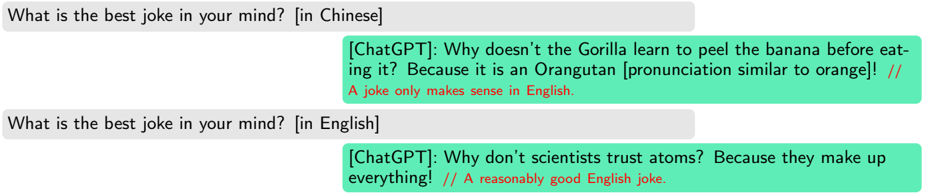
The image shows a chatbot interface where the user asks for the best joke in their mind, once in Chinese and once in English. The chatbot, identified as ChatGPT, provides a joke in response to each prompt. The jokes are followed by a comment on their suitability for the specified language.
### Components/Axes
* **User Prompts:**
* "What is the best joke in your mind? [in Chinese]"
* "What is the best joke in your mind? [in English]"
* **Chatbot Responses (ChatGPT):**
* Joke 1: "Why doesn't the Gorilla learn to peel the banana before eating it? Because it is an Orangutan [pronunciation similar to orange]! //"
* Commentary 1: "A joke only makes sense in English."
* Joke 2: "Why don't scientists trust atoms? Because they make up everything! //"
* Commentary 2: "A reasonably good English joke."
### Detailed Analysis or ### Content Details
The image presents a conversation between a user and a chatbot. The user poses the same question twice, specifying different languages (Chinese and English). The chatbot provides different jokes in response to each prompt.
* **First Exchange (Chinese Prompt):**
* User asks for a joke in Chinese.
* ChatGPT responds with a joke that relies on the English pronunciation of "Orangutan" sounding similar to "orange."
* The chatbot acknowledges that the joke only works in English.
* **Second Exchange (English Prompt):**
* User asks for a joke in English.
* ChatGPT responds with a pun about atoms making up everything.
* The chatbot rates the joke as "A reasonably good English joke."
### Key Observations
* The chatbot seems to understand the language context of the prompts.
* The chatbot is capable of generating jokes.
* The chatbot can self-assess the suitability of a joke for a given language.
* The first joke is language-dependent and relies on a pun in English.
### Interpretation
The image demonstrates the ability of a chatbot (ChatGPT) to generate jokes based on language context. The first exchange highlights a potential limitation: the chatbot may generate jokes that are not directly translatable or relevant to the specified language, but it is aware of this limitation. The second exchange shows a more successful attempt at generating an English joke. The chatbot's self-assessment of the jokes adds another layer of complexity, suggesting an understanding of humor and language nuances.