\n
## Screenshot: Chatbot Conversation
### Overview
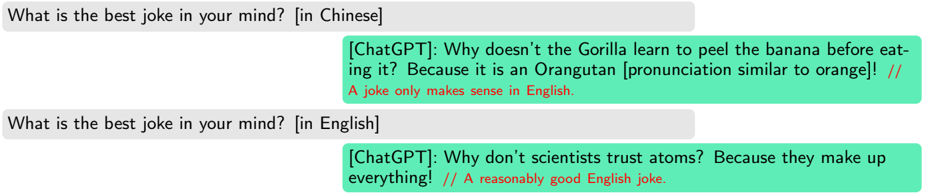
This image is a screenshot of a chatbot conversation, likely with a large language model (LLM) such as ChatGPT. It shows two separate prompts and responses. The first prompt is in Chinese, and the second is in English. The responses are provided by "[ChatGPT]".
### Components/Axes
The screenshot consists of two distinct conversational blocks, stacked vertically. Each block contains:
* A user prompt in a light gray bubble.
* A chatbot response in a light green bubble.
* Comments appended to the chatbot response, indicated by "//".
### Detailed Analysis or Content Details
**Block 1:**
* **Prompt:** "What is the best joke in your mind? [in Chinese]"
* **Response:** "[ChatGPT]: Why doesn't the Gorilla learn to peel the banana before eating it? Because it is an Orangutan [pronunciation similar to orange!] // A joke only makes sense in English."
* The joke relies on a pun between "Orangutan" and "orange".
* The comment indicates the joke is not translatable and only works in English.
**Block 2:**
* **Prompt:** "What is the best joke in your mind? [in English]"
* **Response:** "[ChatGPT]: Why don't scientists trust atoms? Because they make up everything! // A reasonably good English joke."
* This is a pun based on the double meaning of "make up" (to invent/fabricate vs. to constitute).
* The comment acknowledges the joke's quality.
**Chinese Text (Block 1):**
* "[ChatGPT]: 为什么大猩猩不学剥香蕉再吃?因为它是猩猩 [发音类似于橙色!] // 这个笑话只有在英语中才有意义。"
* **English Translation:** "[ChatGPT]: Why doesn't the Gorilla learn to peel the banana before eating it? Because it is an Orangutan [pronunciation similar to orange!] // This joke only makes sense in English."
### Key Observations
* The chatbot is capable of responding in multiple languages, but the quality of the jokes and their translatability vary.
* The chatbot explicitly acknowledges the language dependency of the first joke.
* The chatbot provides commentary on the quality of its own jokes.
* Both jokes are puns.
### Interpretation
The screenshot demonstrates the chatbot's ability to understand and respond to prompts in different languages. It also highlights the challenges of humor translation, as the first joke relies on a linguistic connection that doesn't exist in Chinese. The chatbot's self-assessment of its jokes suggests a level of meta-awareness, or at least the ability to generate commentary that mimics such awareness. The interaction reveals the chatbot's reliance on wordplay and its understanding of the concept of a pun. The responses suggest the chatbot is programmed to provide context and commentary alongside its answers, enhancing the user experience.