## Screenshot: Text Annotation Software Interface
### Overview
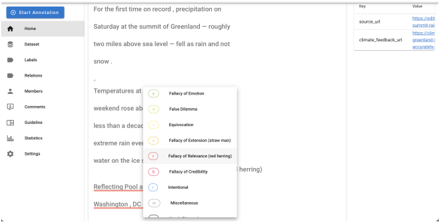
The image is a screenshot of a software application, likely a text annotation or analysis tool. The interface displays a document about weather data on Mount Washington, with an active dropdown menu for selecting logical fallacies or annotation labels. The layout consists of a left sidebar for navigation, a central document viewing area, and a right panel showing data links.
### Components/Axes
**Left Sidebar (Navigation Panel):**
- **Header:** "Start Annotation" button (blue, top-left).
- **Menu Items (listed vertically):**
- Home
- Dataset
- Labels
- Relations
- Members
- Comments
- Guidelines
- Statistics
- Settings
**Main Content Area (Document View):**
- **Text Content:** A document discussing weather observations.
- **Active UI Element:** A dropdown menu (centered, overlaying the text) with a list of selectable options, each preceded by a radio button circle.
- **Highlighted Text:** The phrase "Reflecting Pool" is highlighted in blue. The phrase "Washington, DC" has a red underline.
**Right Panel (Data Links):**
- Contains two labeled hyperlinks:
- `event_url`
- `climate_feedback_url`
### Detailed Analysis / Content Details
**1. Document Text Transcription:**
The visible text in the main panel reads:
> "For the first time on record, precipitation on
> Saturday at the summit of Mount Washington—roughly
> two miles above sea level—fell as rain and not
> snow...
>
> Temperatures at the summit of Mount Washington rose above freezing over the weekend and remained there for more than a day, less than a decade after the mountain saw what scientists called an extreme rain event that dumped 2.7 inches of water on the ice and snow...
>
> Reflecting Pool
> Washington, DC"
**2. Dropdown Menu Options (Transcribed in order from top to bottom):**
- Fallacy of Emotion
- False Dilemma
- Exaggeration
- Fallacy of Extension (other stuff)
- Fallacy of Relevance (red herring)
- Fallacy of Credibility
- Intentional
- Miscellaneous
**3. Right Panel Links:**
- `event_url` (appears as a blue hyperlink)
- `climate_feedback_url` (appears as a blue hyperlink)
### Key Observations
- **Interface State:** The software is in an active annotation mode, with a dropdown menu open for the user to select a label or fallacy type to apply to a segment of text.
- **Text Focus:** The document discusses a specific, notable weather event: rain occurring at the summit of Mount Washington in winter, which is historically unusual. It references data points like an elevation of "roughly two miles above sea level" and a past event with "2.7 inches of water."
- **UI Elements:** The highlighted "Reflecting Pool" and underlined "Washington, DC" suggest these are either entities that have been tagged or are the current focus for annotation. The dropdown menu's options are all related to logical fallacies or argument analysis, indicating the tool's purpose may be for fact-checking, debate preparation, or critical analysis of written content.
### Interpretation
This screenshot captures a moment in a technical workflow where a user is analyzing a text about climate or weather events. The software appears designed for structured annotation, allowing users to tag specific claims or passages with categorical labels (like logical fallacies). The presence of `event_url` and `climate_feedback_url` links strongly suggests the tool is integrated with a fact-checking or scientific verification system, where the text being analyzed is linked to source data or expert reviews.
The content itself highlights an anomalous weather event (rain on a famously cold mountain summit), which is the type of claim that would warrant verification. The user is likely in the process of evaluating the argumentative structure or credibility of the text, hence the fallacy menu. The interface facilitates a deep, structured reading of the document, moving beyond simple comprehension to critical assessment. The tool bridges raw data (the weather event) with analytical frameworks (logical fallacies), supporting tasks like media analysis, scientific communication review, or educational exercises in critical thinking.