# Technical DocumentExtraction: Bar Chart Analysis
## Chart Type
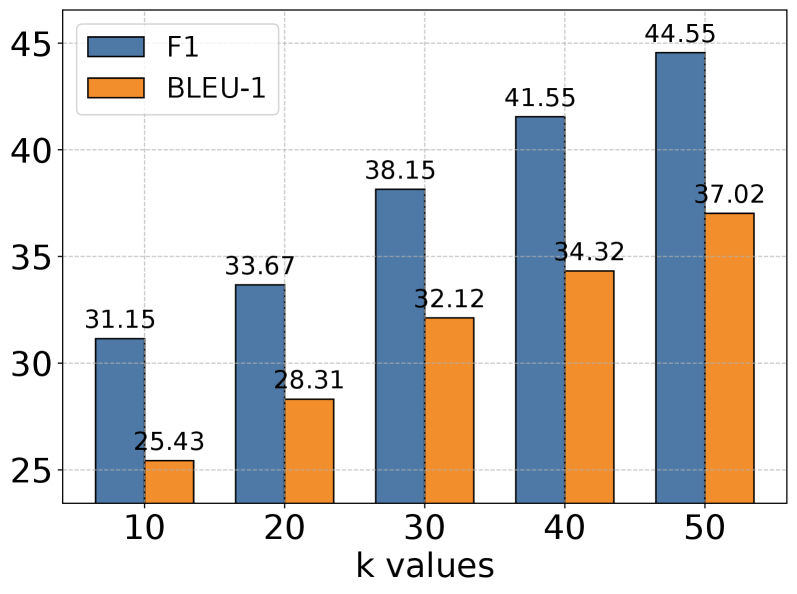
Bar chart comparing two metrics (F1 and BLEU-1) across discrete k values.
## Labels and Axis Titles
- **X-axis**: "k values" (discrete categories: 10, 20, 30, 40, 50)
- **Y-axis**: Numerical scale (25 to 45, increments of 5)
- **Legend**: Located in the top-left corner, with:
- **Blue**: Represents "F1"
- **Orange**: Represents "BLEU-1"
## Data Points
| k value | F1 (Blue) | BLEU-1 (Orange) |
|---------|-----------|-----------------|
| 10 | 31.15 | 25.43 |
| 20 | 33.67 | 28.31 |
| 30 | 38.15 | 32.12 |
| 40 | 41.55 | 34.32 |
| 50 | 44.55 | 37.02 |
## Trends
1. **F1 (Blue)**:
- **Trend**: Steadily increases with higher k values.
- **Values**: 31.15 (k=10) → 44.55 (k=50).
- **Observation**: Consistent upward trajectory, with the largest jump between k=40 and k=50 (+3.00).
2. **BLEU-1 (Orange)**:
- **Trend**: Gradual increase with higher k values.
- **Values**: 25.43 (k=10) → 37.02 (k=50).
- **Observation**: Slower growth compared to F1, with the largest jump between k=30 and k=40 (+2.20).
## Spatial Grounding
- **Legend**: Top-left corner (coordinates: [x=0, y=0] relative to chart boundaries).
- **Bar Placement**:
- Blue bars (F1) are consistently taller than orange bars (BLEU-1) at all k values.
- Values are labeled directly above each bar for clarity.
## Component Isolation
1. **Header**: No explicit title present.
2. **Main Chart**:
- Two grouped bars per k value (blue/orange).
- Y-axis gridlines at 25, 30, 35, 40, 45.
3. **Footer**: No additional annotations or text.
## Verification
- **Legend Accuracy**: Blue/orange colors match F1/BLEU-1 labels.
- **Data Consistency**: All numerical values align with bar heights.
- **Trend Logic**: Both metrics increase with k, but F1 maintains a higher magnitude.
## Conclusion
The chart demonstrates a positive correlation between k values and both F1/BLEU-1 metrics. F1 outperforms BLEU-1 across all k values, with a steeper growth rate.