## Physics Diagram: Lever Torque Balance Problem
### Overview
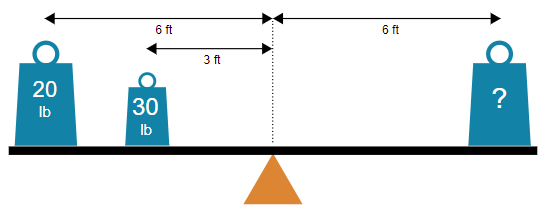
The image displays a static physics diagram representing a lever system balanced on a central fulcrum. The diagram illustrates a classic torque problem where two known weights on the left side of the fulcrum must be balanced by a single unknown weight on the right side.
### Components/Axes
* **Fulcrum:** An orange triangle located at the center, serving as the pivot point for the lever.
* **Lever:** A horizontal black bar resting on the fulcrum.
* **Left Side Weights:**
* **Weight 1:** A blue trapezoidal weight labeled "20 lb". It is positioned at a distance of 6 ft from the fulcrum.
* **Weight 2:** A blue trapezoidal weight labeled "30 lb". It is positioned at a distance of 3 ft from the fulcrum.
* **Right Side Weight:**
* **Weight 3:** A blue trapezoidal weight labeled with a question mark "?". It is positioned at a distance of 6 ft from the fulcrum.
* **Dimension Lines:**
* **Top-left:** A double-headed arrow spanning from the 20 lb weight to the vertical dotted line above the fulcrum, labeled "6 ft".
* **Top-middle-left:** A double-headed arrow spanning from the 30 lb weight to the vertical dotted line above the fulcrum, labeled "3 ft".
* **Top-right:** A double-headed arrow spanning from the vertical dotted line above the fulcrum to the unknown weight, labeled "6 ft".
### Detailed Analysis
To determine the value of the unknown weight, we must calculate the torque (moment) on both sides of the fulcrum. The system is assumed to be in static equilibrium (balanced).
**1. Left Side Torque Calculation:**
* **Torque 1 (20 lb weight):** Force × Distance = 20 lb × 6 ft = **120 lb-ft**
* **Torque 2 (30 lb weight):** Force × Distance = 30 lb × 3 ft = **90 lb-ft**
* **Total Left Torque:** 120 lb-ft + 90 lb-ft = **210 lb-ft**
**2. Right Side Torque Calculation:**
* **Torque 3 (Unknown weight):** Force × Distance = ? lb × 6 ft = **6? lb-ft**
**3. Solving for the Unknown:**
* Since the lever is balanced, Left Torque = Right Torque.
* 210 lb-ft = 6? lb-ft
* ? = 210 / 6
* **? = 35 lb**
### Key Observations
* **Symmetry:** The distance of the outermost weight on the left (6 ft) matches the distance of the unknown weight on the right (6 ft).
* **Weight Distribution:** The left side contains two weights, while the right side contains only one.
* **Torque Contribution:** The 20 lb weight contributes more to the total torque on the left side (120 lb-ft) than the 30 lb weight (90 lb-ft), despite the 30 lb weight being heavier, because the 20 lb weight is placed further from the fulcrum.
### Interpretation
This diagram demonstrates the principle of moments (torque). It illustrates that the rotational force exerted on a lever is the product of the force applied and the perpendicular distance from the pivot point.
The data demonstrates that to balance the combined torque of 210 lb-ft generated by the two weights on the left, the single weight on the right must exert an equal amount of torque. Because the unknown weight is placed at a distance of 6 ft, it must weigh 35 lb to achieve equilibrium. This highlights how distance from the fulcrum acts as a multiplier for force; a lighter weight further away can balance a heavier weight closer to the pivot.