## Diagram: Comparison of Decoding Methods in Language Models
### Overview
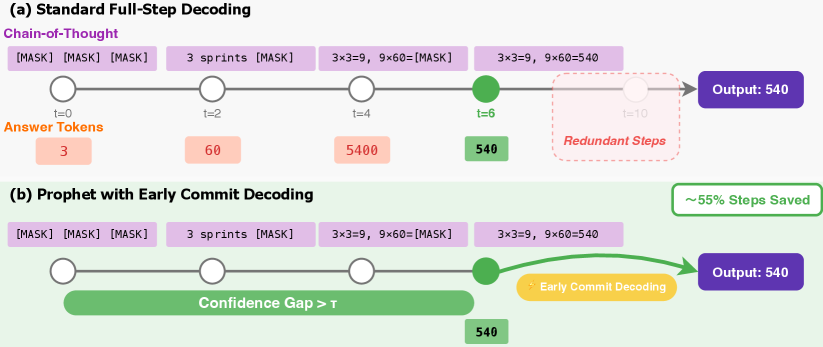
The image compares two decoding strategies in language models:
1. **(a) Standard Full-Step Decoding**: A sequential process with explicit intermediate steps.
2. **(b) Prophet with Early Commit Decoding**: A streamlined approach with confidence-based early termination.
Both methods solve the arithmetic problem "3×3=9, 9×60=?" and output **540**, but differ in computational efficiency.
---
### Components/Axes
#### (a) Standard Full-Step Decoding
- **Timeline (x-axis)**: Steps labeled `t=0`, `t=2`, `t=4`, `t=6`, `t=10`.
- **Y-axis**: Not explicitly labeled; represents stages of decoding.
- **Legend**:
- **Purple**: Chain-of-Thought (CoT) reasoning.
- **Orange**: Answer tokens (e.g., "3", "60", "5400").
- **Green**: Final output ("540").
- **Key Text**:
- "3 sprints [MASK]"
- "3×3=9, 9×60=[MASK]"
- "Redundant Steps" (highlighted at `t=10`).
#### (b) Prophet with Early Commit Decoding
- **Timeline (x-axis)**: Steps labeled `t=0`, `t=2`, `t=4`, `t=6`.
- **Y-axis**: Not explicitly labeled; represents stages of decoding.
- **Legend**:
- **Green**: Confidence Gap > T (threshold for early termination).
- **Yellow**: Early Commit Decoding.
- **Purple**: Final output ("540").
- **Key Text**:
- "Confidence Gap > T"
- "Early Commit Decoding"
- "~55% Steps Saved"
---
### Detailed Analysis
#### (a) Standard Full-Step Decoding
- **Steps**:
- `t=0`: Initial prompt with `[MASK]` placeholders.
- `t=2`: Partial answer "3" (orange).
- `t=4`: Intermediate result "60" (orange).
- `t=6`: Final result "5400" (orange), then corrected to "540" (green).
- `t=10`: Redundant steps (dashed red box) after the correct answer is known.
- **Flow**: Linear progression with no early termination.
#### (b) Prophet with Early Commit Decoding
- **Steps**:
- `t=0`: Initial prompt with `[MASK]` placeholders.
- `t=2`: Partial answer "3" (orange).
- `t=4`: Intermediate result "60" (orange).
- `t=6`: Confidence threshold met (green), triggering early commit.
- **Flow**: Early termination at `t=6` avoids redundant steps.
---
### Key Observations
1. **Efficiency**: Prophet with Early Commit Decoding skips `t=10` steps, saving ~55% of computational effort.
2. **Accuracy**: Both methods produce the same final output (**540**).
3. **Confidence Mechanism**: The green "Confidence Gap > T" in (b) indicates a model's ability to self-correct and terminate early.
4. **Redundancy**: Standard decoding performs unnecessary computations post-solution.
---
### Interpretation
The diagram illustrates how **early commit decoding** optimizes language model inference by leveraging confidence thresholds to avoid redundant computations. This is critical for real-time applications where latency and resource usage matter. The "Confidence Gap > T" mechanism acts as a self-regulating checkpoint, ensuring correctness while minimizing wasted steps. The 55% efficiency gain highlights the practical value of adaptive decoding strategies in large-scale NLP systems.