## Bar Chart: Accuracy Comparison by Pass@1 of qT
### Overview
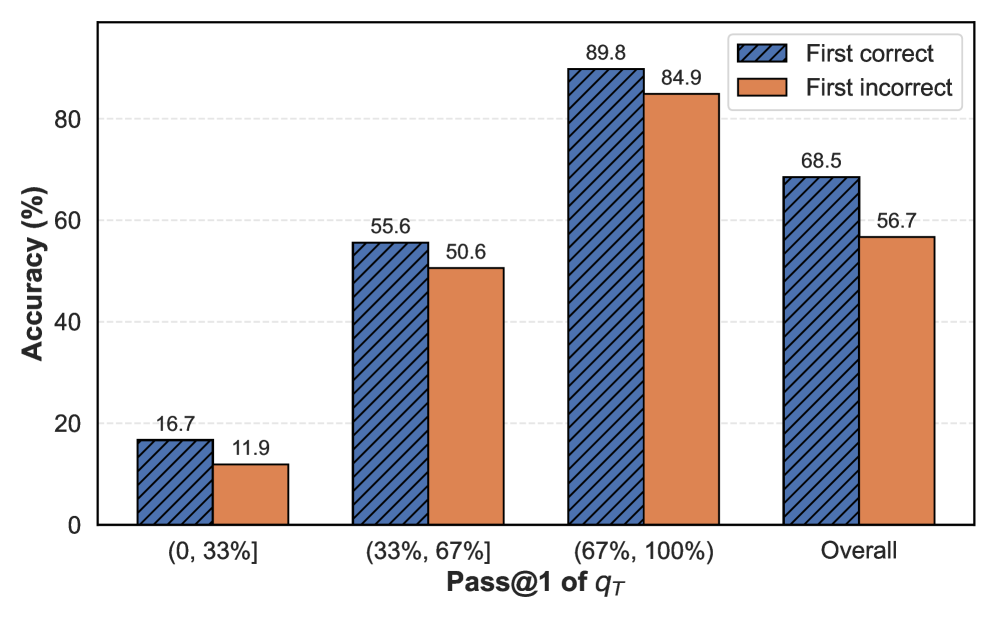
The chart compares accuracy percentages for two categories ("First correct" and "First incorrect") across four performance ranges of "Pass@1 of qT": (0, 33%], (33%, 67%], (67%, 100%], and Overall. The y-axis represents accuracy in percentage, while the x-axis categorizes performance ranges. The legend distinguishes "First correct" (blue striped bars) and "First incorrect" (orange bars).
### Components/Axes
- **X-axis (Categories)**:
- (0, 33%]
- (33%, 67%]
- (67%, 100%]
- Overall
- **Y-axis (Accuracy)**: Labeled "Accuracy (%)" with a range from 0 to 90%.
- **Legend**:
- "First correct" (blue striped pattern)
- "First incorrect" (solid orange)
### Detailed Analysis
1. **(0, 33%]**
- First correct: 16.7% (blue striped)
- First incorrect: 11.9% (orange)
- *Spatial grounding*: Blue bar is taller than orange, positioned leftmost.
2. **(33%, 67%]**
- First correct: 55.6% (blue striped)
- First incorrect: 50.6% (orange)
- *Spatial grounding*: Blue bar remains taller, centrally located.
3. **(67%, 100%]**
- First correct: 89.8% (blue striped)
- First incorrect: 84.9% (orange)
- *Spatial grounding*: Highest bars, right of center. Blue bar marginally taller.
4. **Overall**
- First correct: 68.5% (blue striped)
- First incorrect: 56.7% (orange)
- *Spatial grounding*: Rightmost bars. Blue bar maintains a lead.
### Key Observations
- **Trend verification**:
- "First correct" consistently outperforms "First incorrect" across all categories.
- Accuracy increases with higher pass@1 of qT ranges (e.g., 16.7% → 89.8%).
- The gap between "First correct" and "First incorrect" narrows in the Overall category (11.8% difference vs. 13.1% in (67%, 100%]).
- **Notable outliers**:
- The (0, 33%] range shows the lowest accuracy for both categories.
- The (67%, 100%] range achieves near-90% accuracy for "First correct."
### Interpretation
The data suggests a strong correlation between higher pass@1 of qT performance and improved accuracy. As the pass@1 threshold increases, both "First correct" and "First incorrect" accuracy rise, but the former maintains a consistent advantage. The narrowing gap in the Overall category implies that while performance improves with higher thresholds, the relative effectiveness of "First correct" vs. "First incorrect" diminishes slightly. This could indicate diminishing returns in accuracy gains as pass@1 approaches 100%, or a convergence in the utility of correct vs. incorrect responses at higher performance levels.