## Line Chart: Execution Time: CPU vs GPU Kernels
### Overview
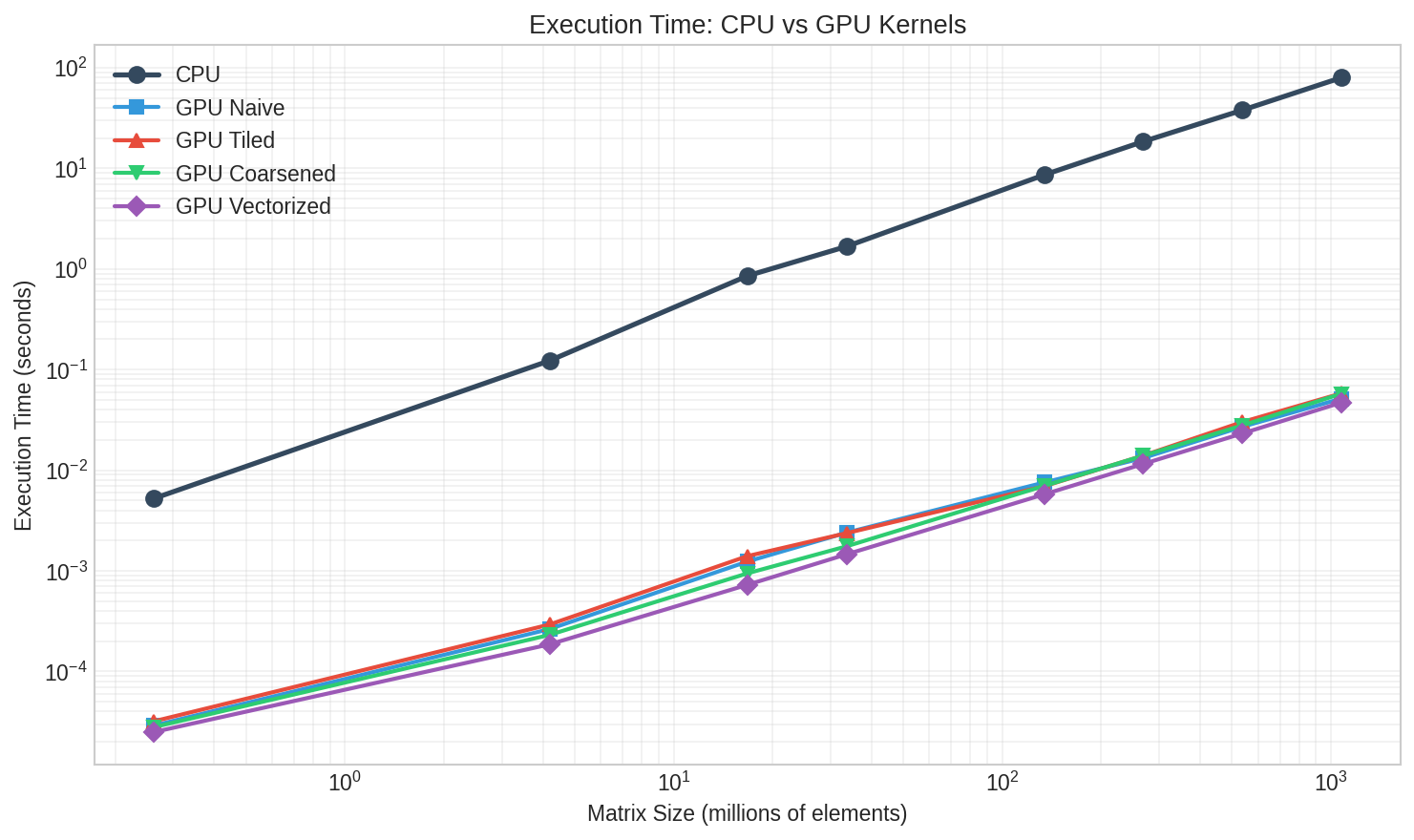
The chart compares execution times (in seconds) for CPU and various GPU kernel implementations (Naive, Tiled, Coarsened, Vectorized) across matrix sizes ranging from 1 million to 1,000 million elements. Execution time is plotted on a logarithmic y-axis, while matrix size uses a linear x-axis.
### Components/Axes
- **X-axis**: Matrix Size (millions of elements)
- Range: 10⁰ (1M) to 10³ (1,000M)
- Labels: 10⁰, 10¹, 10², 10³
- **Y-axis**: Execution Time (seconds)
- Logarithmic scale: 10⁻³ to 10²
- Labels: 10⁻³, 10⁻², 10⁻¹, 10⁰, 10¹, 10²
- **Legend**:
- CPU: Dark blue circles
- GPU Naive: Blue squares
- GPU Tiled: Red triangles
- GPU Coarsened: Green triangles
- GPU Vectorized: Purple diamonds
### Detailed Analysis
1. **CPU Performance**
- Execution time increases exponentially with matrix size.
- At 1M elements: ~0.05 seconds (5×10⁻²)
- At 100M elements: ~10 seconds (1×10¹)
- At 1,000M elements: ~100 seconds (1×10²)
2. **GPU Performance**
- All GPU methods outperform CPU by orders of magnitude.
- **GPU Naive**:
- 1M: ~1×10⁻⁴ seconds
- 100M: ~1×10⁻¹ seconds
- 1,000M: ~5×10⁻¹ seconds
- **GPU Tiled**:
- 1M: ~5×10⁻⁵ seconds
- 100M: ~2×10⁻¹ seconds
- 1,000M: ~4×10⁻¹ seconds
- **GPU Coarsened**:
- 1M: ~3×10⁻⁵ seconds
- 100M: ~1.5×10⁻¹ seconds
- 1,000M: ~4.5×10⁻¹ seconds
- **GPU Vectorized**:
- 1M: ~2×10⁻⁵ seconds
- 100M: ~1×10⁻¹ seconds
- 1,000M: ~4×10⁻¹ seconds
### Key Observations
- **Exponential vs. Polynomial Growth**:
- CPU execution time grows exponentially (straight line on log scale).
- GPU execution times grow polynomially (curved upward on log scale).
- **GPU Efficiency**:
- At 1,000M elements, GPU methods are **200–500x faster** than CPU.
- GPU Vectorized is the fastest, followed by Tiled, Coarsened, and Naive.
- **Convergence at Large Sizes**:
- GPU methods plateau near 0.5 seconds for 1,000M elements, while CPU reaches 100 seconds.
### Interpretation
The data demonstrates that GPU acceleration drastically reduces execution time for large matrix operations, with GPU Vectorized achieving the best performance. The logarithmic scale emphasizes the exponential advantage of GPUs over CPUs as matrix size increases. While GPU optimization techniques (Tiling, Coarsening) improve performance, their differences diminish at scale, suggesting diminishing returns for advanced optimizations in this context. This highlights the critical role of parallel computing in handling large-scale numerical tasks.