## Process Diagram: Legal Process Flow
### Overview
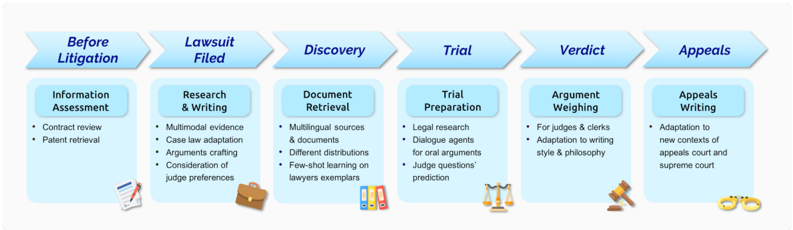
The image is a process diagram illustrating the stages of a legal process, from before litigation to appeals. Each stage is represented by a blue arrow and a corresponding blue box outlining the key activities involved.
### Components/Axes
The diagram consists of the following stages, presented horizontally from left to right:
1. **Before Litigation:**
* Sub-stage: Information Assessment
* Activities:
* Contract review
* Patent retrieval
* Icon: Notepad and pen
2. **Lawsuit Filed:**
* Sub-stage: Research & Writing
* Activities:
* Multimodal evidence
* Case law adaptation
* Arguments crafting
* Consideration of judge preferences
* Icon: Briefcase
3. **Discovery:**
* Sub-stage: Document Retrieval
* Activities:
* Multilingual sources & documents
* Different distributions
* Few-shot learning on lawyers exemplars
* Icon: File folders (red, yellow, blue, green)
4. **Trial:**
* Sub-stage: Trial Preparation
* Activities:
* Legal research
* Dialogue agents for oral arguments
* Judge questions' prediction
* Icon: Scales of Justice
5. **Verdict:**
* Sub-stage: Argument Weighing
* Activities:
* For judges & clerks
* Adaptation to writing style & philosophy
* Icon: Gavel
6. **Appeals:**
* Sub-stage: Appeals Writing
* Activities:
* Adaptation to new contexts of appeals court and supreme court
* Icon: Handcuffs
### Detailed Analysis or ### Content Details
Each stage is represented by a light blue arrow pointing to the right, indicating the flow of the legal process. Below each arrow is a light blue box containing the name of the sub-stage and a bulleted list of activities associated with that stage. Each stage also has a corresponding icon placed below the box.
* **Before Litigation:** Focuses on information assessment, including contract review and patent retrieval.
* **Lawsuit Filed:** Emphasizes research and writing, including multimodal evidence, case law adaptation, arguments crafting, and consideration of judge preferences.
* **Discovery:** Involves document retrieval, including multilingual sources and documents, different distributions, and few-shot learning on lawyers exemplars.
* **Trial:** Centers on trial preparation, including legal research, dialogue agents for oral arguments, and judge questions' prediction.
* **Verdict:** Focuses on argument weighing, including considerations for judges and clerks and adaptation to writing style and philosophy.
* **Appeals:** Involves appeals writing, including adaptation to new contexts of appeals court and supreme court.
### Key Observations
* The diagram presents a linear progression of the legal process.
* Each stage has specific activities associated with it.
* Icons are used to visually represent each stage.
### Interpretation
The diagram provides a high-level overview of the legal process, highlighting the key stages and activities involved. It demonstrates the sequential nature of the process, from initial information assessment to potential appeals. The inclusion of specific activities within each stage offers insights into the tasks and considerations relevant to each phase of the legal process. The icons provide a visual aid to quickly identify each stage.