## Model Translation Example
### Overview
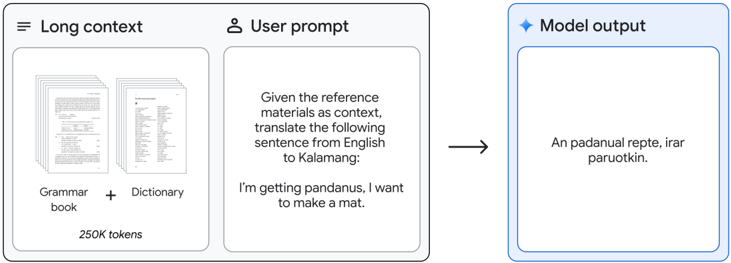
The image shows an example of a model translating a sentence from English to Kalamang, given a long context of grammar and dictionary resources. The image is structured as a flow diagram, showing the input context, the user prompt, and the model's output.
### Components/Axes
* **Long context:** This section represents the reference materials provided to the model. It includes:
* Grammar book
* Dictionary
* 250K tokens (indicating the size of the context)
* **User prompt:** This section contains the instruction given to the model:
* "Given the reference materials as context, translate the following sentence from English to Kalamang: I'm getting pandanus, I want to make a mat."
* **Model output:** This section displays the model's translation:
* "An padanual repte, irar paruotkin."
### Detailed Analysis or ### Content Details
* **Long context:** The "Long context" section shows stacks of documents labeled "Grammar book" and "Dictionary". The text "250K tokens" indicates the size of the context provided to the model.
* **User prompt:** The user prompt asks the model to translate the English sentence "I'm getting pandanus, I want to make a mat" into Kalamang.
* **Model output:** The model outputs the Kalamang translation: "An padanual repte, irar paruotkin."
### Key Observations
* The image demonstrates a translation task where the model uses a large context of grammar and dictionary resources to translate a sentence from English to Kalamang.
* The model provides a translation, but the accuracy of the translation cannot be verified without knowledge of the Kalamang language.
### Interpretation
The image illustrates the use of a language model with a long context window to perform a translation task. The model is provided with a grammar book and dictionary as context, which it uses to translate the given English sentence into Kalamang. This demonstrates the model's ability to leverage external knowledge sources to improve translation accuracy. The example highlights the potential of large language models for low-resource language translation, where limited parallel data is available. The model's output suggests that it can generate grammatically plausible Kalamang sentences, even with limited training data for that language.