## Image Analysis: Object and Spatial Cognition Tasks
### Overview
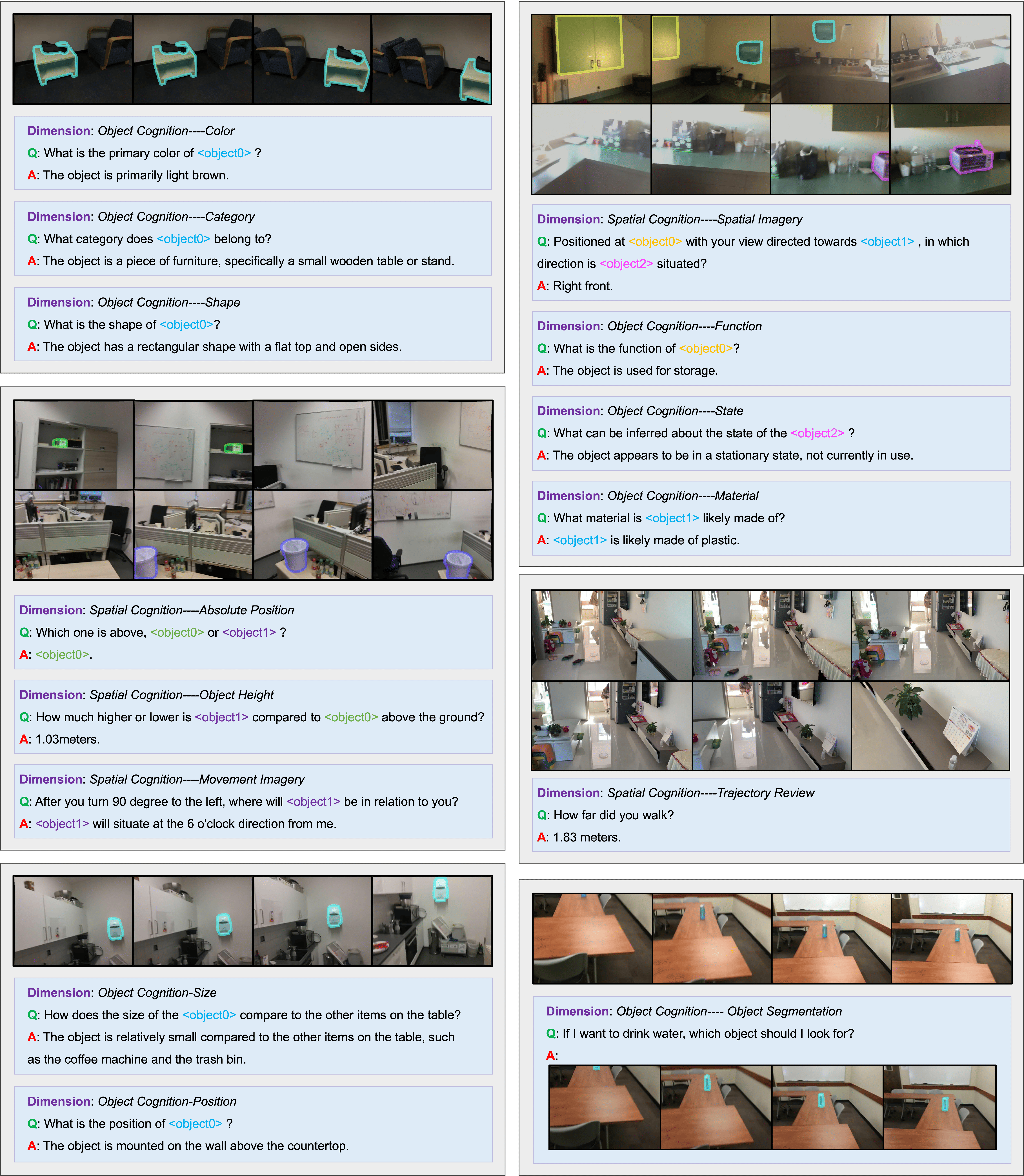
The image presents a series of object and spatial cognition tasks, each consisting of a question (Q) and an answer (A) related to objects depicted in accompanying images. The tasks cover various dimensions of cognition, including color, category, shape, function, state, material, absolute position, object height, movement imagery, trajectory review, size, position, spatial imagery, and object segmentation. Each task is presented with a set of images showing the object or scene in question.
### Components/Axes
The image is organized into six rows and two columns, each containing a separate task. Each task includes the following components:
* **Dimension:** The type of cognitive task being assessed (e.g., "Object Cognition----Color").
* **Question (Q):** A question related to the object or scene.
* **Answer (A):** The answer to the question.
* **Images:** A set of images depicting the object or scene relevant to the question.
### Detailed Analysis or Content Details
Here's a breakdown of each task:
**Row 1, Column 1:**
* **Dimension:** Object Cognition----Color
* **Q:** What is the primary color of <object0>?
* **A:** The object is primarily light brown.
* **Images:** Three images of a small, light brown wooden table.
**Row 1, Column 2:**
* **Dimension:** Spatial Cognition----Spatial Imagery
* **Q:** Positioned at <object0> with your view directed towards <object1>, in which direction is <object2> situated?
* **A:** Right front.
* **Images:** Three images of a room, with a table and chairs.
**Row 2, Column 1:**
* **Dimension:** Object Cognition----Category
* **Q:** What category does <object0> belong to?
* **A:** The object is a piece of furniture, specifically a small wooden table or stand.
* **Images:** Three images of a small, light brown wooden table.
**Row 2, Column 2:**
* **Dimension:** Object Cognition----Function
* **Q:** What is the function of <object0>?
* **A:** The object is used for storage.
* **Images:** Three images of a wall-mounted cabinet.
**Row 3, Column 1:**
* **Dimension:** Object Cognition----Shape
* **Q:** What is the shape of <object0>?
* **A:** The object has a rectangular shape with a flat top and open sides.
* **Images:** Three images of a small, light brown wooden table.
**Row 3, Column 2:**
* **Dimension:** Object Cognition----State
* **Q:** What can be inferred about the state of the <object2>?
* **A:** The object appears to be in a stationary state, not currently in use.
* **Images:** Three images of a printer.
**Row 4, Column 1:**
* **Dimension:** Spatial Cognition----Absolute Position
* **Q:** Which one is above, <object0> or <object1>?
* **A:** <object0>.
* **Images:** Three images of a shelf above a trash bin.
**Row 4, Column 2:**
* **Dimension:** Object Cognition----Material
* **Q:** What material is <object1> likely made of?
* **A:** <object1> is likely made of plastic.
* **Images:** Three images of a trash bin.
**Row 5, Column 1:**
* **Dimension:** Spatial Cognition----Object Height
* **Q:** How much higher or lower is <object1> compared to <object0> above the ground?
* **A:** 1.03 meters.
* **Images:** Three images of a person standing in a room.
**Row 5, Column 2:**
* **Dimension:** Spatial Cognition----Trajectory Review
* **Q:** How far did you walk?
* **A:** 1.83 meters.
* **Images:** Three images of a room.
**Row 6, Column 1:**
* **Dimension:** Spatial Cognition----Movement Imagery
* **Q:** After you turn 90 degree to the left, where will <object1> be in relation to you?
* **A:** <object1> will situate at the 6 o'clock direction from me.
* **Images:** Three images of a room.
**Row 6, Column 2:**
* **Dimension:** Object Cognition---- Object Segmentation
* **Q:** If I want to drink water, which object should I look for?
* **A:**
* **Images:** Three images of a table with a water bottle.
**Row 7, Column 1:**
* **Dimension:** Object Cognition-Size
* **Q:** How does the size of the <object0> compare to the other items on the table?
* **A:** The object is relatively small compared to the other items on the table, such as the coffee machine and the trash bin.
* **Images:** Three images of a hand sanitizer.
**Row 7, Column 2:**
* **Dimension:** Object Cognition-Position
* **Q:** What is the position of <object0>?
* **A:** The object is mounted on the wall above the countertop.
* **Images:** Three images of a hand sanitizer.
### Key Observations
* The tasks cover a wide range of cognitive dimensions related to object recognition and spatial reasoning.
* The answers are generally straightforward and based on visual information present in the images.
* Some tasks involve relative comparisons (e.g., size, height, position).
* The use of placeholders like `<object0>`, `<object1>`, and `<object2>` suggests a standardized format for the questions.
### Interpretation
The image demonstrates a set of cognitive tasks designed to assess an AI's ability to understand and reason about objects and their spatial relationships. The tasks require the AI to:
* Identify objects.
* Categorize objects.
* Describe object properties (e.g., color, shape, material).
* Understand object functions.
* Reason about spatial relationships between objects.
* Infer object states.
* Estimate distances and trajectories.
The tasks could be used to evaluate the performance of computer vision models, robotics systems, or other AI agents that need to interact with the physical world. The standardized format of the questions allows for easy creation of new tasks and comparison of results across different systems.