TECHNICAL ASSET FINGERPRINT
2f57dd3e688e769fda119827
Click to view fullscreen
Press ESC or click to close
FOUND IN PAPERS
EXPERT: healer-alpha-free VERSION 1
RUNTIME: free/openrouter/healer-alpha
INTEL_VERIFIED
## Technical Demonstration Composite: Visual Reasoning System Evaluation
### Overview
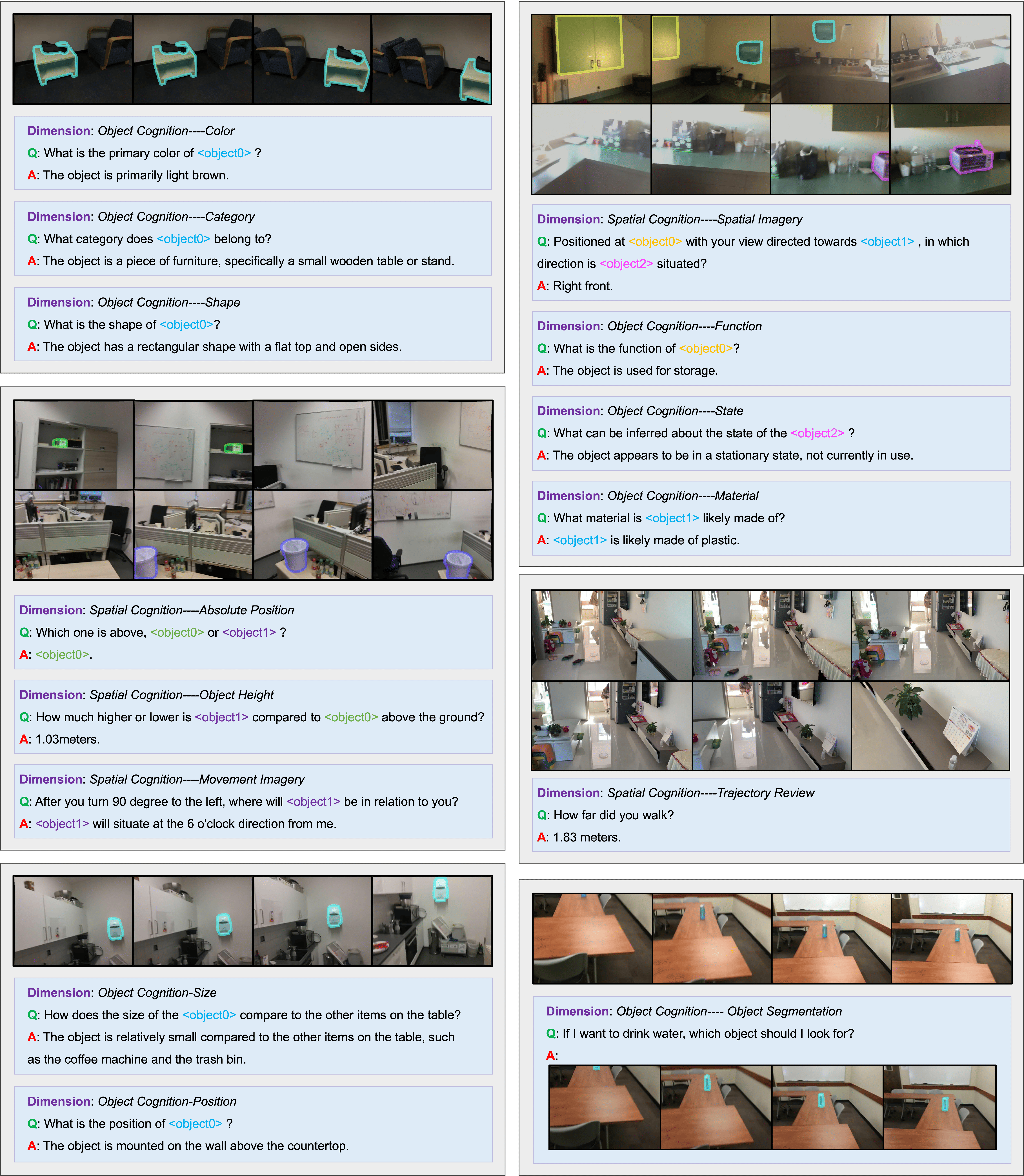
This image is a composite of six distinct panels arranged in a 2x3 grid (two columns, three rows). Each panel demonstrates a visual reasoning task, likely for an AI or robotic system. The format is consistent: a sequence of 4-6 images at the top of each panel shows an indoor scene with colored bounding boxes highlighting specific objects. Below the images, text blocks present structured "Dimensions" of cognition, each containing a Question (Q) and Answer (A) pair that references the highlighted objects (e.g., `<object0>`, `<object1>`). The composite evaluates both **Object Cognition** (properties like color, category, shape, function, state, material, size, position) and **Spatial Cognition** (relationships, positions, heights, movement, trajectories).
### Components/Axes
The composite is segmented into six independent panels. Each panel contains:
1. **Image Sequence:** A series of frames showing a scene from slightly different viewpoints or moments, with colored bounding boxes (cyan, green, purple, yellow, magenta) overlaid on specific objects.
2. **Text Blocks:** Labeled with a "Dimension" (e.g., `Object Cognition----Color`), followed by a Question (Q) and Answer (A). Objects are referenced with placeholders like `<object0>`, `<object1>`, etc., which correspond to the colored bounding boxes in the images.
### Detailed Analysis
#### **Panel 1 (Top-Left): Object Cognition - Basic Properties**
* **Image Sequence:** Shows a room with blue chairs and a small, light-brown wooden table/stand. A **cyan** bounding box consistently highlights this table across all frames.
* **Text Content:**
* **Dimension: Object Cognition----Color**
* Q: What is the primary color of `<object0>`?
* A: The object is primarily light brown.
* **Dimension: Object Cognition----Category**
* Q: What category does `<object0>` belong to?
* A: The object is a piece of furniture, specifically a small wooden table or stand.
* **Dimension: Object Cognition----Shape**
* Q: What is the shape of `<object0>`?
* A: The object has a rectangular shape with a flat top and open sides.
#### **Panel 2 (Top-Right): Spatial & Object Cognition - Complex Scene**
* **Image Sequence:** Shows a kitchen/break room with cabinets, a counter, and appliances. Multiple objects are highlighted:
* **Yellow** box: A cabinet or shelf unit.
* **Cyan** box: A small appliance (possibly a toaster oven).
* **Magenta** box: Another small appliance (possibly a coffee grinder or similar).
* **Text Content:**
* **Dimension: Spatial Cognition----Spatial Imagery**
* Q: Positioned at `<object0>` with your view directed towards `<object1>`, in which direction is `<object2>` situated?
* A: Right front.
* **Dimension: Object Cognition----Function**
* Q: What is the function of `<object0>`?
* A: The object is used for storage.
* **Dimension: Object Cognition----State**
* Q: What can be inferred about the state of the `<object2>`?
* A: The object appears to be in a stationary state, not currently in use.
* **Dimension: Object Cognition----Material**
* Q: What material is `<object1>` likely made of?
* A: `<object1>` is likely made of plastic.
#### **Panel 3 (Middle-Left): Spatial Cognition - Office Environment**
* **Image Sequence:** Shows an office with shelves, a whiteboard, and a desk. Two objects are highlighted:
* **Green** box: An item on a shelf.
* **Purple** box: A trash bin on the floor.
* **Text Content:**
* **Dimension: Spatial Cognition----Absolute Position**
* Q: Which one is above, `<object0>` or `<object1>`?
* A: `<object0>`.
* **Dimension: Spatial Cognition----Object Height**
* Q: How much higher or lower is `<object1>` compared to `<object0>` above the ground?
* A: 1.03 meters.
* **Dimension: Spatial Cognition----Movement Imagery**
* Q: After you turn 90 degree to the left, where will `<object1>` be in relation to you?
* A: `<object1>` will situate at the 6 o'clock direction from me.
#### **Panel 4 (Middle-Right): Spatial Cognition - Trajectory**
* **Image Sequence:** Shows a hallway or living area with plants, a bench, and a calendar. A **cyan** bounding box highlights an object (possibly a plant or decorative item) on a low table.
* **Text Content:**
* **Dimension: Spatial Cognition----Trajectory Review**
* Q: How far did you walk?
* A: 1.83 meters.
#### **Panel 5 (Bottom-Left): Object Cognition - Size & Position**
* **Image Sequence:** Shows a kitchen counter with a coffee machine, a trash bin, and a wall-mounted object (highlighted in **cyan**).
* **Text Content:**
* **Dimension: Object Cognition-Size**
* Q: How does the size of the `<object0>` compare to the other items on the table?
* A: The object is relatively small compared to the other items on the table, such as the coffee machine and the trash bin.
* **Dimension: Object Cognition-Position**
* Q: What is the position of `<object0>`?
* A: The object is mounted on the wall above the countertop.
#### **Panel 6 (Bottom-Right): Object Cognition - Segmentation & Function**
* **Image Sequence:** Shows a conference room with wooden tables and chairs. A **cyan** bounding box highlights a small, vertical object on the table (likely a water bottle or dispenser).
* **Text Content:**
* **Dimension: Object Cognition---- Object Segmentation**
* Q: If I want to drink water, which object should I look for?
* A: [The answer is not provided in the text; the visual answer is the cyan-highlighted object on the table.]
### Key Observations
1. **Structured Evaluation Framework:** The composite uses a consistent template to test discrete cognitive abilities, separating object properties from spatial reasoning.
2. **Visual Grounding:** The colored bounding boxes provide explicit visual grounding for the textual placeholders (`<object0>`, etc.), creating a direct link between perception and reasoning.
3. **Diverse Indoor Scenes:** The tasks are set in varied, realistic indoor environments (living room, kitchen, office, hallway, conference room), testing generalization.
4. **Quantitative Spatial Reasoning:** Some answers provide precise numerical values (1.03 meters, 1.83 meters), indicating the system is expected to perform metric estimation.
5. **Multi-Object Interaction:** Several questions require understanding relationships between multiple objects (e.g., relative direction, height comparison).
### Interpretation
This composite image serves as a benchmark or demonstration suite for a **multimodal visual reasoning system**. It systematically evaluates the system's ability to:
* **Perceive and describe** object attributes (color, shape, material, size, position).
* **Categorize and infer** object function and state.
* **Understand and calculate** spatial relationships, both topological (above, left/right) and metric (height difference, distance walked).
* **Perform mental transformations** (e.g., imagining a new viewpoint after a turn).
The underlying goal is to assess whether an AI can build a coherent, queryable model of a 3D environment from visual input, a fundamental capability for robotics, augmented reality, and advanced scene understanding. The absence of an answer in the final panel ("which object should I look for?") suggests it may be a prompt for the system to generate an answer, highlighting the interactive or generative nature of the evaluation. The precision of the answers (e.g., "1.03 meters") implies the system is being tested on its ability to produce detailed, quantitative outputs, not just qualitative descriptions.
DECODING INTELLIGENCE...