## Text-Based Q&A Dataset: Object and Spatial Cognition Analysis
### Overview
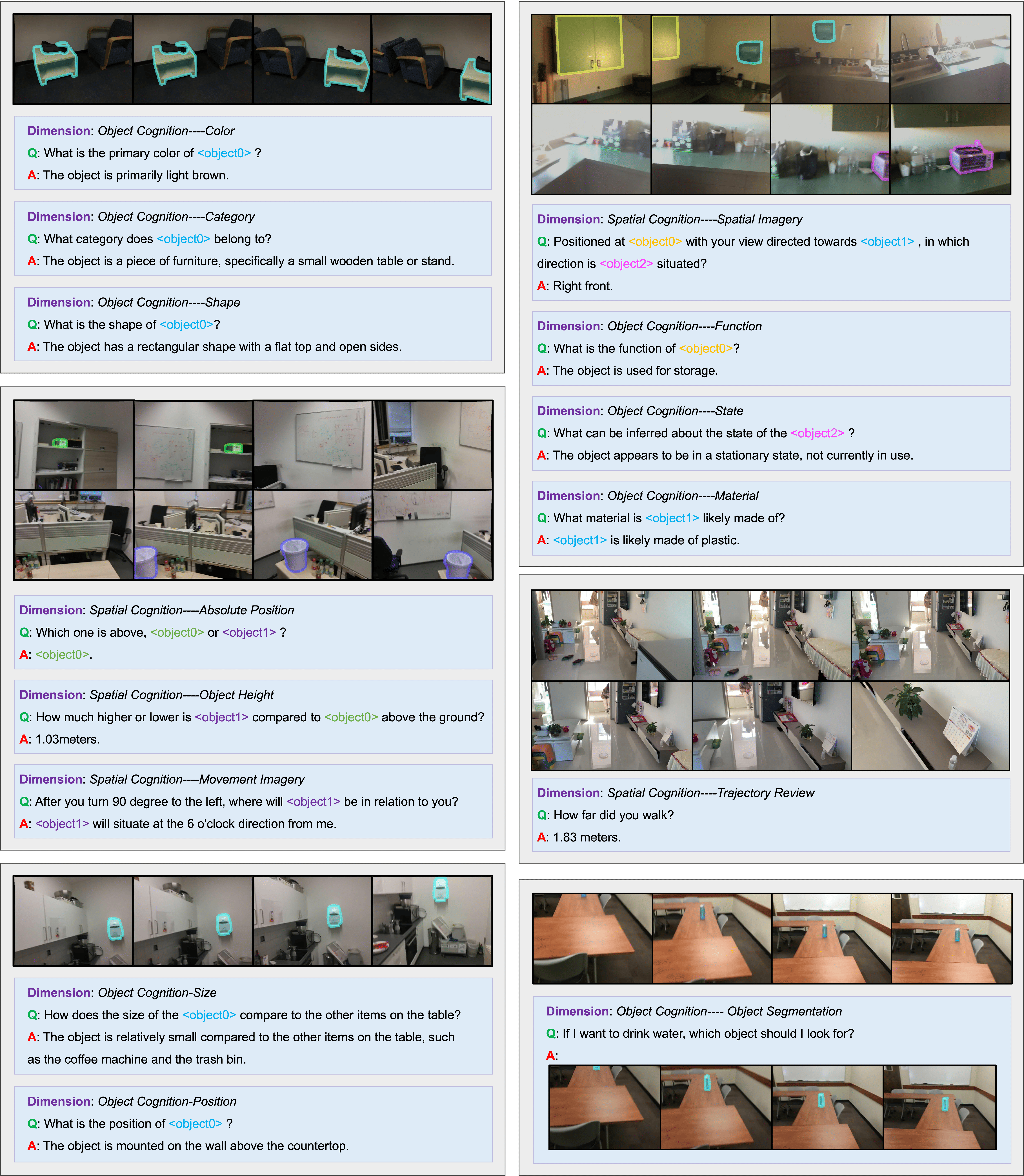
The image contains a structured dataset of questions and answers (Q&A pairs) organized into cognitive dimensions related to object and spatial cognition. Each section focuses on a specific attribute (e.g., color, shape, function) or spatial relationship (e.g., position, movement) of objects in various room settings.
### Components/Axes
- **Dimensions**: Labeled in purple text (e.g., "Object Cognition---Color", "Spatial Cognition---Spatial Imagery").
- **Questions (Q)**: Green text, asking about object attributes or spatial relationships.
- **Answers (A)**: Red text, providing factual responses based on visual context.
- **Objects**: Highlighted in cyan or magenta bounding boxes across multiple room scenes.
### Content Details
#### Object Cognition Dimensions
1. **Color**
- Q: What is the primary color of `<object0>`?
- A: The object is primarily light brown.
2. **Category**
- Q: What category does `<object0>` belong to?
- A: The object is a piece of furniture, specifically a small wooden table or stand.
3. **Shape**
- Q: What is the shape of `<object0>`?
- A: The object has a rectangular shape with a flat top and open sides.
4. **Function**
- Q: What is the function of `<object0>`?
- A: The object is used for storage.
5. **State**
- Q: What can be inferred about the state of `<object2>`?
- A: The object appears to be in a stationary state, not currently in use.
6. **Material**
- Q: What material is `<object1>` likely made of?
- A: `<object1>` is likely made of plastic.
#### Spatial Cognition Dimensions
1. **Spatial Imagery**
- Q: Positioned at `<object0>` with your view directed towards `<object1>`, in which direction is `<object2>` situated?
- A: Right front.
2. **Absolute Position**
- Q: Which one is above, `<object0>` or `<object1>`?
- A: `<object0>`.
3. **Object Height**
- Q: How much higher or lower is `<object1>` compared to `<object0>` above the ground?
- A: 1.03 meters.
4. **Movement Imagery**
- Q: After turning 90 degrees left, where will `<object1>` be in relation to you?
- A: `<object1>` will be at the 6 o’clock direction from me.
5. **Trajectory Review**
- Q: How far did you walk?
- A: 1.83 meters.
#### Additional Object Cognition Dimensions
1. **Size**
- Q: How does the size of `<object0>` compare to other items on the table?
- A: The object is relatively small compared to the coffee machine and trash bin.
2. **Position**
- Q: What is the position of `<object0>`?
- A: The object is mounted on the wall above the countertop.
3. **Object Segmentation**
- Q: If I want to drink water, which object should I look for?
- A: [No explicit answer provided in the image.]
### Key Observations
- **Consistency**: Answers are contextually grounded in visual cues (e.g., object placement, material inference).
- **Ambiguity**: Some questions (e.g., segmentation) lack answers, suggesting incomplete data.
- **Room Context**: Objects are analyzed across diverse environments (e.g., office, kitchen, living room).
### Interpretation
This dataset evaluates cognitive tasks involving object recognition (color, category, function) and spatial reasoning (position, movement). The structured Q&A format implies its use in training or benchmarking AI models for visual understanding. The absence of answers for segmentation questions highlights potential gaps in the dataset’s scope or labeling process. Spatial cognition tasks emphasize relative positioning and movement prediction, critical for robotics or augmented reality applications.