## Text Block: Collision Analysis
### Overview
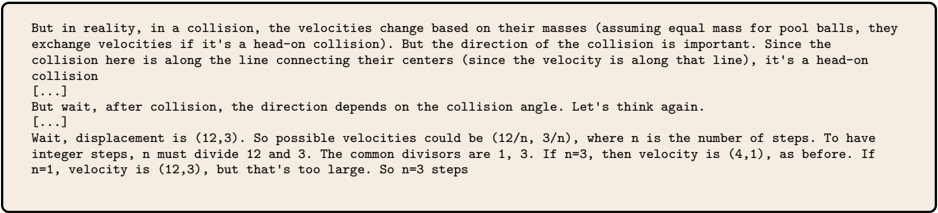
The image presents a text block discussing the physics of collisions, specifically focusing on how velocities change based on mass and collision direction. It includes a calculation to determine the velocity based on displacement and the number of steps.
### Components/Axes
There are no axes or scales in this image. It is purely textual.
### Detailed Analysis or ### Content Details
The text can be broken down into the following key points:
1. **Initial Statement:** In a collision, velocities change based on the masses of the objects involved. The example uses pool balls, assuming equal mass.
2. **Head-on Collisions:** If the collision is head-on, the objects exchange velocities.
3. **Direction Importance:** The direction of the collision is important. If the collision occurs along the line connecting the centers of the objects, it's considered a head-on collision.
4. **Collision Angle:** After the collision, the direction depends on the collision angle.
5. **Displacement and Velocity Calculation:**
* Displacement is given as (12, 3).
* Possible velocities are calculated as (12/n, 3/n), where 'n' is the number of steps.
* To have integer steps, 'n' must divide both 12 and 3.
* The common divisors of 12 and 3 are 1 and 3.
* If n = 3, the velocity is (4, 1).
* If n = 1, the velocity is (12, 3), which is considered too large.
* Therefore, n = 3 steps is the chosen solution.
### Key Observations
* The text focuses on simplifying collision physics by assuming equal masses.
* The calculation aims to find a reasonable velocity based on a given displacement and the constraint of integer steps.
* The text uses a process of elimination to determine the appropriate number of steps.
### Interpretation
The text explains the basic principles of collisions and then applies these principles to a specific scenario involving displacement and velocity. The calculation demonstrates how to determine a plausible velocity by considering the number of steps involved and ensuring that the resulting velocity components are integers. The conclusion that n=3 steps is the correct solution suggests an attempt to find a physically realistic outcome.