\n
## Text Block: Physics Collision Analysis
### Overview
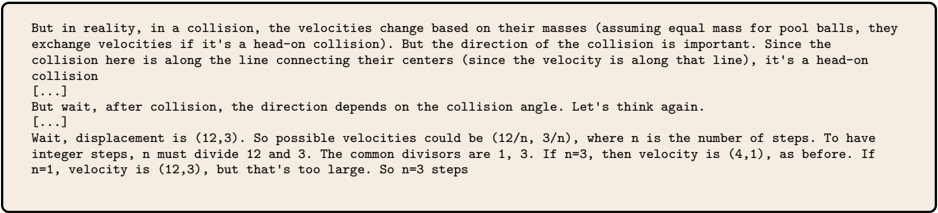
The image contains a block of text discussing the physics of collisions, specifically focusing on velocity changes, head-on collisions, and the impact of collision angles. It appears to be a thought process or notes related to solving a physics problem.
### Content Details
The text can be transcribed as follows:
"But in reality, in a collision, the velocities change based on their masses (assuming equal mass for pool balls, they exchange velocities if it's a head-on collision). But the direction of the collision is important. Since the collision here is along the line connecting their centers (since the velocity is along that line), it's a head-on collision.
[...]
But wait, after collision, the direction depends on the collision angle. Let's think again.
[...]
Wait, displacement is (12,3). So possible velocities could be (12/n, 3/n), where n is the number of steps. To have integer steps, n must divide 12 and 3. The common divisors are 1, 3. If n=3, then velocity is (4,1), as before. If n=1, velocity is (12,3), but that's too large. So n=3 steps"
### Key Observations
The text includes ellipses "[...]" indicating omitted sections of thought or calculation. The discussion centers around finding possible velocities after a collision, given a displacement of (12,3). The author explores the concept of dividing the displacement components by a factor 'n' to achieve integer velocities, and identifies 1 and 3 as common divisors of 12 and 3. The author concludes that n=3 is a valid solution, resulting in a velocity of (4,1).
### Interpretation
The text represents a problem-solving approach to a physics problem involving collisions. The author is working through the implications of different factors (mass, direction, angle) on the resulting velocities. The use of 'n' as a divisor suggests an attempt to discretize the problem or find integer solutions. The final conclusion that n=3 yields a valid velocity indicates a step towards solving the problem, potentially related to finding the smallest possible integer steps for the velocity components. The ellipses suggest that the author may have explored other possibilities or calculations that were ultimately deemed irrelevant. The context suggests this is a hand-written or typed note from a physics student or professional.