## Text Block: Physics Problem Discussion
### Overview
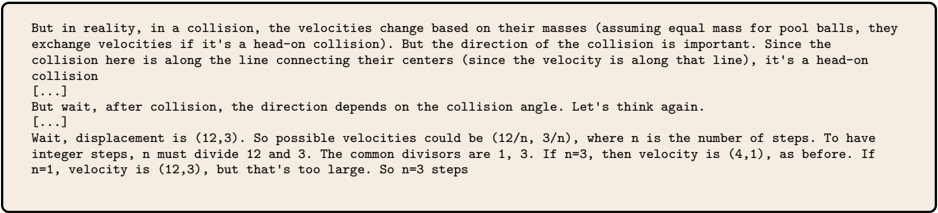
The image contains a block of text, likely from a technical discussion, forum post, or problem-solving session. The text discusses the physics of collisions, specifically focusing on how velocities change based on mass and collision angle, and then transitions into a mathematical problem involving displacement, velocity, and integer steps. The content is presented in a conversational, step-by-step reasoning style.
### Content Details (Full Transcription)
The text is in English. The exact transcription is as follows:
```
But in reality, in a collision, the velocities change based on their masses (assuming equal mass for pool balls, they exchange velocities if it's a head-on collision). But the direction of the collision is important. Since the collision here is along the line connecting their centers (since the velocity is along that line), it's a head-on collision
[...]
But wait, after collision, the direction depends on the collision angle. Let's think again.
[...]
Wait, displacement is (12,3). So possible velocities could be (12/n, 3/n), where n is the number of steps. To have integer steps, n must divide 12 and 3. The common divisors are 1, 3. If n=3, then velocity is (4,1), as before. If n=1, velocity is (12,3), but that's too large. So n=3 steps
```
### Key Observations
1. **Structure**: The text is not a single coherent paragraph but appears to be a sequence of thoughts or reasoning steps. The ellipses `[...]` indicate omitted sections, suggesting this is an excerpt from a longer discussion.
2. **Content Shift**: The text begins with a conceptual discussion of collision physics (momentum, mass, direction) and then abruptly shifts to a specific numerical problem involving displacement `(12,3)` and calculating possible velocities based on integer step constraints.
3. **Mathematical Reasoning**: The latter part demonstrates a clear mathematical logic:
* Given displacement `d = (12, 3)`.
* Proposes velocity `v = (12/n, 3/n)` for `n` steps.
* Imposes the constraint that steps must be integers, requiring `n` to be a common divisor of 12 and 3.
* Identifies common divisors: 1 and 3.
* Evaluates both cases: `n=3` yields velocity `(4,1)` (which is noted as consistent with a previous result), and `n=1` yields velocity `(12,3)` (which is rejected as "too large").
* Concludes `n=3` steps is the valid solution.
### Interpretation
This text fragment captures a moment of problem-solving or explanation. The author is working through two related but distinct concepts:
1. **General Physics Principle**: The initial lines establish the rules for a head-on collision between equal masses (velocity exchange) and note the importance of collision direction/angle.
2. **Specific Applied Problem**: The final section applies a mathematical model to a specific case. The displacement `(12,3)` likely represents the total change in position over a series of steps. The reasoning seeks a constant velocity vector that, when applied over an integer number of steps (`n`), results in that exact displacement. The rejection of `n=1` suggests an implicit constraint from the broader context (e.g., the velocity must be a "reasonable" or previously defined value, or the steps represent discrete time intervals where a large velocity is implausible).
The `[...]` breaks are critical, as they hide the connective tissue between the collision theory and the displacement problem. The phrase "as before" indicates reference to a prior calculation or given information not visible in this excerpt. The text is a snapshot of iterative reasoning, where the author corrects or refines their approach ("Let's think again").