## Text Block: Physics Collision Analysis
### Overview
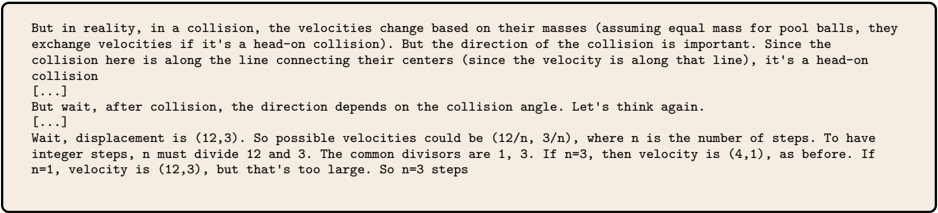
The text discusses the principles of collision dynamics, focusing on velocity exchange, displacement vectors, and step-based velocity decomposition. It emphasizes head-on collisions, mass equality assumptions, and mathematical constraints for integer velocity components.
### Components/Axes
No charts, diagrams, or axes are present. The content is purely textual with embedded mathematical reasoning.
### Detailed Analysis
1. **Collision Dynamics**:
- Velocities change based on masses (equal for pool balls, leading to velocity exchange in head-on collisions).
- Direction depends on collision angle, but head-on collisions occur along the line connecting centers.
2. **Displacement and Velocity**:
- Displacement vector: **(12, 3)**.
- Possible velocities: **(12/n, 3/n)**, where **n** is the number of steps.
- **n** must divide both 12 and 3 (common divisors: 1, 3).
- If **n=3**, velocity becomes **(4, 1)**. If **n=1**, velocity is **(12, 3)** (deemed "too large").
3. **Mathematical Constraints**:
- Integer steps require **n** to be a common divisor of displacement components.
- Preference for smaller **n** (e.g., **n=3**) to avoid excessively large velocity magnitudes.
### Key Observations
- The analysis assumes idealized conditions (e.g., equal mass, no external forces).
- The choice of **n=3** balances mathematical validity (divisibility) and practicality (avoiding large steps).
- The displacement vector’s components (12, 3) are critical for determining valid velocity solutions.
### Interpretation
This text illustrates principles of elastic collisions in physics, where momentum conservation and vector decomposition govern outcomes. The focus on integer steps suggests an application in computational simulations or discrete-time models, where velocity adjustments must align with grid-based or stepwise motion. The preference for **n=3** highlights a trade-off between precision (smaller steps) and computational simplicity (avoiding overly large velocity magnitudes). The reasoning underscores the importance of divisibility in constrained systems, a common consideration in physics-based algorithms or educational problem-solving.