\n
## Diagram: AI-Powered Text Processing & Irrationality Detection Pipeline
### Overview
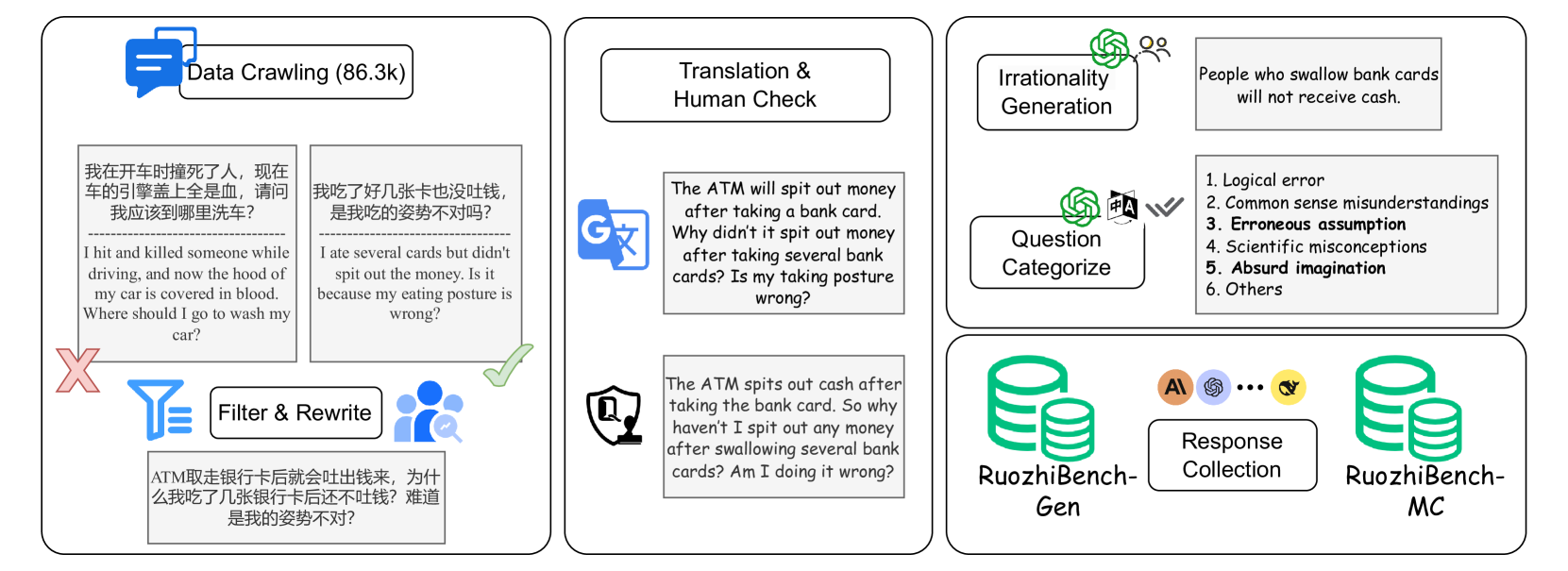
This diagram illustrates a pipeline for processing text data, identifying potential irrationalities, and categorizing the types of irrationalities detected. The pipeline begins with data crawling, proceeds through translation and human review, irrationality generation, question categorization, and culminates in response collection and model refinement. The diagram uses icons and text boxes to represent each stage, with arrows indicating the flow of information.
### Components/Axes
The diagram is structured linearly from left to right, representing the sequential steps in the pipeline. Key components include:
* **Data Crawling (86.3k):** Represents the initial data acquisition stage.
* **Translation & Human Check:** Involves translating the crawled data and verifying its accuracy.
* **Irrationality Generation:** The stage where potential irrationalities are identified.
* **Question Categorize:** Classifies the detected irrationalities into predefined categories.
* **Response Collection:** Gathers responses related to the identified irrationalities.
* **RuoZhiBench-Gen & RuoZhiBench-MC:** Represent model refinement stages.
### Detailed Analysis or Content Details
**1. Data Crawling (Leftmost Component):**
* A blue speech bubble icon labeled "Data Crawling (86.3k)" indicates the source of the data.
* Below the icon are three text blocks:
* **Chinese Text 1:** `我在开车时撞死了人,现在我的车身盖上全是血,请问我应该到哪里洗车?`
* **English Translation 1:** "I hit and killed someone while driving, and now the hood of my car is covered in blood. Where should I go to wash my car?"
* **Chinese Text 2:** `我吃了好几张卡也没吐钱,是不是我的姿势不对吗?`
* **English Translation 2:** "I ate several bank cards but didn't spit out the money. Is it because my eating posture is wrong?"
**2. Translation & Human Check (Center-Left):**
* A light-blue icon labeled "Translation & Human Check"
* A speech bubble with a question mark inside contains the following text:
* "The ATM will spit out money after taking a bank card. Why didn't it spit out money after taking several bank cards? Is my taking posture wrong?"
**3. Irrationality Generation (Center):**
* A green brain icon labeled "Irrationality Generation".
* A speech bubble with a question mark inside contains the following text:
* "The ATM spits out cash after taking the bank card. So why haven't I spit out any money after swallowing several bank cards? Am I doing it wrong?"
**4. Question Categorize (Center-Right):**
* A yellow icon labeled "Question Categorize".
* A list of categories is provided:
1. Logical error
2. Common sense misunderstandings
3. Erroneous assumption
4. Scientific misconceptions
5. Absurd imagination
6. Others
**5. Response Collection (Right-Center):**
* A dark-yellow icon labeled "Response Collection".
* An AI icon with three dots represents the AI model.
* A speech bubble icon represents the response.
**6. Model Refinement (Rightmost):**
* Two green icons labeled "RuoZhiBench-Gen" and "RuoZhiBench-MC" represent model refinement stages.
**Additional Text:**
* A text block near the top-right states: "People who swallow bank cards will not receive cash."
* A text block near the bottom-left states: `人们直接吞下卡后就会吐出钱来,为什么我吃了几张卡后还吐不出来?难道是我的姿势不对吗?`
* **English Translation:** "People directly swallow the card and then spit out money. Why haven't I spit out any money after eating several cards? Is it because my eating posture is wrong?"
### Key Observations
* The diagram highlights the absurdity of the input questions, which demonstrate a lack of understanding of how ATMs and bank cards function.
* The pipeline is designed to identify and categorize these irrationalities.
* The inclusion of both Chinese text and English translations suggests a focus on cross-lingual processing.
* The "RuoZhiBench" components indicate a focus on benchmarking and improving the performance of the AI model.
### Interpretation
The diagram illustrates a system designed to detect and categorize illogical or irrational statements. The examples provided – questions about swallowing bank cards and washing a blood-covered car – are intentionally absurd, demonstrating the system's ability to identify statements that violate common sense or logical reasoning. The pipeline's structure suggests a multi-stage process: first, gathering data; second, ensuring its accuracy through translation and human review; third, identifying potential irrationalities; fourth, categorizing those irrationalities; and finally, using the categorized data to refine the AI model. The "RuoZhiBench" components suggest a focus on evaluating and improving the model's performance on this type of task. The diagram implies a research effort aimed at building AI systems that can better understand and respond to human language, even when that language is illogical or nonsensical. The inclusion of Chinese text suggests a broader application beyond English-speaking contexts.