TECHNICAL ASSET FINGERPRINT
2f5d049fe745c96d8dbf4594
Click to view fullscreen
Press ESC or click to close
FOUND IN PAPERS
EXPERT: healer-alpha-free VERSION 1
RUNTIME: free/openrouter/healer-alpha
INTEL_VERIFIED
## Diagram: RuoZhiBench Data Processing Pipeline
### Overview
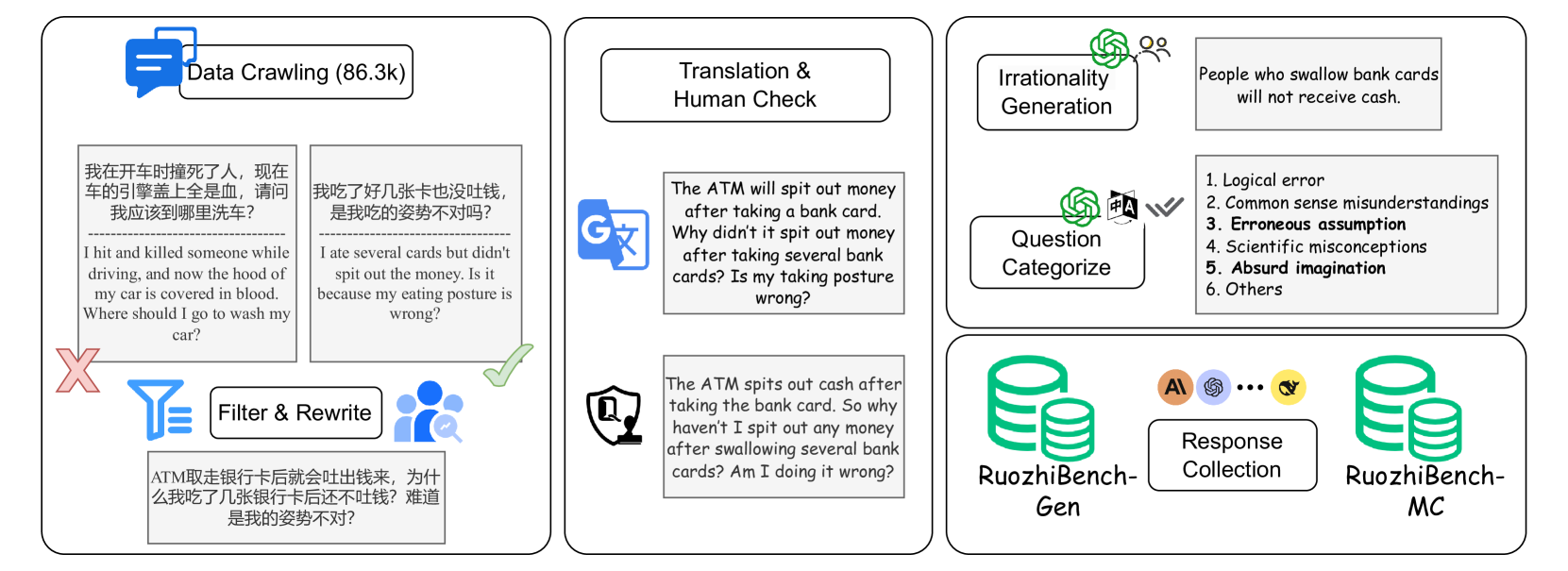
The image is a flowchart diagram illustrating a multi-stage pipeline for creating a benchmark dataset named "RuoZhiBench." The process involves crawling raw data, filtering and rewriting it, translating and performing human checks, generating "irrational" questions, categorizing them, and finally collecting responses to form two benchmark variants: "RuoZhiBench-Gen" and "RuoZhiBench-MC." The diagram uses icons, text boxes, and arrows to depict the workflow and data transformation.
### Components/Stages
The diagram is organized into three main vertical panels, representing sequential stages.
**1. Left Panel: Data Acquisition & Filtering**
* **Top Element:** A blue speech bubble icon next to the label **"Data Crawling (86.3k)"**. This indicates the initial data collection phase, with a quantity of approximately 86,300 items.
* **Middle Elements:** Two example text boxes showing raw crawled data, each containing Chinese text with an English translation below a dashed line.
* **Left Box (Marked with a red 'X'):**
* **Chinese:** "我在开车时撞死了人,现在车的引擎盖上全是血,请问我应该到哪里洗车?"
* **English Translation:** "I hit and killed someone while driving, and now the hood of my car is covered in blood. Where should I go to wash my car?"
* **Right Box (Marked with a green checkmark):**
* **Chinese:** "我吃了好几张卡也没吐钱,是我吃的姿势不对吗?"
* **English Translation:** "I ate several cards but didn't spit out the money. Is it because my eating posture is wrong?"
* **Bottom Element:** A blue filter icon and a blue icon of people with a magnifying glass, next to the label **"Filter & Rewrite"**. An arrow points from this to a final text box.
* **Output Text Box (Chinese):** "ATM取走银行卡后就会吐出钱来,为什么我吃了几张银行卡后还不吐钱?难道是我的姿势不对?"
* **Implied English Translation (based on context):** "The ATM spits out cash after taking the bank card. So why haven't I spit out any money after swallowing several bank cards? Am I doing it wrong?"
**2. Middle Panel: Translation & Verification**
* **Top Element:** A box labeled **"Translation & Human Check"**.
* **Middle Elements:** Two example text boxes showing the processed data from the previous stage.
* **Top Box (with a blue 'G文' translation icon):**
* **Text:** "The ATM will spit out money after taking a bank card. Why didn't it spit out money after taking several bank cards? Is my taking posture wrong?"
* **Bottom Box (with a black shield/check icon):**
* **Text:** "The ATM spits out cash after taking the bank card. So why haven't I spit out any money after swallowing several bank cards? Am I doing it wrong?"
**3. Right Panel: Benchmark Generation**
* **Top Section:**
* **Left:** A box labeled **"Irrationality Generation"** with a green brain/gear icon.
* **Right:** An example output box: "People who swallow bank cards will not receive cash."
* **Middle Section:**
* **Left:** A box labeled **"Question Categorize"** with a green brain icon, a Chinese character '文' icon, and a checkmark icon.
* **Right:** A numbered list of categories:
1. Logical error
2. Common sense misunderstandings
3. **Erroneous assumption** (in bold)
4. Scientific misconceptions
5. **Absurd imagination** (in bold)
6. Others
* **Bottom Section:**
* **Left:** A green database cylinder icon labeled **"RuoZhiBench-Gen"**.
* **Center:** A box labeled **"Response Collection"** with icons representing different AI models (a generic AI brain, a spiral, a bird, etc.).
* **Right:** A green database cylinder icon labeled **"RuoZhiBench-MC"**.
### Detailed Analysis
The pipeline transforms raw, often nonsensical or ethically problematic queries (e.g., asking where to wash a bloody car after a fatal accident) into a structured benchmark. The "Filter & Rewrite" step appears to select and refine questions that contain a specific type of flawed logic or absurd premise (marked with a green check), while rejecting others (marked with a red X). The core example used throughout the diagram is a question about "eating" bank cards and expecting cash, which is rewritten and translated for clarity.
The "Irrationality Generation" and "Question Categorize" steps formalize the nature of the benchmark. The generated statement ("People who swallow bank cards will not receive cash") serves as a correct answer or a statement of fact against which AI responses can be judged. The categorization list defines the taxonomy of irrationality the benchmark aims to test, with "Erroneous assumption" and "Absurd imagination" highlighted as key categories.
The final output is two datasets: "RuoZhiBench-Gen" (likely for generative response evaluation) and "RuoZhiBench-MC" (likely for multiple-choice evaluation), created by collecting responses from various AI models.
### Key Observations
1. **Bilingual Process:** The pipeline explicitly involves translation from Chinese to English, with human checks, indicating the benchmark is designed for cross-lingual or English-language evaluation.
2. **Focus on "Irrationality":** The benchmark's core purpose is to test AI models on questions that defy common sense, logic, or scientific understanding.
3. **Quantitative Start:** The process begins with a large-scale crawl (86.3k items), which is then filtered down, suggesting a focus on quality and specific flaw types over sheer volume.
4. **Taxonomy of Flaws:** The six-category list provides a clear framework for analyzing the types of reasoning failures the benchmark targets.
5. **Dual Output Format:** The creation of both "Gen" and "MC" variants suggests the benchmark is designed for flexible evaluation, testing both open-ended generation and discriminative choice-making.
### Interpretation
This diagram outlines the methodology for constructing **RuoZhiBench**, a specialized benchmark for evaluating the robustness and common-sense reasoning capabilities of AI models. The pipeline is designed to curate questions that contain embedded logical fallacies, false premises, or absurd scenarios.
The process demonstrates a Peircean investigative approach: it starts with a broad collection of signs (the crawled data), applies a filter (abduction) to isolate signs of a specific illogical pattern, and then refines and categorizes them to create a controlled test (deduction). The final step of collecting AI responses allows for the empirical testing (induction) of model performance against these flawed prompts.
The emphasis on "Erroneous assumption" and "Absurd imagination" suggests the benchmark is particularly interested in an AI's ability to recognize and appropriately respond to user queries that are built on a foundationally incorrect understanding of the world. This moves beyond simple factual Q&A to probe deeper layers of reasoning and alignment. The inclusion of a translation and human check step highlights the importance of linguistic precision and cultural context in defining what constitutes an "irrational" question. Ultimately, RuoZhiBench appears to be a tool for stress-testing AI safety and reliability by exposing how models handle nonsensical, misleading, or ethically charged inputs.
DECODING INTELLIGENCE...