## Flowchart: Multilingual Data Processing Pipeline with Error Analysis
### Overview
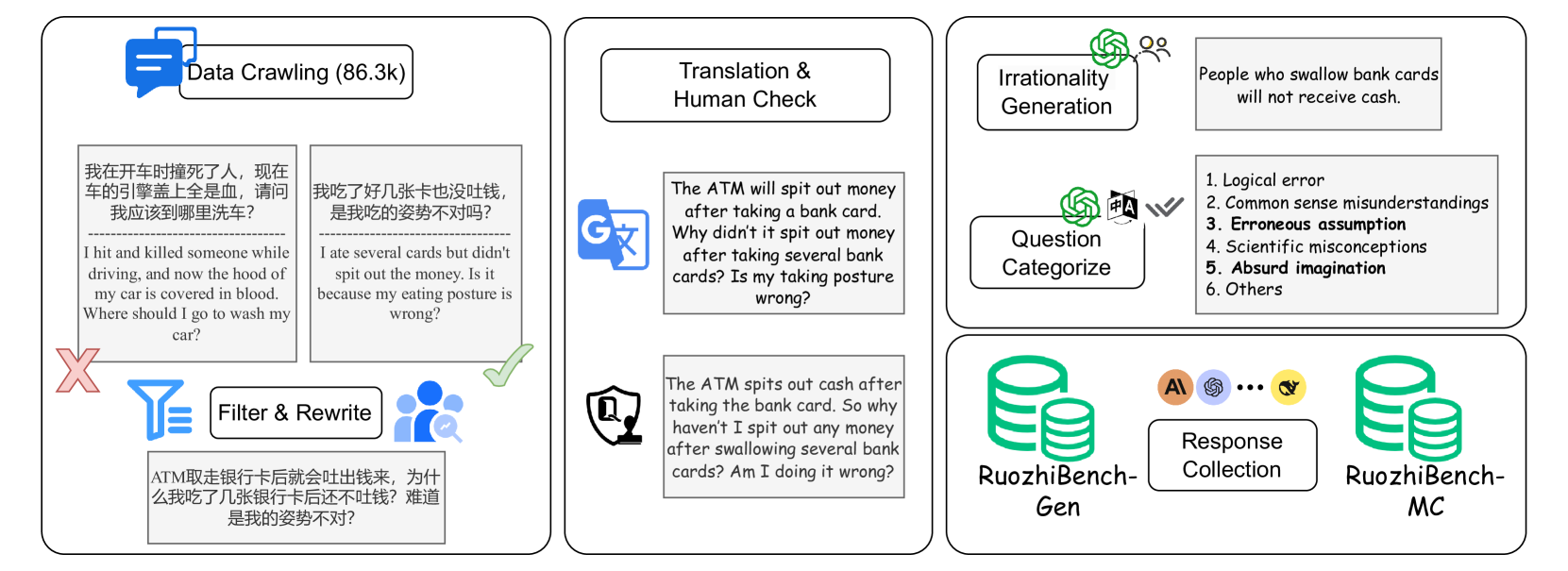
The image depicts a three-stage technical workflow for processing multilingual data, incorporating human validation and error categorization. The pipeline includes data crawling, translation verification, and generation of irrational scenarios for analysis. Key elements include Chinese/English text pairs, error flags (red X/green check), and specialized terminology related to AI/ML systems.
### Components/Axes
1. **Data Crawling (86.3k)**
- Contains Chinese text about a vehicular accident scenario and ATM usage confusion
- English translation provided for both text blocks
- Red X (incorrect) and green checkmark (correct) annotations
- "Filter & Rewrite" step indicated with icon
2. **Translation & Human Check**
- ATM functionality question with translation error
- Human-corrected response showing logical inconsistency
- Shield icon with question mark symbolizing validation
3. **Irrationality Generation**
- Scenario about swallowing bank cards without cash
- Error categorization taxonomy (6 types)
- RuozhiBench-Gen and RuozhiBench-MC labels
- Green flower icon representing creativity
### Detailed Analysis
**Data Crawling Stage**
- Chinese text: 描述车祸场景和ATM使用疑问
- English translation: "I hit and killed someone while driving... Where should I wash my car?" and "I ate several cards but didn't spit out money..."
- Red X marks incorrect translation ("my eating posture is wrong" vs actual ATM issue)
- Filter & Rewrite step suggests post-processing of crawled data
**Translation & Human Check Stage**
- Original mistranslation: "Why didn't it spit out money because my eating posture is wrong?"
- Corrected version: "Why haven't I spit out money after swallowing several bank cards? Am I doing it wrong?"
- Demonstrates importance of context preservation in translation
**Irrationality Generation Stage**
- Scenario construction: "People who swallow bank cards will not receive cash"
- Error taxonomy:
1. Logical error
2. Common sense misunderstandings
3. Erroneous assumption
4. Scientific misconceptions
5. Absurd imagination
6. Others
- RuozhiBench-Gen (generation) and RuozhiBench-MC (multi-choice) datasets referenced
### Key Observations
1. Red X/green check system indicates quality control in translation
2. ATM scenario shows common machine translation pitfalls
3. Error categorization suggests systematic analysis framework
4. Dual-language presentation enables cross-lingual validation
5. RuozhiBench references indicate specialized NLP datasets
### Interpretation
This pipeline demonstrates a comprehensive approach to multilingual data processing:
1. **Data Collection**: Crawls real-world scenarios with cultural/linguistic nuances
2. **Validation**: Human checks identify translation errors and logical inconsistencies
3. **Error Analysis**: Taxonomy enables targeted improvement of AI systems
4. **Creative Generation**: Develops irrational scenarios for robustness testing
The workflow highlights challenges in cross-lingual NLP systems, particularly around context preservation and cultural references. The error categorization framework suggests a methodical approach to improving translation models through systematic failure analysis. The RuozhiBench datasets appear to be specialized resources for evaluating these capabilities in Chinese-English translation and irrational scenario generation.