\n
## Code Snippets: Solvability Examples
### Overview
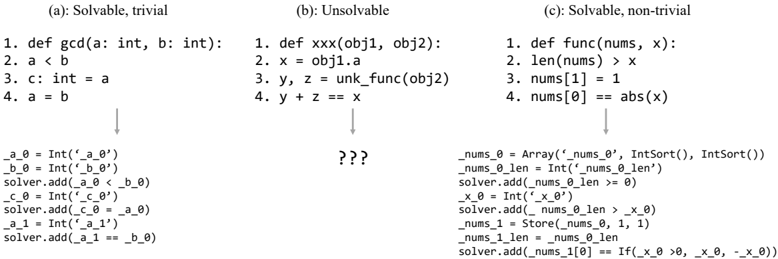
The image presents three code snippets, labeled (a), (b), and (c), demonstrating examples related to the solvability of constraints. Each snippet is accompanied by a series of lines representing a potential solution process or constraint propagation steps. The snippets appear to be written in a Python-like syntax, possibly related to a constraint solving library.
### Components/Axes
The image is divided into three columns, each representing a different case:
* **(a): Solvable, trivial** - A simple example that is easily solvable.
* **(b): Unsolvable** - An example that cannot be solved.
* **(c): Solvable, non-trivial** - A more complex example that is solvable but requires more steps.
Each column contains:
1. A code definition (function or similar).
2. A series of numbered lines representing constraints or operations.
3. A series of lines representing the solver's steps.
### Detailed Analysis or Content Details
**(a): Solvable, trivial**
* **Code Definition:** `def gcd(a: int, b: int):`
* `a < b`
* `c: int = a`
* `a = b`
* **Solver Steps:**
* `a_0 = Int('a 0')`
* `b_0 = Int('b 0')`
* `solver.add(a_0 < b_0)`
* `c_0 = Int('c 0')`
* `solver.add(c_0 == a_0)`
* `a_1 = Int('a 1')`
* `solver.add(a_1 == b_0)`
**(b): Unsolvable**
* **Code Definition:** `def xxx(obj1, obj2):`
* `x = obj1.a`
* `y, z = unk_func(obj2)`
* `y + z == x`
* **Solver Steps:** `???` (Indicates no solution or an unknown solution process)
**(c): Solvable, non-trivial**
* **Code Definition:** `def func(nums, x):`
* `len(nums) > x`
* `nums[1] = 1`
* `nums[0] == abs(x)`
* **Solver Steps:**
* `nums_0 = Array('nums 0', IntSort(), IntSort())`
* `nums_0_len = Int('nums 0 len')`
* `solver.add(nums_0_len > 0)`
* `x_0 = Int('x 0')`
* `solver.add(nums_0_len > x_0)`
* `nums_1 = Store(nums_0, 1, 1)`
* `nums_1_len = nums_0_len`
* `solver.add(nums_1[0] == If(x_0 > 0, x_0, -x_0))`
### Key Observations
* Snippet (a) demonstrates a simple constraint solving scenario with clear variable assignments and inequalities.
* Snippet (b) is marked as unsolvable, and the solver steps are unknown, suggesting a failure to find a consistent solution.
* Snippet (c) involves array manipulation and absolute values, making the constraint solving process more complex. The use of `Store` indicates modification of the array elements.
* The solver steps in (a) and (c) use a consistent naming convention (e.g., `a_0`, `b_0`, `x_0`) to represent variables and their indices.
* The use of `IntSort()` and `Array()` suggests the use of a constraint solving library that supports integer variables and arrays.
### Interpretation
The image illustrates the different outcomes of applying a constraint solver to various code snippets. The snippets represent simplified examples of constraint satisfaction problems.
* **(a)** shows a trivial case where the constraints are easily satisfied, leading to a straightforward solution.
* **(b)** demonstrates a case where the constraints are contradictory or insufficient, resulting in an unsolvable problem. The `???` indicates that the solver either failed to find a solution or encountered an error.
* **(c)** presents a more complex scenario involving array manipulation and absolute values. The solver successfully propagates the constraints, as evidenced by the detailed solver steps.
The use of `Int('variable name')` suggests the creation of integer variables within the solver's environment. The `solver.add()` function is used to add constraints to the solver. The `Store()` function modifies the array elements. The `If()` function introduces conditional logic within the constraints.
The image highlights the importance of constraint solving in verifying the correctness and consistency of code. It also demonstrates the challenges of solving complex constraints and the need for efficient constraint propagation techniques. The examples are likely used to illustrate the capabilities and limitations of a specific constraint solving library or framework.