## Code Transformation Examples: Solvability Analysis
### Overview
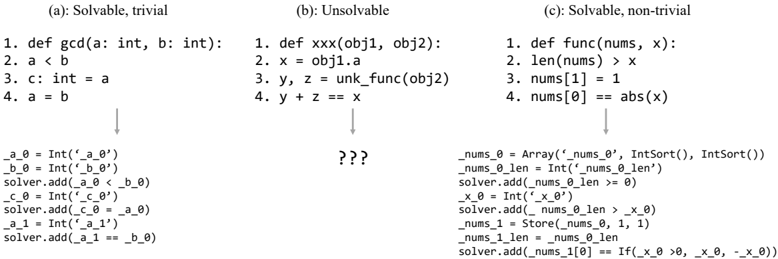
The image presents three code examples categorized by solvability and complexity, demonstrating how code snippets are transformed into solver-compatible representations. Each example includes original code, transformation steps, and solvability status.
### Components/Axes
1. **Example (a): Solvable, trivial**
- **Original Code**:
```python
def gcd(a: int, b: int):
a < b
c: int = a
a = b
```
- **Transformation**:
```
_a_θ = Int('a_θ')
_b_θ = Int('b_θ')
solver.add(_a_θ < _b_θ)
_c_θ = Int('c_θ')
solver.add(_c_θ == _a_θ)
_a_1 = Int('a_1')
solver.add(_a_1 == _b_θ)
```
2. **Example (b): Unsolvable**
- **Original Code**:
```python
def xxx(obj1, obj2):
x = obj1.a
y, z = unk_func(obj2)
y + z == x
```
- **Transformation**:
```
???
```
3. **Example (c): Solvable, non-trivial**
- **Original Code**:
```python
def func(nums, x):
len(nums) > x
nums[1] = 1
nums[0] == abs(x)
```
- **Transformation**:
```
_nums_θ = Array('nums_θ', IntSort(), IntSort())
_nums_θ_len = Int('nums_θ_len')
solver.add(_nums_θ_len > 0)
_x_θ = Int('x_θ')
solver.add(_nums_θ_len > _x_θ)
_nums_1 = Store(_nums_θ, 1, 1)
solver.add(_nums_1[0] == If(_x_θ > 0, _x_θ, -_x_θ))
```
### Detailed Analysis
- **Example (a)**:
- Trivial solvability: Direct variable assignments and comparisons are mapped to solver constraints using symbolic variables (`_a_θ`, `_b_θ`) and equality checks.
- Key pattern: Linear transformations with no branching or complex operations.
- **Example (b)**:
- Unsolvable: The presence of `unk_func` (likely an undefined or non-deterministic function) prevents transformation into solver constraints.
- Missing transformation steps indicate ambiguity in handling unknown function outputs.
- **Example (c)**:
- Non-trivial solvability: Involves array operations, conditional logic (`If`), and absolute value transformations.
- Complexity arises from:
- Array length constraints (`_nums_θ_len > _x_θ`)
- Conditional assignment (`If(_x_θ > 0, _x_θ, -_x_θ)`)
- Indexed value manipulation (`Store` and `nums[0]`)
### Key Observations
1. **Solvability Correlation**:
- Trivial examples (a) map directly to solver constraints.
- Non-trivial examples (c) require advanced transformations (arrays, conditionals).
- Unsolvable examples (b) lack deterministic mappings due to unknown functions.
2. **Transformation Patterns**:
- Symbolic variable renaming (e.g., `a → _a_θ`).
- Constraint generation via `solver.add()`.
- Handling of control flow with `If` statements.
- Array/collection operations via `Store` and `Array` constructs.
### Interpretation
The examples illustrate a framework for code-to-solver translation:
- **Trivial cases** (a) serve as baseline for simple variable tracking.
- **Non-trivial cases** (c) demonstrate handling of collections and conditional logic, critical for real-world applications.
- **Unsolvable cases** (b) highlight limitations when dealing with undefined functions or non-deterministic operations.
The transformation process reveals how code semantics are abstracted into constraint satisfaction problems, with solvability depending on:
1. Determinism of operations
2. Presence of unknown/undefined functions
3. Complexity of data structures (scalars vs. collections)
4. Control flow depth (linear vs. conditional)