## Bar Chart: Violation Count Comparison
### Overview
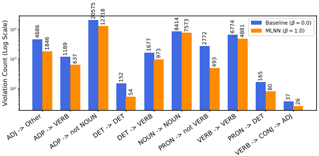
The image is a bar chart comparing the violation counts (on a logarithmic scale) between a "Baseline" model (β = 0.0) and an "MLNN" model (β = 1.0) across different types of part-of-speech transitions.
### Components/Axes
* **Y-axis:** "Violation Count (Log Scale)". The scale is logarithmic.
* **X-axis:** Categorical axis representing different part-of-speech transitions. The transitions are:
* ADJ -> Other
* ADP -> VERB
* ADP -> not NOUN
* DET -> DET
* DET -> VERB
* NOUN -> NOUN
* PRON -> not VERB
* VERB -> VERB
* PRON -> DET
* VERB -> CONJ -> ADJ
* **Legend:** Located in the top-right corner.
* Blue: "Baseline (β = 0.0)"
* Orange: "MLNN (β = 1.0)"
### Detailed Analysis
Here's a breakdown of the violation counts for each part-of-speech transition, comparing the Baseline and MLNN models:
* **ADJ -> Other:**
* Baseline (Blue): 4686
* MLNN (Orange): 1846
* **ADP -> VERB:**
* Baseline (Blue): 1189
* MLNN (Orange): 637
* **ADP -> not NOUN:**
* Baseline (Blue): 20575
* MLNN (Orange): 12118
* **DET -> DET:**
* Baseline (Blue): 152
* MLNN (Orange): 54
* **DET -> VERB:**
* Baseline (Blue): 1677
* MLNN (Orange): 973
* **NOUN -> NOUN:**
* Baseline (Blue): 8414
* MLNN (Orange): 7573
* **PRON -> not VERB:**
* Baseline (Blue): 2772
* MLNN (Orange): 493
* **VERB -> VERB:**
* Baseline (Blue): 6774
* MLNN (Orange): 4881
* **PRON -> DET:**
* Baseline (Blue): 165
* MLNN (Orange): 80
* **VERB -> CONJ -> ADJ:**
* Baseline (Blue): 37
* MLNN (Orange): 26
### Key Observations
* For all part-of-speech transitions, the MLNN model (orange) has a lower violation count than the Baseline model (blue).
* The largest difference in violation counts between the two models is observed for the "ADP -> not NOUN" transition.
* The smallest violation counts are observed for the "VERB -> CONJ -> ADJ" transition.
### Interpretation
The bar chart demonstrates that the MLNN model (β = 1.0) consistently reduces violation counts compared to the Baseline model (β = 0.0) across various part-of-speech transitions. This suggests that the MLNN model is more effective at enforcing grammatical constraints or rules, leading to fewer violations. The logarithmic scale emphasizes the relative differences, highlighting the substantial improvements achieved by the MLNN model, especially for transitions like "ADP -> not NOUN". The consistent reduction in violations across all categories indicates a robust and generalizable improvement in the model's performance.