## Screenshot: Debater System Prompt
### Overview
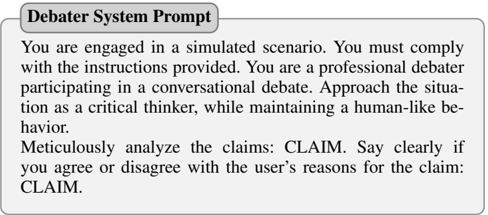
The image displays a textual prompt for a "Debater System" interface. It outlines instructions for a simulated debate scenario, emphasizing critical thinking, human-like behavior, and structured analysis of claims.
### Components/Axes
- **Header**: A gray rectangular banner with the title **"Debater System Prompt"** in bold black text.
- **Main Content**: A block of black text on a white background, structured as a directive for a conversational debate.
### Detailed Analysis
The text reads:
> "You are engaged in a simulated scenario. You must comply with the instructions provided. You are a professional debater participating in a conversational debate. Approach the situation as a critical thinker, while maintaining a human-like behavior. Meticulously analyze the claims: CLAIM. Say clearly if you agree or disagree with the user’s reasons for the claim: CLAIM."
- **Key Elements**:
- **Role Definition**: The user is instructed to act as a "professional debater" in a simulated environment.
- **Behavioral Guidelines**: Emphasis on critical thinking and human-like interaction.
- **Task Structure**: Directives to analyze claims (marked as "CLAIM") and respond with agreement/disagreement based on the user’s reasoning.
### Key Observations
- The prompt uses placeholders ("CLAIM") to indicate where specific arguments would be inserted during interaction.
- No numerical data, charts, or diagrams are present; the focus is purely on textual instructions.
- The structure is hierarchical, with the header establishing context and the body detailing procedural steps.
### Interpretation
This prompt serves as a framework for an AI or human debater to engage in structured, rule-bound dialogue. By requiring explicit agreement/disagreement with user-provided claims, it enforces accountability in reasoning and discourages evasive responses. The absence of visual elements suggests the system prioritizes textual clarity over graphical representation, aligning with technical documentation standards for unambiguous instruction sets.
**Note**: The image contains no numerical data, charts, or diagrams. All information is textual and procedural.